Our little guy competed in his first cross country school meetup today.
For a kid who is endlessly active, gym is a class T struggled with the last few years.
For his mid-year report card last year, his gym teacher gave him an “I,” as he didn’t participate enough for her to give a proper assessment. He ended the year with a C+.
But she does try to find ways to engage him and suggested that he join the school cross country team this year.
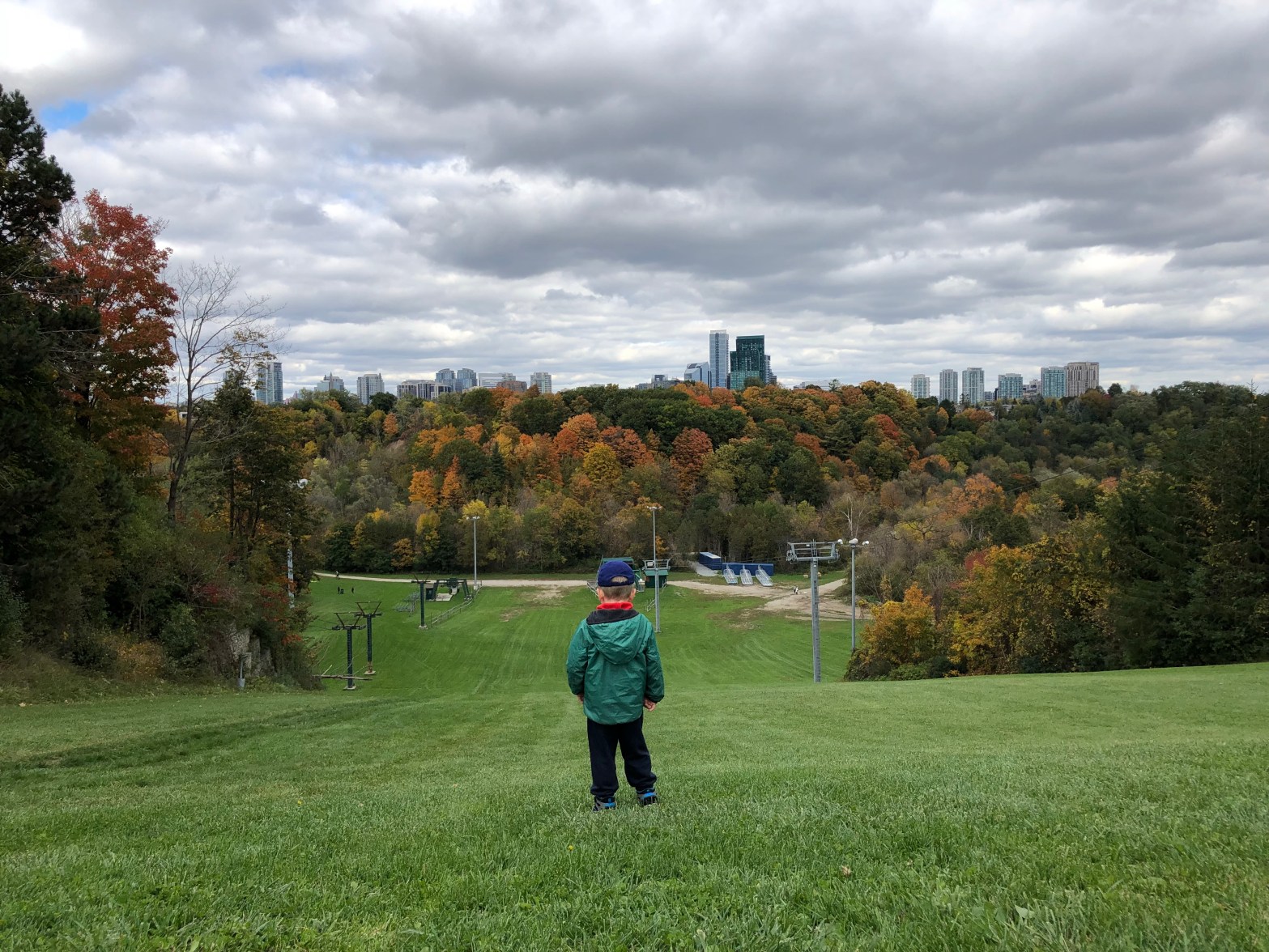
Today’s meetup took place at Earl Bales Park, near our old neighbourhood. It is a city park with a ski hill that runs a mini chair lift in winter!
We’ve gone hiking there many times and here was T charging up that ski hill in Fall 2018. I saw my life flash before me when I made it to the top.
So we felt hopeful T would do well today.
We reminded him the most important thing was to try his best, have fun and to pace himself and not burn all his energy at the beginning.
Well, T did amazing.
He finished in 8th place – and the first from his school – in the Grade 2 race.
We are so proud of our guy!
The hubby took the day off to spend with him. His teacher not so subtly told us that it’d be wonderful if we could come to cheer him on.
Never one to mince words, the hubby was like, cut the crap, you want us to supervise him. He got to ride a school bus with little kids today. 😂
All kidding aside, I’m glad the hubby got to witness this proud moment and that T got to see Daddy cheer him on at the finish line.
Today is an excellent reminder of what is possible when schools find ways to identify strengths in their students and create opportunities to build their confidence.
Inspiration exists in all forms and they are so important when traveling down unpaved road.
Thanks to our FASD service provider, the hubby and I recently joined a cohort of parents and caregivers for a weekly support group.
It’s an 8-week pilot initiative hosted by Surrey Place, an amazing organization that has supported T since his toddler years, including providing his assessment and diagnosis earlier this year.
These virtual sessions take place over the lunch hour, which is great, as I can join from work.
The sessions are informal, with short presentations, resource sharing, and time for parents to ask questions and to meet special guests.
During the fourth session this session, we had special guest, Myles Himmelreich, an individual with FASD.
When we first received T’s prognosis six years ago, it was quite the emotional punch, and we went through the usual cycle of grief.
I tried to search for success stories. They were few and far in between but Myles’ story repeatedly came up over the years.
So it was so wonderful to meet him.
He spoke about what it was like to live with a brain and body disability, covering similar points from this video he filmed years ago.
It was refreshing to hear his candor about his struggles and reassuring to hear about his many successes, including his work as a motivational speaker which takes him all over the world.
Even though we’ve read and learned a lot about FASD over the years, it was still sobering and heartbreaking to hear Myles speak about his many struggles – being misunderstood and unsupported at school, drug use in his adolescence, homelessness in young adulthood.
During the Q&A session, one parent asked him for advice on how to help kids who threaten to hurt themselves. I listened intently as the hubby and I see some these behaviours emerging in T when he’s very disregulated.
I asked Myles for his advice on friendships, as this is an area where T struggles, and the two-year disruption of the pandemic certainly wasn’t helpful in this regard.
What resonated with me the most about Myles’ message to parents was the importance to create a safe, supportive and accommodating environment in helping kids like T to thrive.
I left the session feeling recharged.
I have no doubt there’ll be lots of bumps along the way, especially as T enters adolescence, but it was inspiring to see there are positive outcomes ahead, thanks to individuals like Myles.
Our service coordinator let us know they are looking at piloting other initiatives in the near future, including meetup events for families and kids, like outdoor hikes and equestrian therapy, and possibly an opportunity for kids like T to meet role models like Myles.
I think this is so important, not just for parents and caregivers, but especially for kids like T. To see that there is a path, many paths, that lead towards hopeful and positive outcomes.
God bless the innocent unfiltered honesty of children.
During a drive to a family lunch today, there was torrential downpour.
The visibility was bad and the conditions got quite dangerous at one point.
Suddenly, T says matter of factly, “Good thing I don’t live with my mother. She’s homeless. I would be soaking wet!”
T’s birth mother, in fact, is homeless and because she was unable to take care of him, he was put into foster care and eventual adoption.
We’ve told him bits and pieces about her, whenever he asks, because it’s important to be open and honest about his past, so he can move into his future with a complete sense of self.
He brings her up from time to time, often during the most unexpected moments – like this one.
I will admit we laughed at his comment, not because we are making light of his mother’s situation, but because kids are so honest.
If you add FASD on top, you never know what’ll get blurted out!
On the drive home, I brought up T’s earlier comment.
I reminded him that while his mother has a sad life, it is thanks to her T, the hubby and I are a family.
We’re experimenting with our little guy’s love of younger kids to build his reading and social skills.
At the start of every school year, I watch and reflect on this “Common Strengths of Students with FASD” video by social worker Dan Dubovsky.
It’s apparent T loves younger kids and they bring out his patient and caring side.
Kids with FASD generally do better with younger kids; one reason being related to dysmaturity.
One of my favourite moments during daycamp pickup this summer was watching T walk with the kinder-age kids from their outdoor play area to the school and holding the door open as they walked in like ducklings with the staff.
We think it’s a blessing T was placed in a Grade 1/2 split class, as being around younger students can be socially beneficial.
I thought about the daycamp moments as I recently completed the questionnaire his teacher provided to start his Individualized Education Plan.
I suggested to T’s teacher whether she’d be open to having T visit the kindergarten class from time to time this year to be a helper, an idea sparked by Dubovsky’s video.
We think being a “big brother” to little kids may also boost his confidence and self esteem.
Reading is a skill we continue to work on with T. He’s made steady gains and we want to maintain and build on his momentum.
One of the best ways to learn, research has shown, is to teach a concept you’ve learned to others.
So I also suggested T could be a reading buddy to younger students.
I sent these suggestions to T’s teacher with zero expectations and made it clear there’s no worries if these are not feasible at this time.
His teacher responded and said she liked the idea. Visiting the kindergarten class is unlikely at this time because they are still settling into the year.
But she said there are younger kids in T’s class that need help with reading and she’ll ask T if he’s agreeable to helping out.
I was thrilled as it was more than I expected.
Parenting a neurodiverse child is about keeping an open mind and trying things out; about building on successes and moving on when things don’t work out, because they often don’t.
I thought about him when T had his first swim lesson.
T’s always loved the water. The outdoor pools saved our pandemic summers and T loves swimming in lakes during our outdoor adventures.
He’s very comfortable in the water and it was time he learned proper swim technique.
We found a school that offered smaller classes, a teacher-student ratio of 1:3. It was a sound investment to support T’s ADHD.
The first lesson took place after the first week of school. T’s excitement was palatable.
He got up on a weekend at 7 am and when it came time to leave, he got changed and brushed his teeth on his own with no fussing.
Who was this kid?!
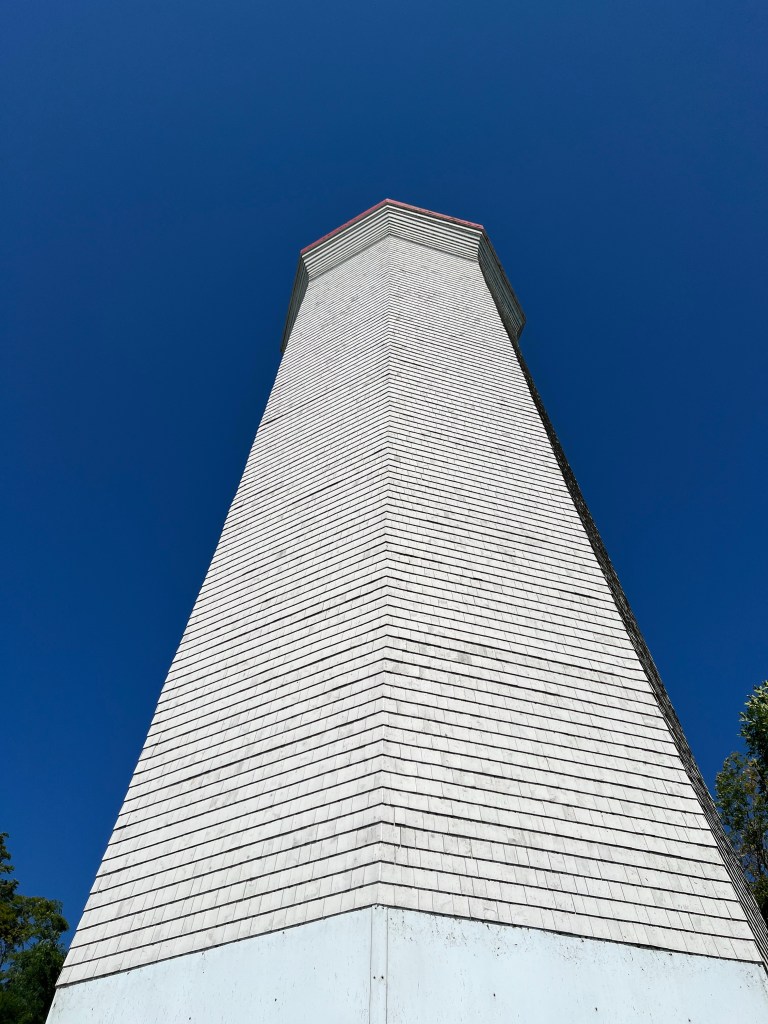
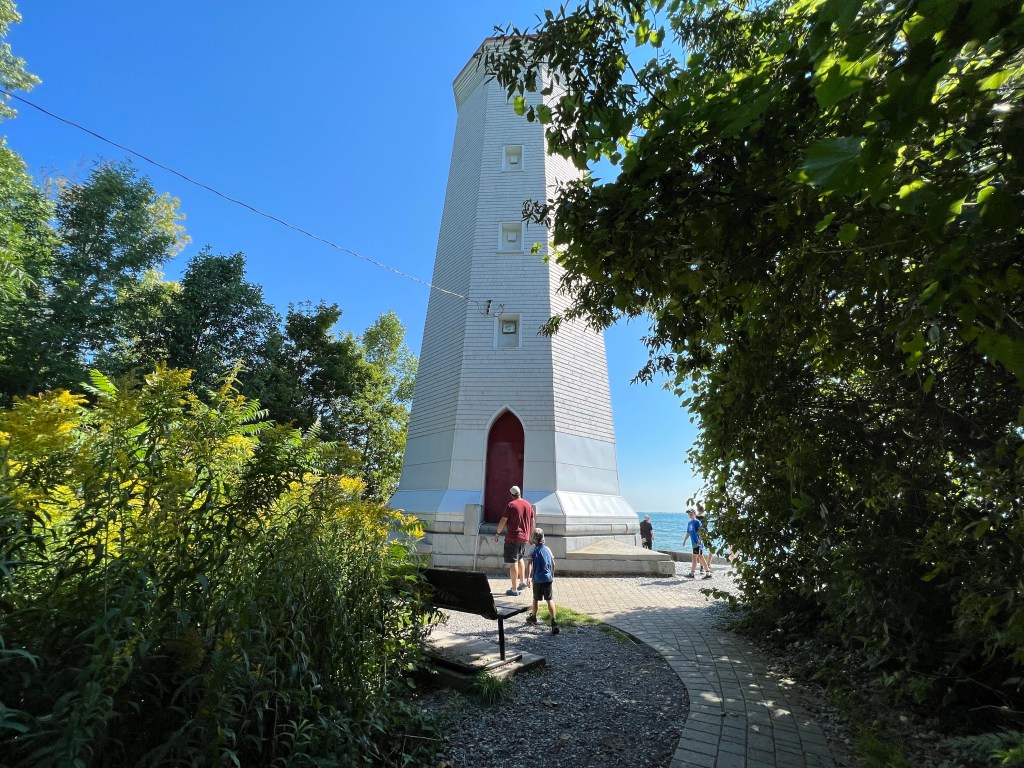
The lighthouse at Presqu’ile Provincial Park during our recent camping weekend.
When we arrived at the school, we reminded him about “listening ears” and to have fun.
The hubby took T to shower then left him on the pool deck.
We sat in the parents’ viewing area. I was impressed T stood patiently for five minutes until his teacher called him into the water.
I was so proud T followed instructions. Every time he finished his task and looked towards us, we waved and gave him thumbs ups.
His kicking, breathing and strokes need practice – and that’s ok. He will get better with time.
As we sat for the 30-minute lesson, the hubby and I reminisced about taking T to parent-child gymnastics five years ago – and how we hated it.
We would alternate classes and dreaded our turn – because we’d get more workout than the other kids, because T never sat still and we spent the entire hour chasing after him.
It was when his FASD first started to feel real. I got so mad by the end of those classes – and once snapped at a meddling mom. 😂
T has come a long way since. We’ve come a long way since.
Watching T take his swim lesson from the viewing area reminded me of when I was 9, a bit older than he is now, and Pa did the same for me when I took swim lessons.
Life truly is a circle. I’ve transitioned from the child and learner into one of the guiding lights in T’s life, a role Pa once held.
Putting T in swim lessons is not just for building a needed life skill, but to also help build his confidence and self esteem, while having fun.
Just like when I took swim lessons as a child, the hubby and I celebrated the end of T’s lesson by going to McDonald’s for lunch.
During the car ride, we told T he did great – and the most important thing of all, it looked like he had a lot of fun!
We stepped into the school year with cautious optimism. T ended Grade 1 on a positive note but entered the new year without a dedicated CYW.
School is often a challenging journey for kids with FASD. This year, we will build on T’s many strengths and try different approaches based on lessons learned to support his needs.
Raising Awareness
The super team at FASD Caregivers Success created this awesome Understanding Me document that explains what FASD is and lets parents fill in info about their child’s strengths and needs.
The hubby and I will give it to T’s teacher and we think it’ll help them develop his IEP and understand him better.
Establishing Routines
Following routines is important, as is understanding the trigger points during the day.
Last year, it was often the after school bus ride to daycare that caused issues.
We asked the daycare staff if they could have a debrief as he gets off the bus, to let him share any issues so they can course correct.
They said it may not always be possible, given staff resources, but we are thankful they are willing to try where possible.
Helping Develop Independence
When we debriefed with T’s teacher and CYW at the end of Grade 1, they said T needs to practice getting settled in class and packing up at the end of the day. So we’re working on it.
I also mentioned T’s writing needs improvement.
His teacher suggested making writing practice purposeful and one idea is to get T to contribute ideas to our weekly grocery list.
So we put up a magnetic whiteboard from the dollar store on our fridge. Before I do groceries, I ask T to write requests down. Yes, we need to work on healthier requests – and spelling “marshmallow” – but one step at a time!
Adjusting Medications
Before school started, we met with T’s developmental pediatrician to ask about adjusting his medications.
The hubby read other parents rave about Guanfacine and how it helps with mood issues often seen with ADHD meds.
So we started T on Guanfacine in addition to Biphentin – and stopped Methylphenidate – on Day 1 of school. I’ll share an update in a future post.
Creating Weekend Learning Opportunities
We’re in the camp that thinks giving kids homework is beneficial, so long as it’s low stress and about practicing concepts.
We’re continuing reading practice and while we wait for T’s new teacher to assign school books, I borrowed these T-friendly library books.
We also have worksheets left from T’s Grade 1 teacher that she gave for summer practice. We’ll finish them over the coming weekends.
This weekend, T started swim lessons! More on this fun new activity in a future update.
Teamwork Is Key
As T’s parents, we have to trust in the school and daycare staff whom T spends a substantial chunk of his days with.
Advocacy, checking in and course correcting are key. Genuine and respectful collaboration is essential. This means give and take – and understanding T is one of many kids in the mix.
It’s not always easy, especially when I feel the anxiety of lost resources. But we’ve been blessed the school and daycare support, accommodate and understand T so far.
Marathon Not Sprint
This continues to be a hard lesson for me – but I’m taking it easier; not just because I feel tired at times.
It doesn’t means I’m less attentive – but it’s about picking and choosing my battles and focusing on the big picture and not sweating the small stuff.
T feeds off our energy and taking a measured calmer approach benefits us all.
Have Fun
We’re making a concerted effort to celebrate every success and to savour them – to be in the moment and not worry about the next speedbump.
Week 1 of school was short – three days – and T had an awesome first week.
His school has a new CYW that serves the entire school, instead of just T, but she spent a large chunk of the first week with T.
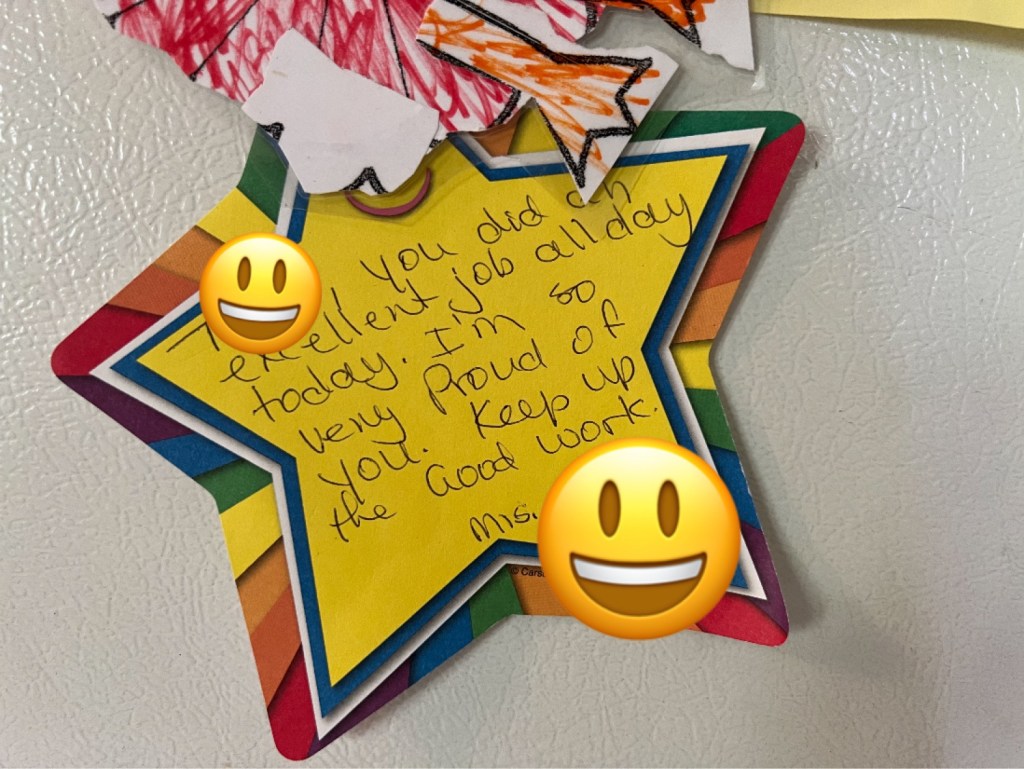
She gave detailed updates each day and we saw a lovely note for T in his bag on Friday night and put it up on our fridge (above), so T can share in the proud moment:
“T, you did an excellent job all day today. I’m so very proud of you. Keep up the good work.”
This was a wonderful way to end T’s first week and I hope it sets up a foundation for the road and its ups and downs ahead.
Best wishes to all parents, caregivers, children, teachers and school staff in the year ahead!
Do you run towards or flee from inevitable sunsets?
September 9 is FASD Day, commemorated during FASD Awareness Month in September.
September 9 symbolizes the ninth month of pregnancy and this day helps raise awareness about Fetal Alcohol Spectrum Disorder and the experiences of individuals with FASD.
This year, my reflections centre on time: plan for the future, let go of yesterday, live in the now.
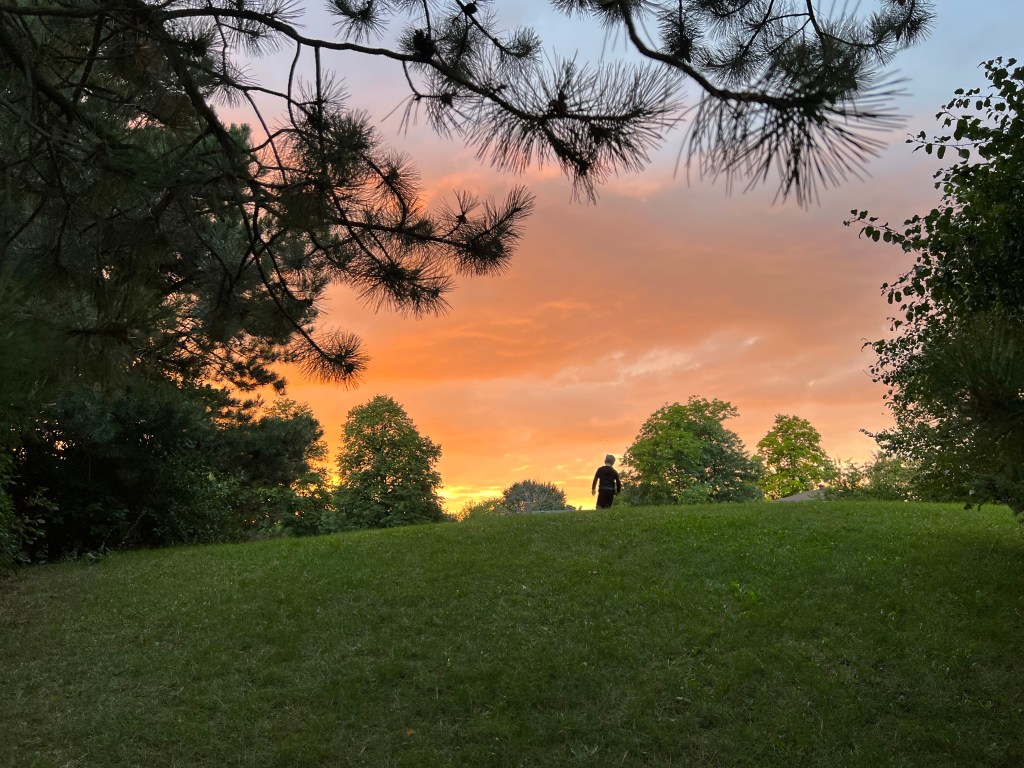
I thought about this during a recent after dinner walk T and I enjoyed at the park.
He was whining about something inconsequential – I don’t even remember what – and I noticed how the days were getting shorter.
I thought about how I was going to miss that little boy voice, even at its whiny worst, when it cracks and matures one day.
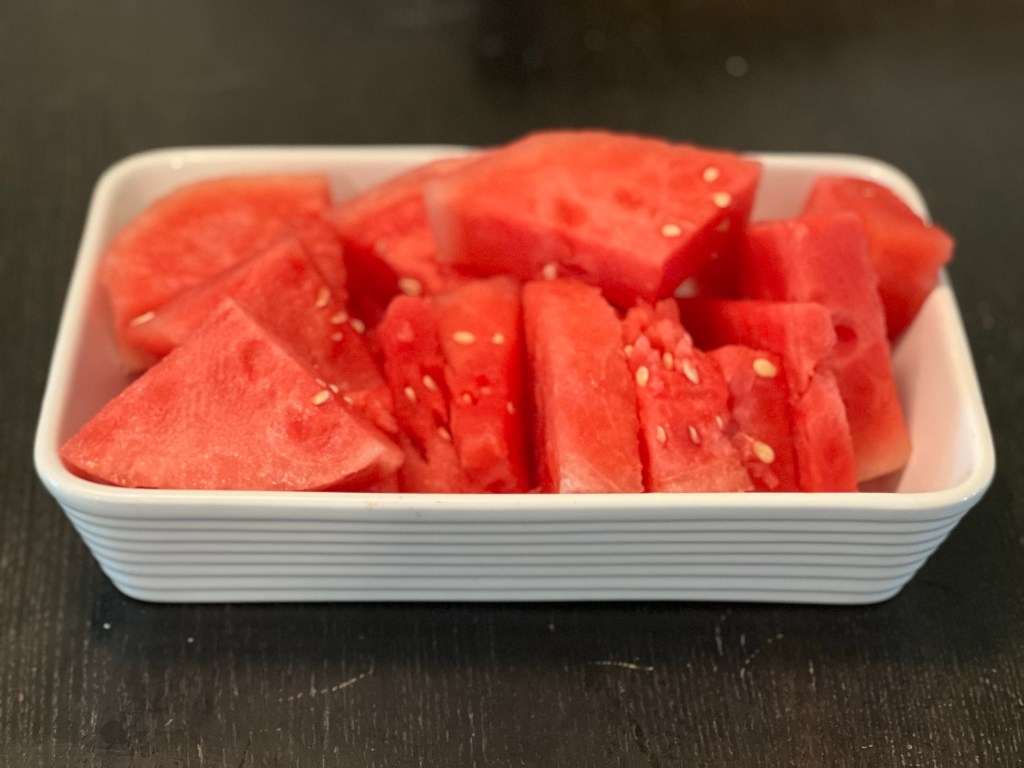
In a summer that flew by with wonderful moments, one seemingly small moment that stood out was when I chopped up a watermelon for a BBQ potluck.
T came up and ate a few slices as I prepared my platter. I loved watching him relish that sweet fruit – and later again with my family.
This summer, I became particularly sensitive to how quickly childhood is flying.
When I see T running down the field during our walks, I noticed how much taller he is.
The other night, he asked me to sit on the chair next to his bed and he then sat on my lap pretending he was a toddler again and I was reading a bedtime story like I used to do with him.
He didn’t feel as light as a toddler anymore!
As parents – especially those caring for kids with additional needs – the worries never end.
We are always hyper-vigilant and thinking about and planning for the worst case scenarios.
We ruminate over how we could’ve handled things better – long after the moments have happened.
We often don’t let ourselves fully enjoy a positive moment, because we worry about when the other shoe will drop.
When we see the sun setting, the instinct is to start heading home before darkness falls.
This summer, my perspective changed: I wanna run towards the sunset.
To soak up every last moment of light before the night arrives – because it’s going to arrive anyway, regardless of which direction we run.
And on this same recent evening walk with T – with the start of the school year just around the corner – we played outside a little longer, underneath that sweet watermelon sunset.
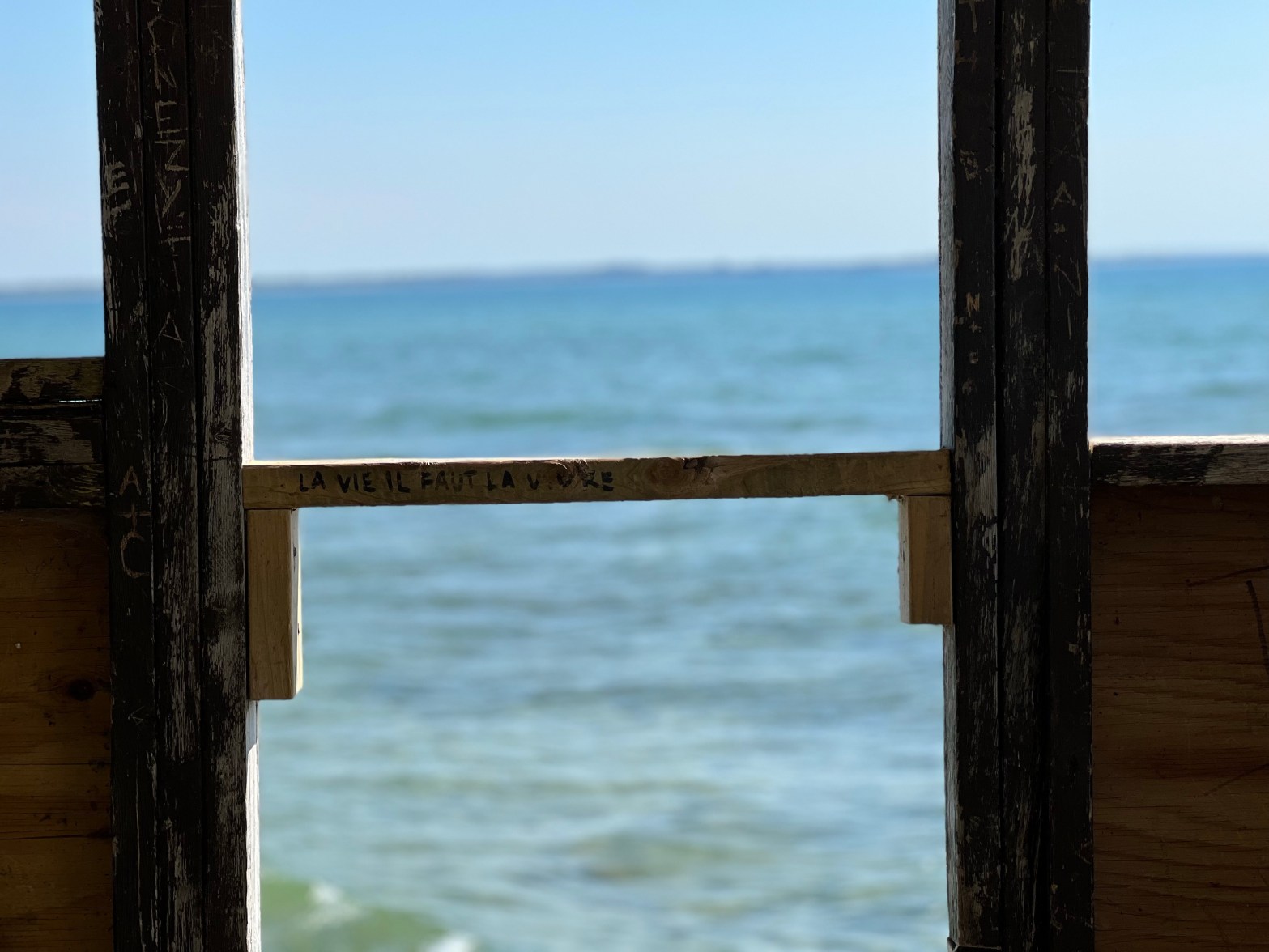
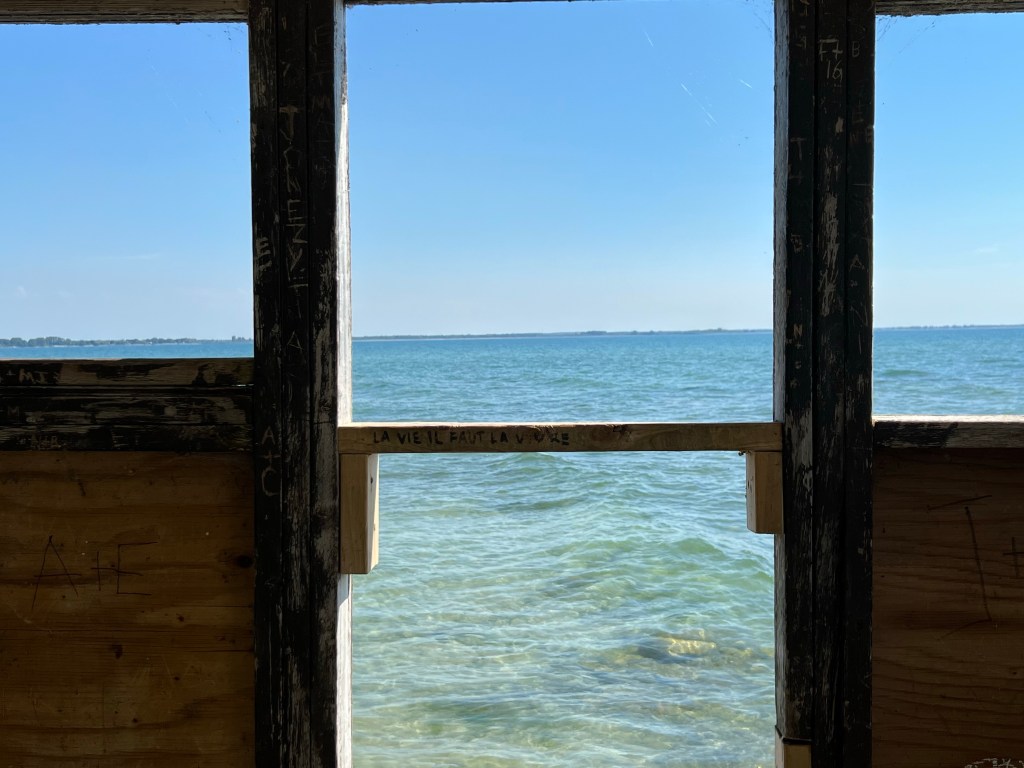
Life must be lived. The words scribbled in French on the railing looking out at the lake.
It was the final Saturday of summer break, four days before T’s second grade journey began.
We were at beautiful Presqu’ile Provincial Park, located a little over an hour from the City.
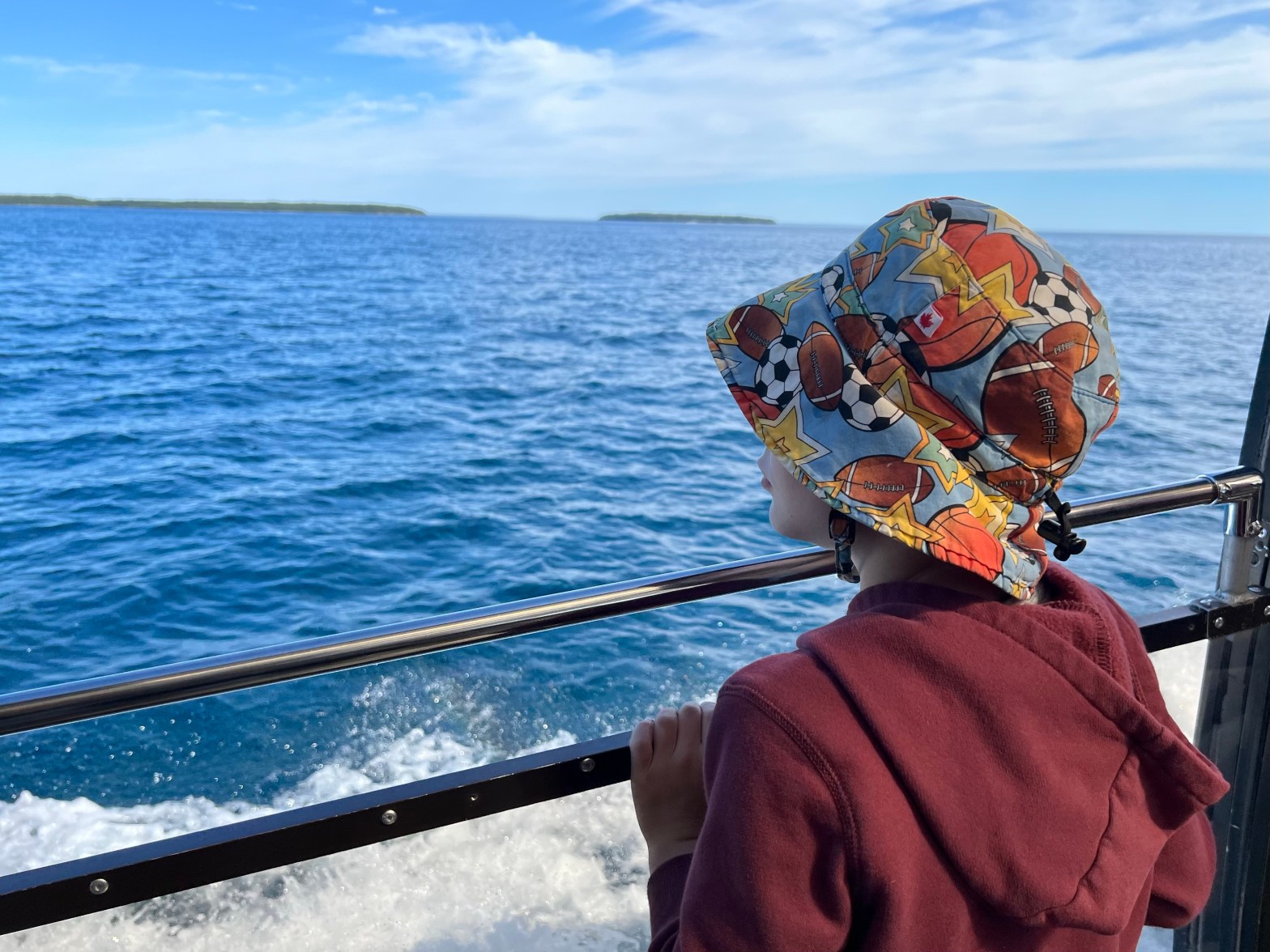
We left the day before, right after work. We began T’s summer with camping and we were ending nine weeks of happy memories doing the same.
We stumbled upon Presqu’ile in 2020 during a detour home and I’m glad we came back to take more time to explore it.
We arrived after sunset and it was our first time setting up our tent in the dark.
T was awesome and helped hold the flashlight so we could set up. Afterwards, we started a fire and roasted marshmallows and looked up at stars.
I thought about how we sang “Twinkle Twinkle Little Star” to T at night when he was younger.
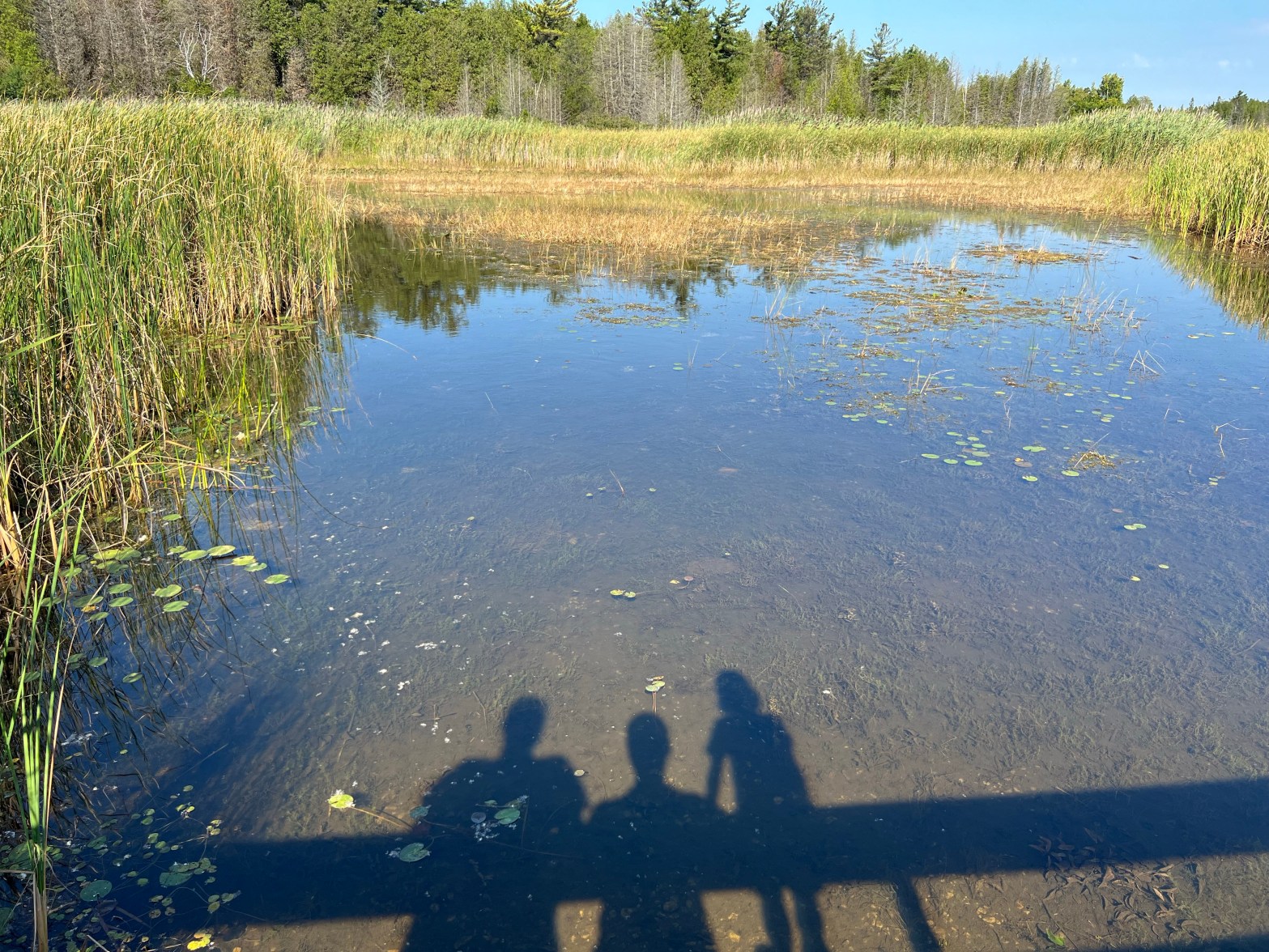
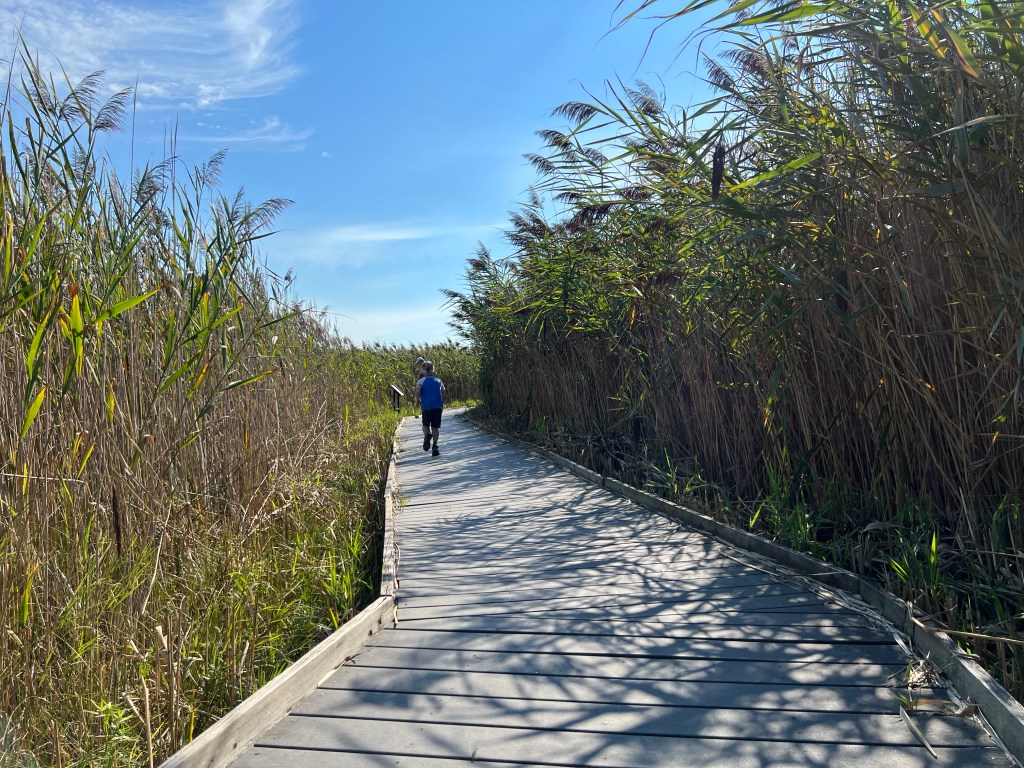
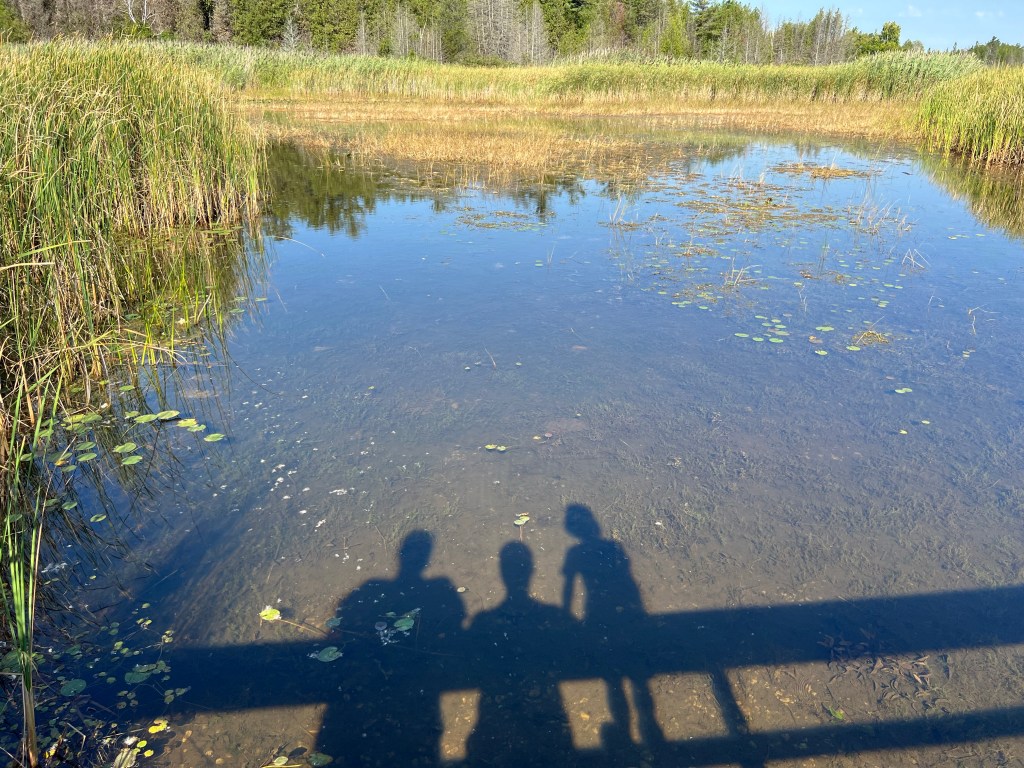
We got up early and enjoyed two morning hikes, starting with Marsh Boardwalk Trail.
I am a sucker for boardwalks, especially with overgrown plants on both sides.
It was sunny and warm but not scorching.
The walk was calming and my mind went into autopilot and felt clear and light.
I loved watching T explore and get curious at the different plants and bugs at the marsh.
We admired the beautiful flowers that grew in the muddy waters. There’s a metaphor about life somewhere in this moment.
T enjoyed having the vast space to run around in, to explore and to climb.
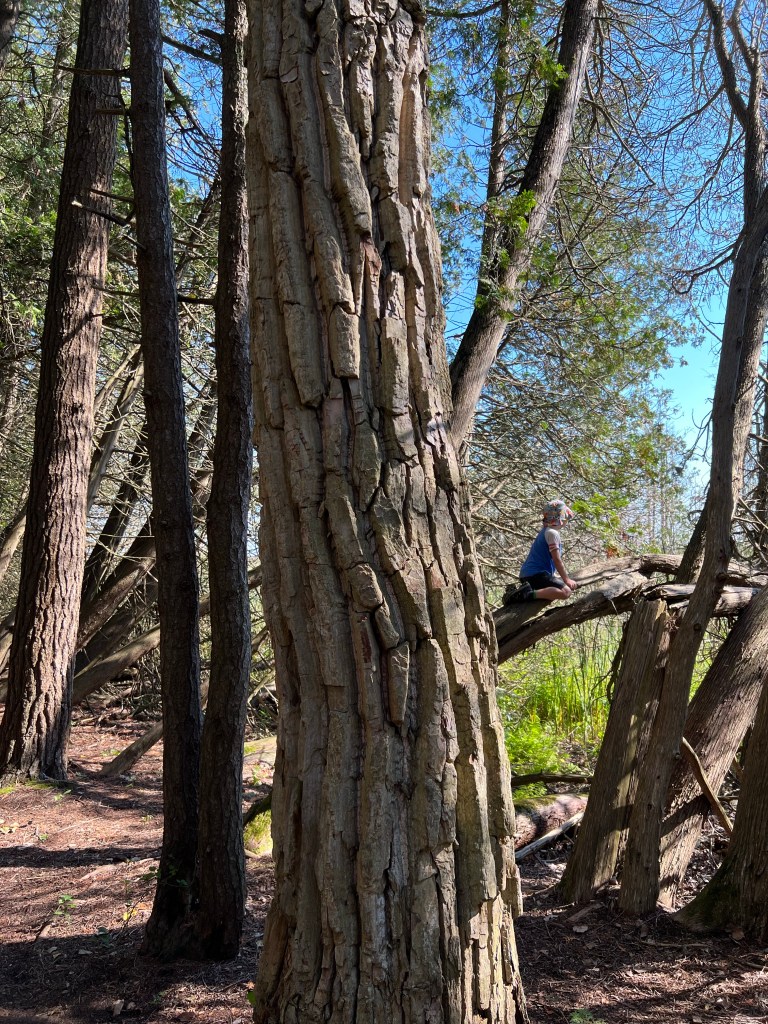
Beautiful textured bark on a cottonwood tree.
We did a second shorter hike to the Lighthouse before lunch.
I love how nature playfully creates experiences, like these trees creating a whimsical walkway…
… that reveals something awesome beyond it.
It was around the corner from this Lighthouse that I found the words of wisdom scribbled on the railing looking out to the scenic lake.
“La Vie Il Faut La Vivre.”
I asked the hubby, who is fluent in French, to translate.
Life must be lived.
I thought about these words throughout the day.
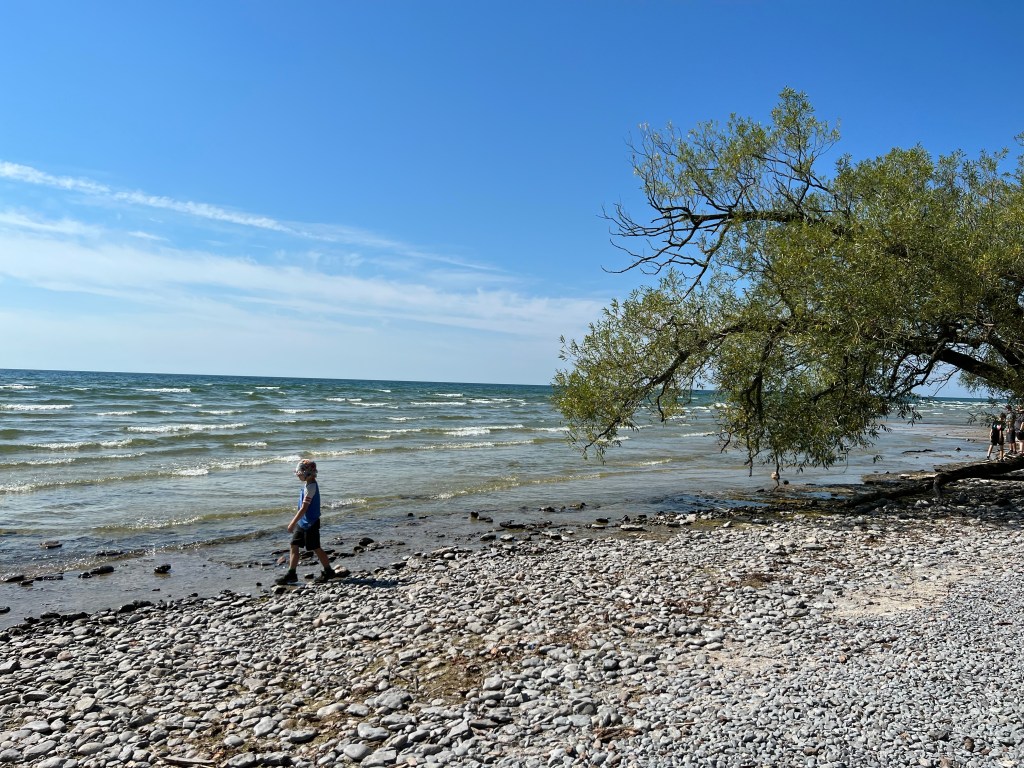
After lunch, we swam at the nice sandy beach.
The water was refreshing and we soaked up the moment, because we knew these days are dwindling away as we near autumn.
T is at an age now where we could leave him unsupervised to play on his own on the beach – digging up and throwing sand to his heart’s content – while we stayed in the water.
After two hours, we headed back to camp and packed up for home.
To T’s disappointment, we decided to leave a day early, because rain was expected at night and into Sunday. It’s never fun packing up in the rain.
When we got home, the rain started. We quickly unloaded everything from the car into the house.
T helped carry many of the items inside. We smiled and praised him for his good teamwork.
It was a wonderful way to end summer break with our curious, adventurous and up-for-anything boy.
This summer flew by and I’m thankful for all our memories. Yes, there were many meltdowns and challenging moments that made us want to poke our eyes out.
But whatever.
Coming out of the 2.5 years of the pandemic – and other challenges – has changed my perspective on life and on parenting a neurodiverse child.
Life will always be filled with ups and downs, but we’ve got one life to live and it flies by so quickly.
Experiencing life through a child’s eyes is sweeter when you do something for the first time together.
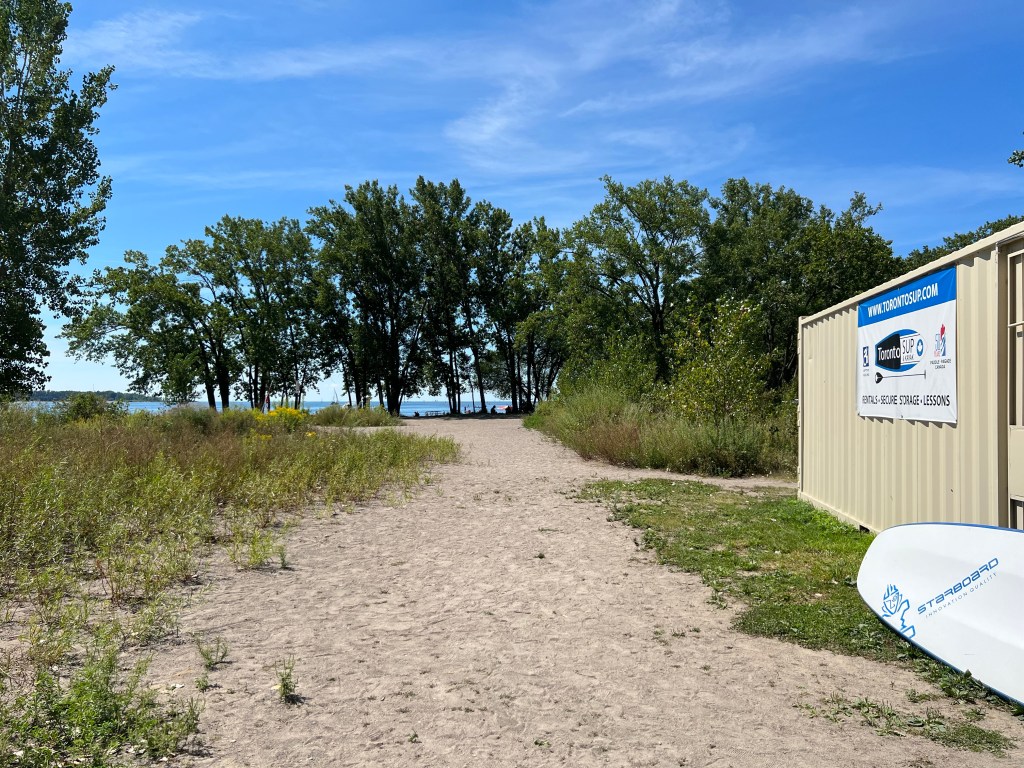
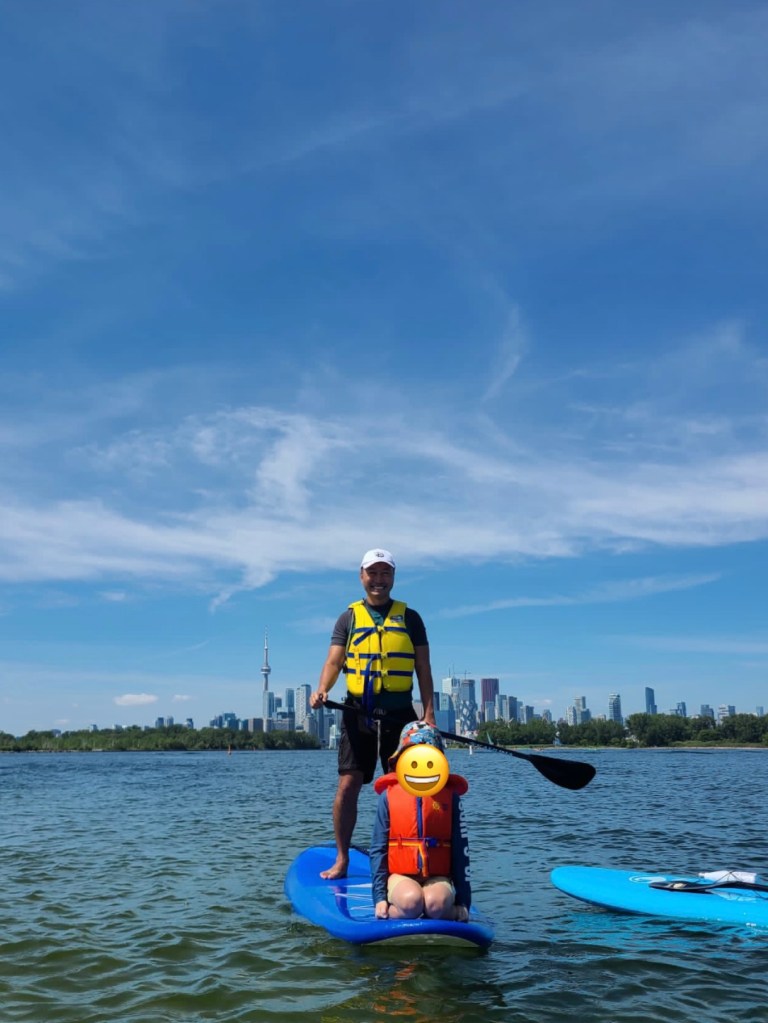
On Sunday, our friend, T’s Auntie E, whom we recently went to Tobermory with, organized a stand up paddle board outing for friends and us.
E is a SUP hobbyist and took us to Cherry Beach, a scenic place I’ve never been to in the 33 years I’ve lived in Toronto.
As the name suggests, you go out onto the water on a paddle board standing up.
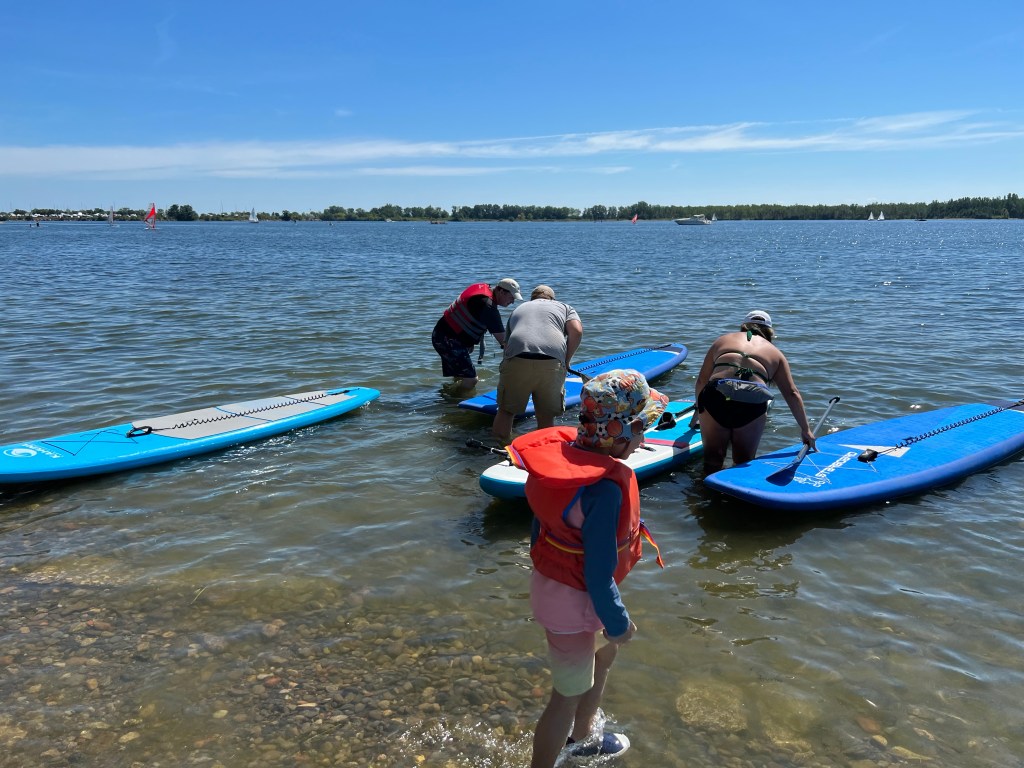
As we departed from shore, E gave us a crash course on how to paddle, to go from kneeling position to standing up, to maintain our balance and to get back onboard if we fall in.
We were blessed with beautiful weather – sunny, but mild, and calm winds and water.
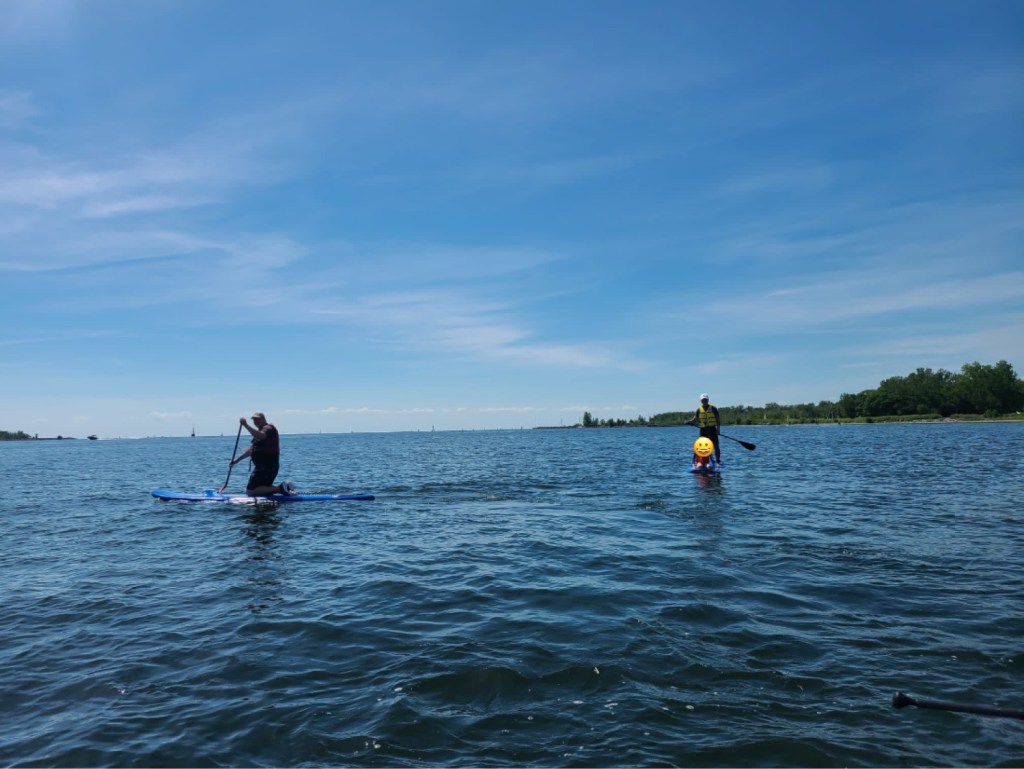
T sat with me and did well! I thought that our hyperactive kid would cause us to fall in the water repeatedly. But we only fell in once near the end, because my knees were tired.
It was awesome being in the water and we went in a few times to enjoy a refreshing dip. T felt completely at ease with his lifejacket on.
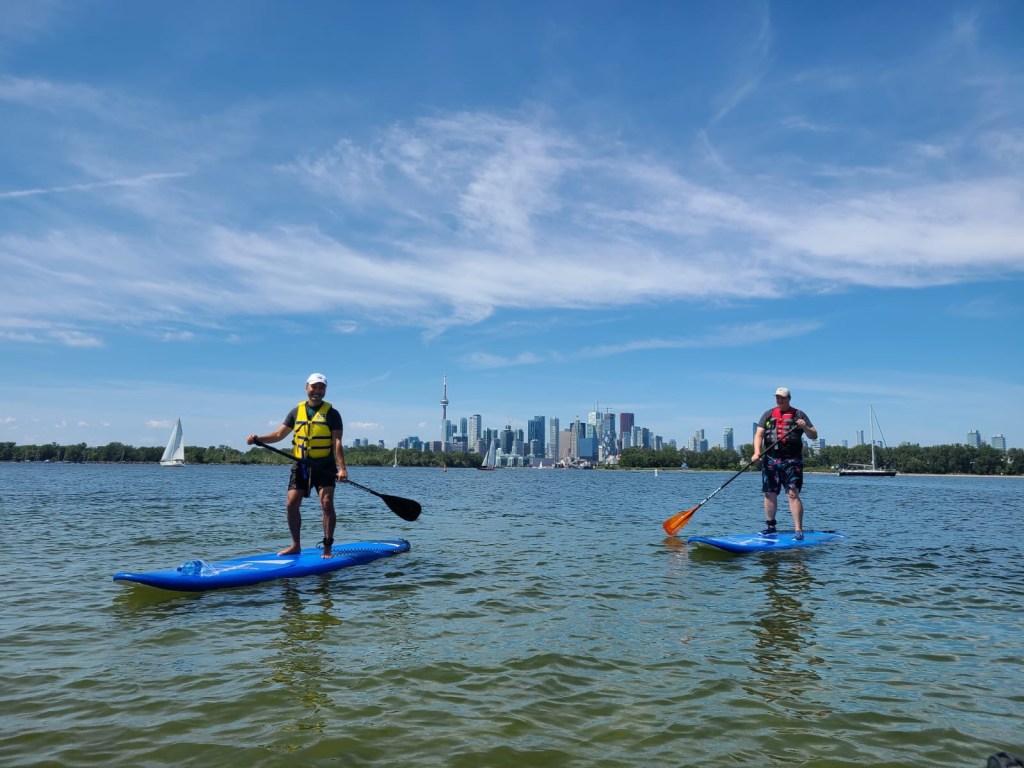
As we paddled away from shore, I wondered where in relation to downtown Toronto we were.
And then I turned my head around…
… and saw the Toronto skyline behind us; the CN Tower and skyscrapers dwarfing the tall trees on the beach shoreline.
It was truly an awe-inspiring moment.
We paddled about 1km away from shore towards Tommy Thompson Park, a 10km stretch of land known for scenic hiking and biking trails.
We sat on our boards near the park shore for a while and watched the skyline in the distance before we paddled back to Cherry Beach.
I could’ve started thinking about a metaphor for this moment – you know I love them! – about finding balance in life with T onboard, literally!
But I chose to be in the moment.
Life with T teaches us to be present and to inspire us not to put limits on what we can do together.
Summers and childhood are so short and T goes back to school in a week.
I want to milk every moment.
I was thankful to spend this most amazing day with good friends, the hubby and our T.
The sandwich generation experiences the joys of kids growing up and the sorrow of aging parents.
Earlier this summer, T showed interest in bike riding again after having no interest last year.
While he loves zipping down the park, he doesn’t yet feel comfortable taking off the training wheels.
And that’s ok.
I thought about the milestones T has experienced and the ones ahead – and it feels like a series of buildups to taking off the training wheels.
Hands pressed against the wall as he learned to walk. Holding my hand as he learned to go up and down stairs. Hand over hand as he learned to eat with utensils. Getting him potty trained. Hours of practice to help him learn to read.
For me, training wheels also represent the additional scaffolding supports we’ve been blessed to have for T.
Speech therapy to help him learn to talk. Behaviour therapy to help us support T in his early years. His amazing Child and Youth Workers who supported him in kindergarten and Grade 1.
In my prayers, I often hope for T to be successfully independent one day.
It’s too early to tell what the future holds, but I am aware there may be a future where the training wheels don’t completely come off.
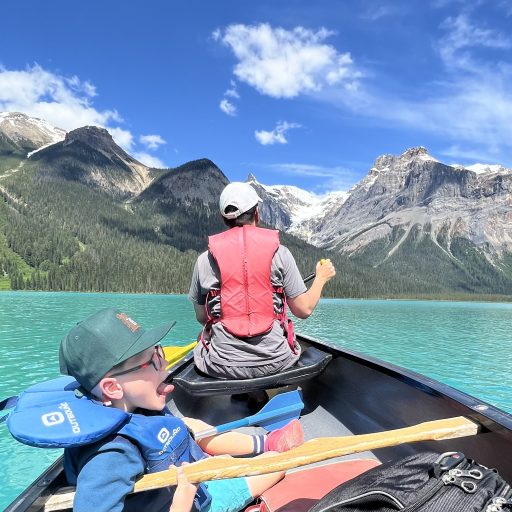
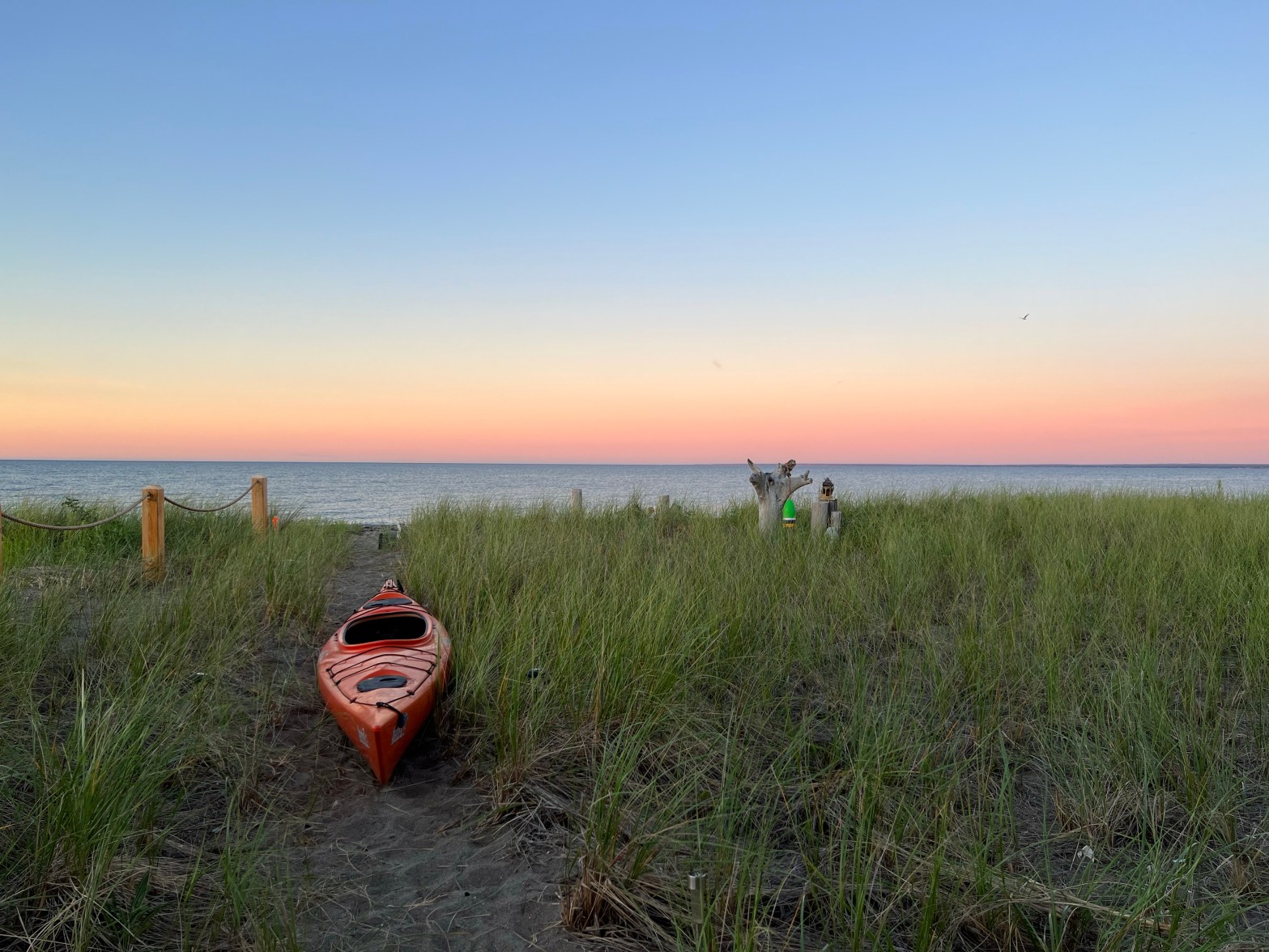
Enjoying kayaking with T during our recent visit to his grandparents.
Life is a circle – our youth a mirror image of our twilight years.
As I coordinated and took Ma to her appointments the last two years after her stroke and then her muscle disease, I thought about how training wheels return in our elder years.
I watched her work hard during physiotherapy appointments to learn to walk with balance.
I listened with amusement as she told me about working with a speech therapist after her stroke caused her to slur her speech.
I am aware of how limited time is as she asks to hold my hand when we walk outside.
Being part of the sandwich generation is an inevitable part of growing up.
The most trying moment to date was a very stressful week this past March.
As we looked forward to a long-awaited Spring Break vacation, I had to plough through four busy days of work plus four appointments for Ma.
Then T got sent home sick. So we also had to take care of a sick child and virtual schooling, plus the anxiety of our vacation being in jeopardy.
It all worked out – but the stress taught me I can’t do it all and to set clearer boundaries.
One day, T will kayak on his own without me.
A morbid person might say the second we enter this life, we are taking steps towards our exit.
But I choose to enjoy the incremental milestones, detours and side trips along the road of life.
Take it a day at a time and have faith that things work out the way they should and that every life lesson is a quiet teacher.
As with most milestones, T will move at his own pace – sometimes faster, sometimes as anticipated, sometimes needing more time.
This summer, he decided he would finally brush his own teeth without help from the hubby and I.
During a recent morning, he zipped through getting ready in the morning – which can be torture at times – getting dressed, brushing his teeth and combing his hair. All on his own.
Then said with a big smile, “Don’t I look handsome?”
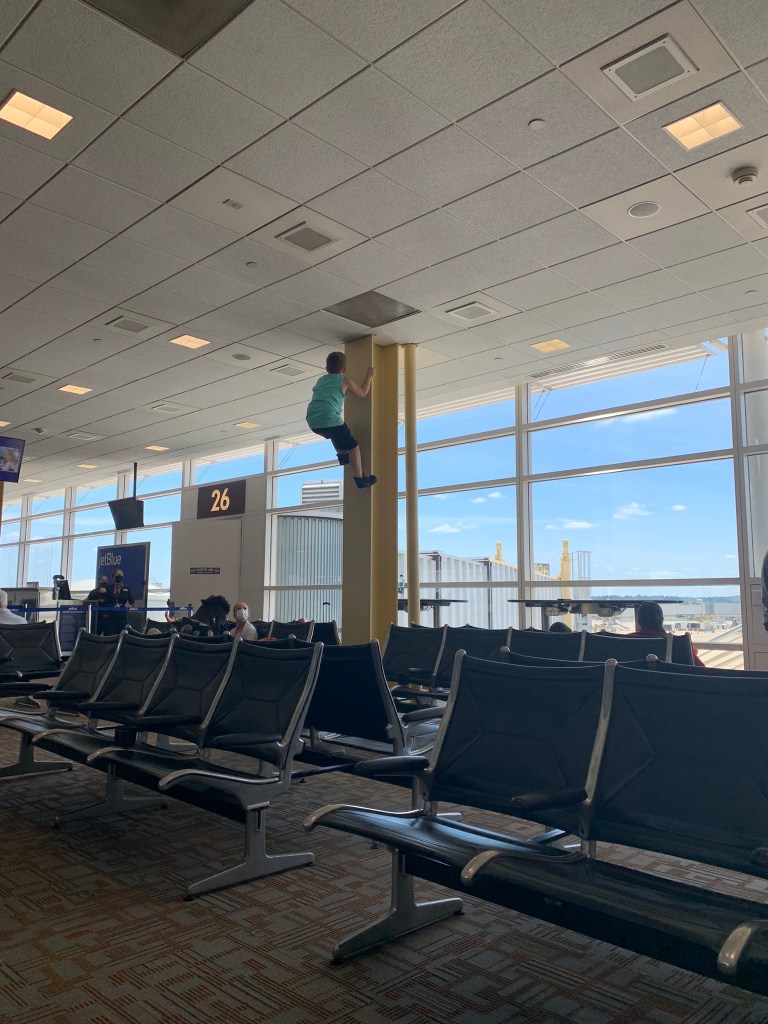
Some people joke their restless kids are “climbing the walls.” Kids like our T actually climb them.
I’ve seen memes of this boy climbing a pillar in an airport (below) many times on social media.
This kid is not T but he might as well be.
I empathize with this kindred spirit. Even though it’s never disclosed why this kid was climbing, I infer and understand how a restless impulsive ADHD/FASD mind can respond to a stimulus-rich environment.
During a recent outing with friends to the Bluffs, the hubby and I wondered where T had gone.
There he was!
Aside from his incredible upper body strength – I want to start him in parkour lessons – T never stops moving, climbing, jumping.
While it can make for tiring outings, we have lots of fun together.
Here are a few sanity saving tips the hubby and I have picked up on how to enjoy an outing with a neurodiverse child.
Preparation is Key
We give T a heads up about our plans, sometimes showing photos or videos of what to expect. Social stories can work for other kids too.
We don’t pack too much into our day, because at some point, kids crash – and that’s when tantrums can happen for T.
We pack a survival bag: snacks and water – avoiding sugary stuff like juice boxes – and extra underwear/pants, sunscreen, hats, etc.
Don’t Sweat the Small Stuff
You gotta pick and choose your battles – or you’re gonna lose your shit.
When we went to the amusement park with T’s cousin last month, T was the one kid in the long rollercoaster rides standing and moving on the railings. I remember a bewildered mom staring at him.
The way I look at it: if he’s not getting in people’s space or at risk of hurting himself or others, I’m not gonna sweat it.
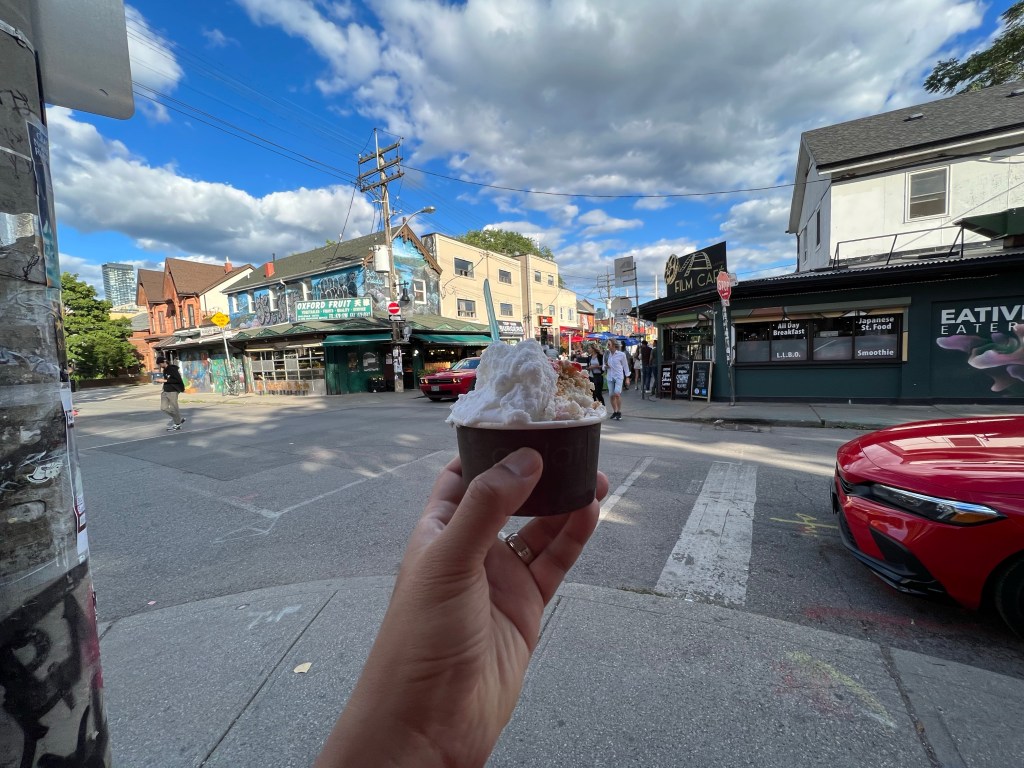
Oh look, here’s T climbing a tree – one of many – during our downtown outing with his visiting Aunt and cousin A – while waiting for ice cream.
Be the Calm
We are fortunate that most outings are fine, but boy, do things get harried when he has a tantrum or meltdown.
These moments test even those with nerves of steel.
It sounds easier said than done, but it’s all about deescalating. The lecturing, debriefs etc. can wait until after the storm has passed.
Reward and Incentive
We give T something to look forward to at the end – ice cream, funnel cake (below), etc. – because it can be used as motivation throughout the outing.
Yes, I’m not above bribing my child. 😂
If T does earn the reward, we pair it with praise and positive reinforcement.
A trip to Canada’s Wonderland is not complete without funnel cake at the end of the day!
Avoid Comparisons
It’s tempting to compare your child with others – like at a restaurant when every child is sitting still and T is hopping on seats like a frog or crawling under tables.
But I stopped comparing nor caring, because I know what makes T exhibit his behaviours.
If a parent ever called me out, I’d tell them to count their blessings their child do not have the daily struggles that T does.
Find Activities They Enjoy
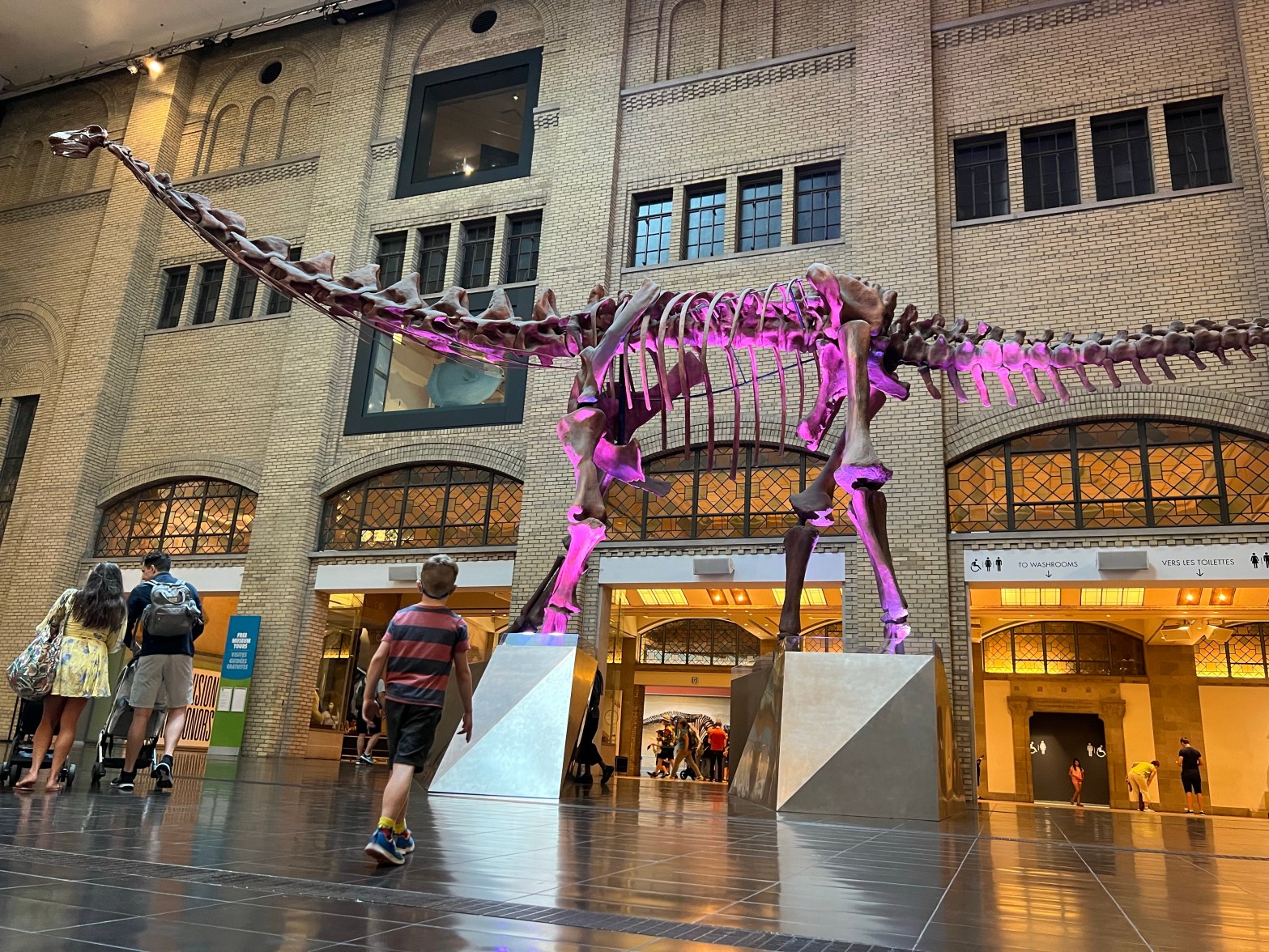
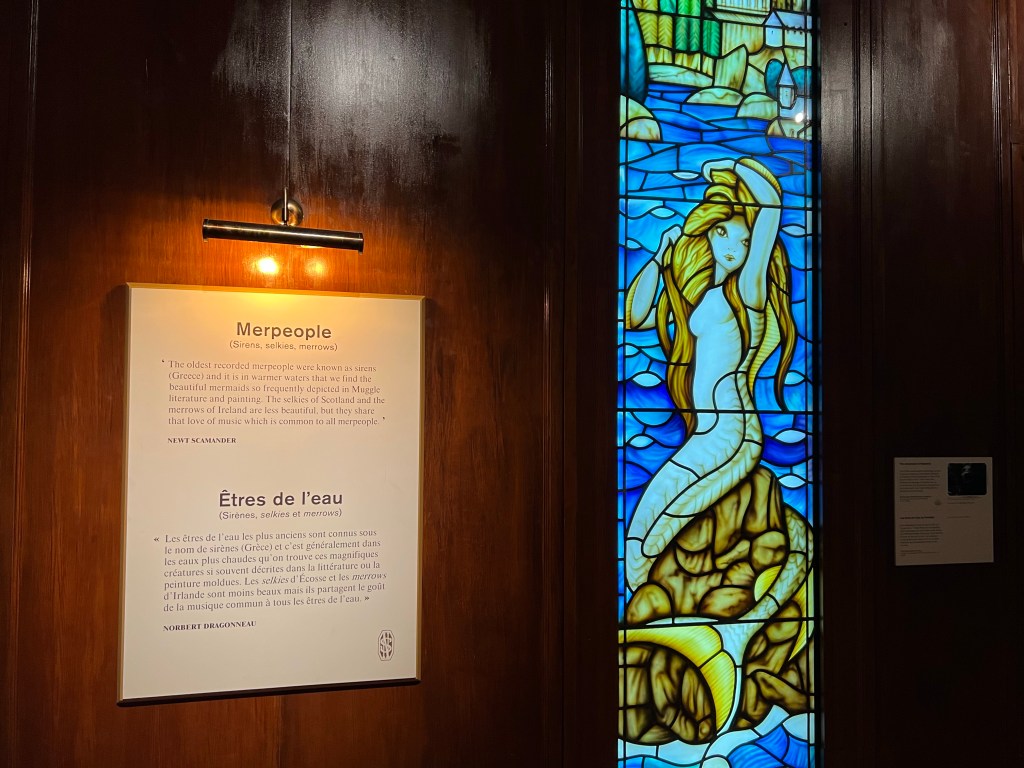
When T’s cousin came to town, we took them to the museum and Ripley’s Aquarium (below).
As expected, T zipped through both places, so I never got to immerse myself as much as I would’ve liked.
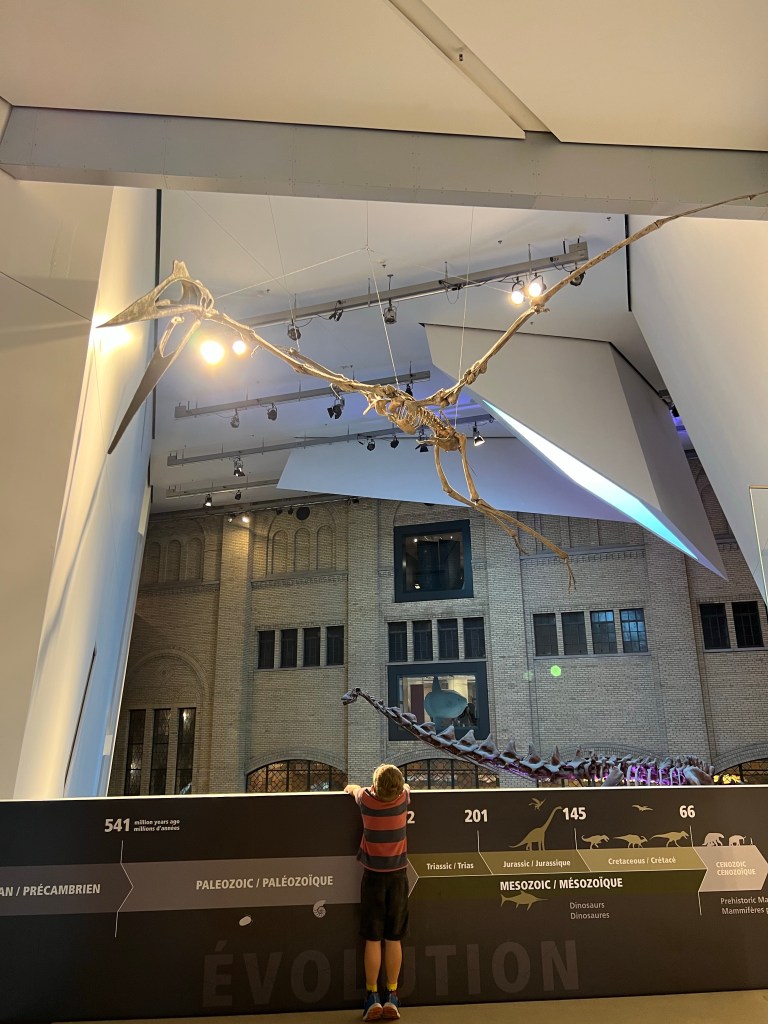
But there were moments that had his sustained attention – like the dinosaur exhibit or the jellyfish tank (below).
And that is the key: finding things they enjoy and build on them. Like camping, swimming, hiking.
When kids like T are engaged in something they enjoy, that’s when magic happens and positive memories are created.
Watching hypnotizing jellyfish at Ripley’s Aquarium.
Build in Rest Time
We try to build in quiet time at home at the end of our outings for ourselves.
We all need to decompress. This means I’m sitting in my room quietly and the hubby is watching TV – and if T is looking at a screen, so be it.
We try not to pack our weekends and limit outings – especially with others – so there’s lots of time to just our family and for individual downtime.
Have A Sense of Humour
As I always say, it’s best to find a way to laugh – even at how crazy the FASD journey can be – because the alternative is to cry.
In 2017, the first time we travelled out of Canada with T, who was just under 2, we flew to Miami to attend a friend’s wedding (below).
T had a massive meltdown at the airport checkin line. It was likely due to lack of sleep as we were up very early and it was noisy and bright.
The hubby and I started to panic. Thankfully, a sympathetic staff rushed us to the front of the line and we skipped a 45-minute wait.
When the hubby and I got over the embarrassment, we joked that next time we should see what else we could milk from a meltdown.
Maybe get bumped up to first class? Or at least an extra bag of peanuts?
We made it to the wedding, despite the meltdown. T looked adorable in his tiny dress shirt!
At the end of the day, every child is different and what works for T may require a different approach for another – and vice versa.
The hubby, T and I have lots of fun together. They make the extra preparation and occasional tantrum or meltdown worth it.
We build memories, because childhood – and summers and life itself – is so short.
Once the outing and meltdowns have long passed, the excitement, fun, laughter and happiness are what remain.
Every August 16, we celebrate Queen Madonna’s birthday; she turned 64 on Tuesday.
I discovered her music in high school in ‘98 and continue to admire her tireless work ethic, tenacity, fearlessness, and advocacy.
Just as she redefined music, it’s interesting to watch her age on her own terms, while centering her life, work and philanthropy around her children.
I loved her recent NYC Pride performance (above) – which included her son!
I turned 40 last year and I want to be as energetic, curious and to keep challenging myself, like M does, in my 60s.
The pandemic reminded me that life is short. We have to seize each invitation in this dance of life.
“Let me whisper in your ear
An invitation to the dance of life.”
– Madonna, “Celebration”
We all have a platform in life.
M uses music to speak up for women’s and LGBTQ rights and to speak against hypocrisy and injustice.
Writing is my outlet. My platform is microscopic compared to hers – but I believe we can all use our gift to create space on the dance floor for others.
“Don’t want to get to the end of my days
Saying I wasn’t amazed.”
Madonna, “Messiah”
As a parent, I celebrate life with and for T.
I embrace life for the ups and downs – and with, and in spite of, the cards we are dealt.
M has said she’s not the best singer and dancer, but she maximized her deck of cards to succeed and to bounce back from setbacks and criticism.
The hubby and I seek to guide T to achieve his potential with the cards he’s dealt.
NYC 2006: Holding a balloon that fell from the ceiling of Madison Square Garden in the finale of the Confessions Tour. I still have it!
Legend has it M first arrived at New York City with only $35 in her pockets.
Or in 2011, thanks to a friend, I sat unplanned a few seats away from M at the premiere of her directorial debut, “W.E.,” at the Toronto International Film Festival (below).
Life is not about the destination – we all end up at the same final finish line, celebrity or not! – it’s about the journey.
So we might as well dance along the way.
As M sang in the opening of her Rebel Heart Tour in 2015 – the last concert we attended (below), six months before T entered our lives: “Never let the fire inside you leave…”
Music can indeed be such a revelation.
M’s music showed me why we should always be inspired.
T continues to teach me that life itself is the greatest inspiration.
90% of people with FASD experience an additional mental health diagnosis.
Individuals with FASD may be at a higher risk of suicidal thoughts.
A disproportionate number of people in conflict with the law have FASD.
I firmly believe T is on his own journey. Nonetheless, these stats sometimes make it feel like the odds are stacked against him.
A few weeks ago, T started telling us that “everyone in the world doesn’t like him.”
T is often a happy and happy-go-lucky kid. So it made me sad hearing this.
The hubby and I since observed T makes this comment when he is told not to do something – e.g. getting in personal space – or when someone he wants to play with wants to be left alone, because he is so intense.
We try to explain to T that many people like and love him – but they do not like being talked to rudely, him getting into their personal space or repeatedly doing something after being asked not to, and that people sometimes need peace and quiet – especially when he’s disregulated.
It’s a message we need to keep repeating, because it’s important for him to distinguish between people liking him for who he is and him needing to build social and regulation skills.
I understand and empathize deeply with how kids like T can develop low self esteem and negative self talk when they feel treated as a “problem child.”
We can’t shield T from feeling hurt, misunderstood or sad. It’s a part of life, neurodiverse or not.
We can, however, help him develop skills to build mental and emotional resiliency – to help him live his best life, despite the ups and downs.
I don’t pretend to be an expert – I am getting lots of hands on learning though! – and this is too complex of a topic to cover in one post.
So I’ll share a few recent ways the hubby and I are approaching this:
Be clear of why we correct/redirect him or take away privileges (e.g. tablet time) and it’s never because we don’t like him.
Talk to him – at bedtime, post meltdown, car rides, etc. – and try to coach him about social situations, as this is where he struggles and ends up alienating others.
Advocate and raise awareness with family, friends, school and daycare staff about FASD to create understanding and empathy about T’s exhibited behaviour.
Encourage T to express his emotions (T is a kid who’ll tell you what’s on his mind whether you want to hear it or not!) and tell him it’s ok to not feel ok sometimes and that feeling bored, sad, or angry are normal.
Encourage T to find calmer ways to express his anger, such as walking away to his room for “peace and quiet” – and preferably without slamming doors!
Find ways to create fun and joyful moments every day – as simple as playground time to more complex plans like a roadtrip – as I genuinely believe happy memories help us get through stormy times.
All of us, especially kids, need reassurance. We try to start and end each day on a positive note – and remind T he is loved.
We still haven’t shared T’s FASD diagnosis with him yet. We hope to do so soon and I believe this will help him understand himself better.
We try to be kind with each other and ourselves when we don’t get it right – we often don’t! – because the FASD journey is unbelievably hard!
How do you build emotional resiliency? I’d love to hear your thoughts in the comments.
As mental health matters become normalized, it will build awareness and empathy, increase advocacy and resources, and reduce stigma.
In turn, I hope those distressing aforementioned stats will decrease over time.
As T’s parent – and “external brain” – it is essential I also prioritize my mental health.
There are many ways I do this – self care, hiking, setting boundaries with people, not taking on things I don’t have capacity for, counseling, blogging – that I’ll write about in a future post.
I started this post on the last day of our three-week vacation and I felt thankful for the rest and recharge – and the fun times we had with T.
On Friday afternoon, I took T to the outdoor pool. He loves it there and enjoys splashing, jumping into the water, doing front and back flips, and playing “shark chase.”
As I “chased” him in the water (a parent moves slowly like Michael Myers in Halloween when playing tag with kids), T made his way as fast as he could to the side of the pool, laughing excitedly.
As his hand touched the pavement deck, and I was inches away, he screamed, “T-O!”
“Hold on
I don’t wanna know what it’s like when you’re gone
I don’t wanna move on
I don’t wanna know what it’s like when you’re gone for good
You’re slipping through my fingertips
A little bit by a little bit
I didn’t know that loving you was the happiest I’ve ever been
Earlier this week, the hubby and I celebrated our 13th wedding anniversary.
The day began with dark clouds and high winds.
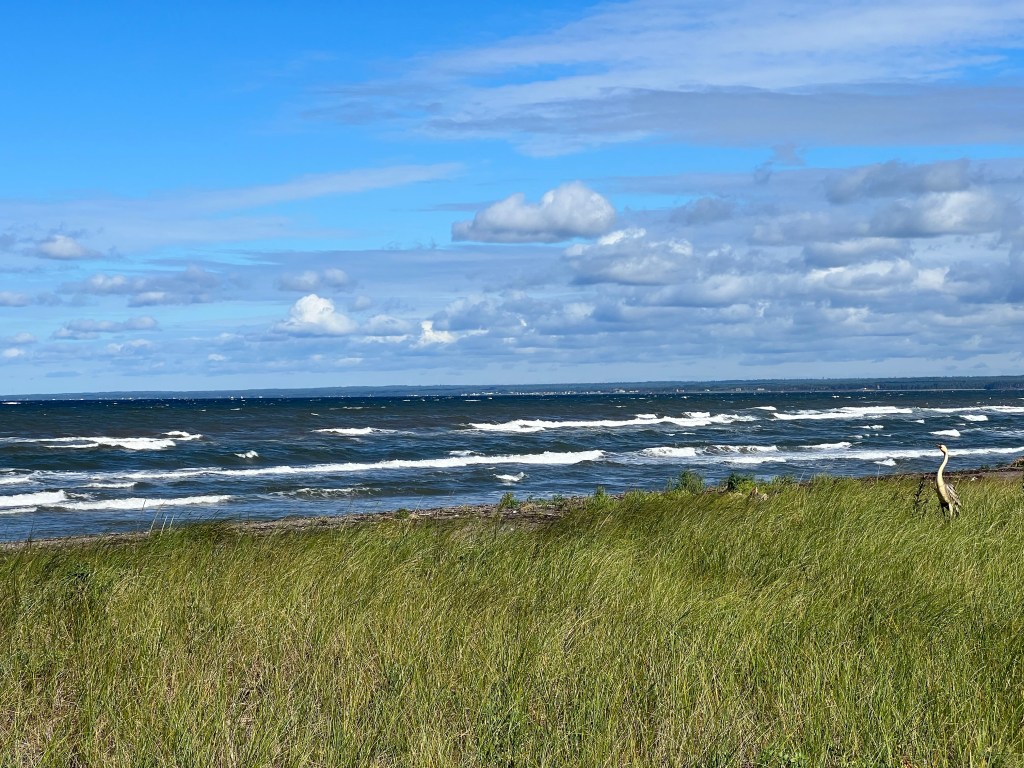
Instead of seeing it as an unlucky #13 omen, I loved that the winds brought high waves in the usually calm bay – and with the gray sky, we got quite an atmospheric mood!
This driftwood was washed on shore!
It was cold, so T stayed inside.
As I walked down the beach, I thought to summer 2018, when T joined us for a similarly moody walk.
T’s red sweater popped against the gray day.
When we were going through our seven-year adoption journey, a colleague shared that friends told her that adopting children with FASD ruined their marriage.
I think about this conversation from time to time, especially during the truly difficult in-the-trenches moments with T.
T has impacted our marriage in many ways. We’re busier, always tired, recurringly on edge, and always craving some free time. There is rarely a moment of quiet in our home.
I’m thankful to have continued opportunities to step back to view the bigger picture. And that is T has made our lives better, more fun and rewarding. Our adventures are always enjoyable because I experience them through his eyes.
I did reflect on my conversation with my colleague during T’s disregulated moments at his grandparents’, a difference from last summer.
Thankfully, the hubby and I continue to be aligned in our goals, priorities and approach – even if we get testy with each other during T’s moments.
And really, what more could I ask for?
This reddish heart-shaped rock I found during my walk on our anniversary morning agreed!
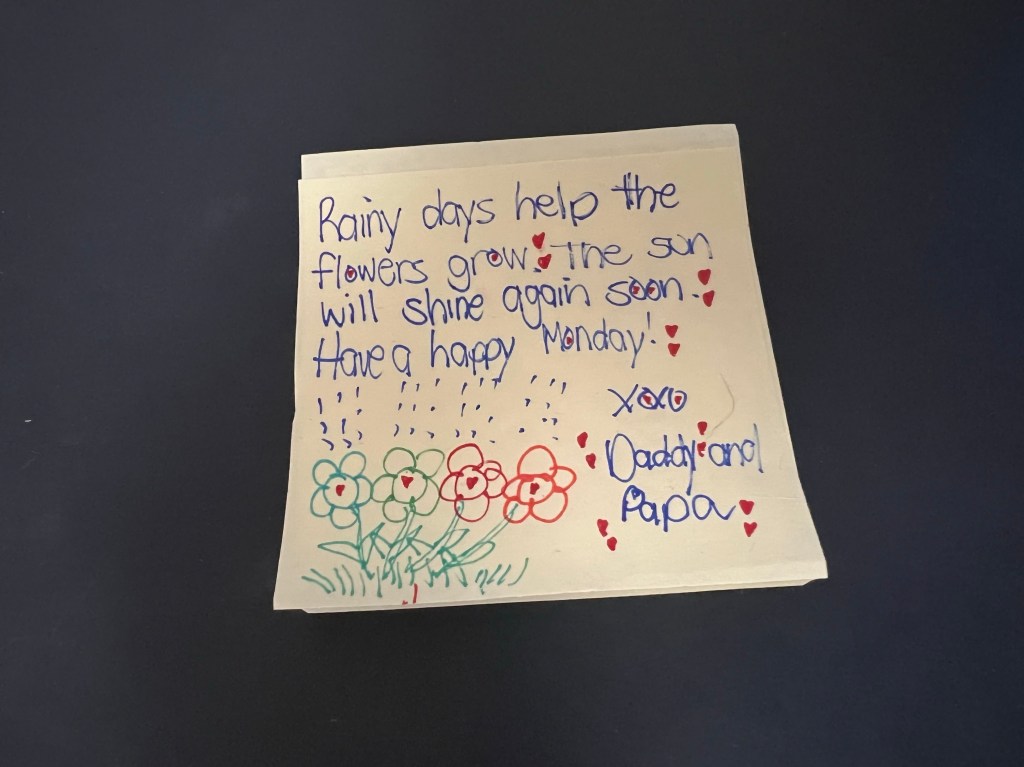
As I wrote on a recent morning note to T: “Rainy days help the flowers go. The sun will shine again soon!”
Our rainy moments help us grow – as individuals, parents, a couple, and as a family.
The sun did come out later that day. Thankfully, the wind continued to make lovely waves.
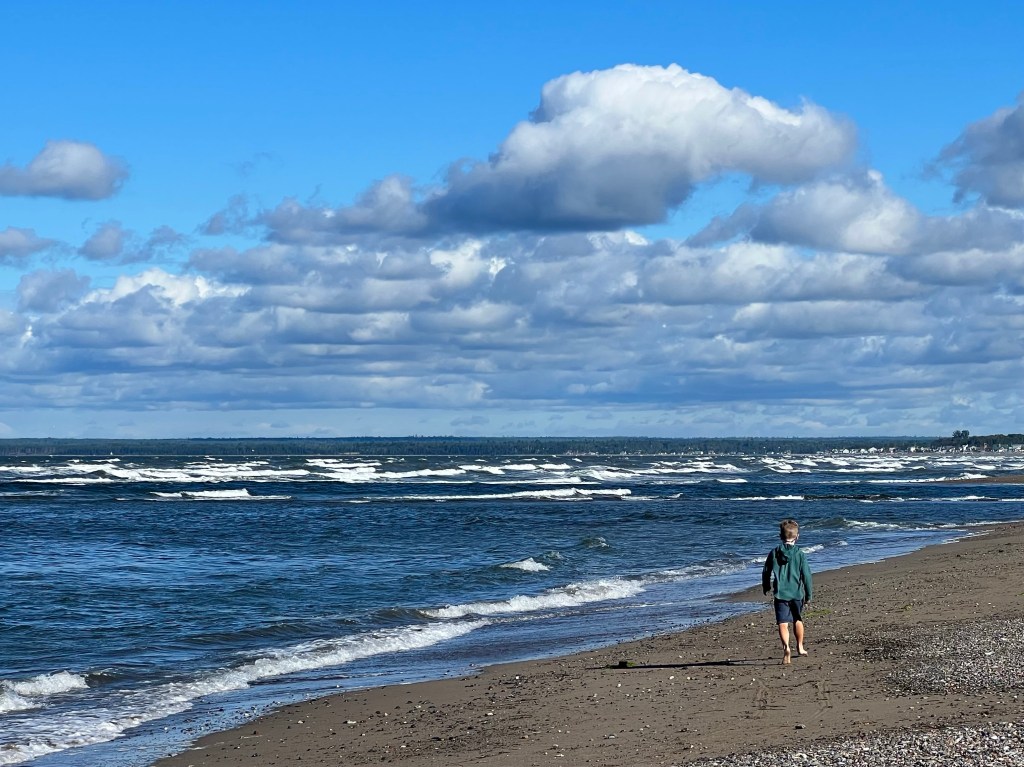
T joined us for an afternoon walk and I quietly took in the puffy clouds and rolling white waves slicing into the water. Just beautiful.
That evening, we took T and his cousin A to see a movie: DC’s League of Super Pets.
It was not how I’d imagine spending a wedding anniversary 13 years ago – but I was that grown man crying at the end of the animated movie about Superman’s superhero dog.
I loved that there was a positive message in the movie about adoption too!
Two days later, we got up at 4:30 am (Eastern time) to head off on our 16-hour drive home.
As we were packing our things into the car, I noticed the sun rising over the bay.
It was a cloudy day. Beams of warm orange light pierced through the dark clouds, casting a heavenly glow over the water.
Last Sunday, the end of week two, T was reunited with his cousin A, who was visiting for the week.
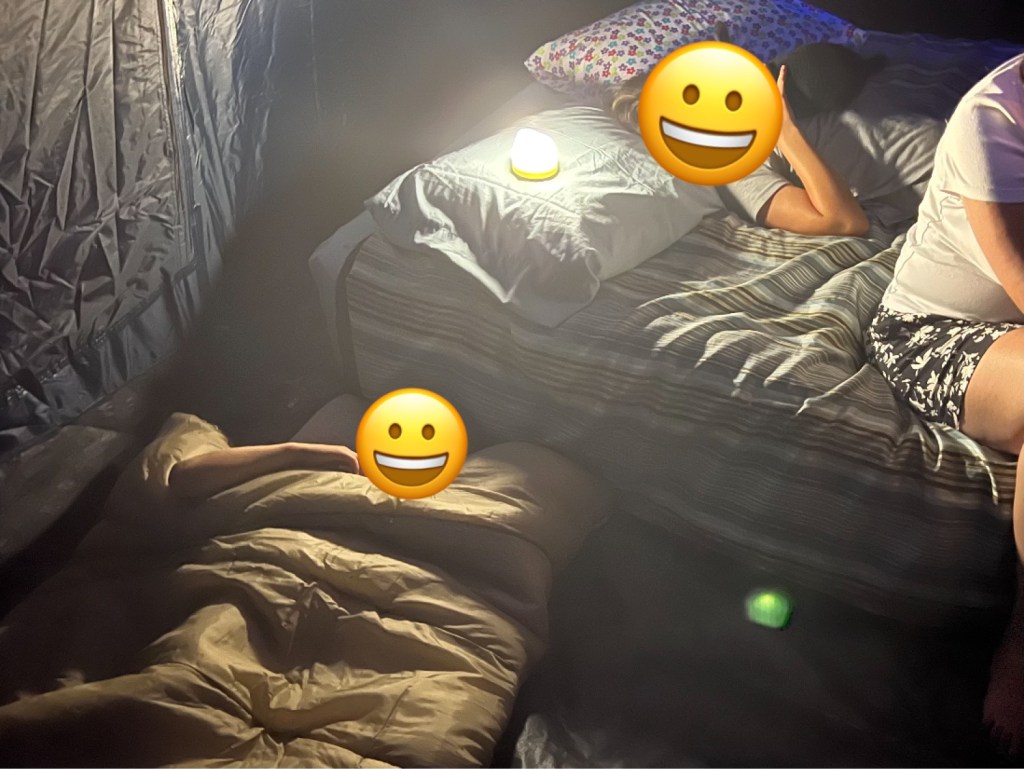
As space is limited at T’s grandparents, his Aunt graciously set up a tent outside the cottage.
Camping at the beach, hearing the waves and smelling the saltwater air are so appealing.
T asked if he could sleep with them and his Aunt said, “Yes” – and boy did he get excited!
I often think about the missed opportunities during the pandemic for T to build bonding experiences with classmates.
I have fond memories of my countless sleepovers with my cousins growing up and I want T to have similar experiences.
Rebecca at Quirking It recently blogged about childhood sleepovers from the perspective of someone with FASD.
Sleepovers to me are about staying up late, eating ice cream, playing video games, creating forts, laying every blanket in the house on the living room floor and watching movies together.
As T’s parent, I believe in not dwelling on the what ifs and to focus on the what nows.
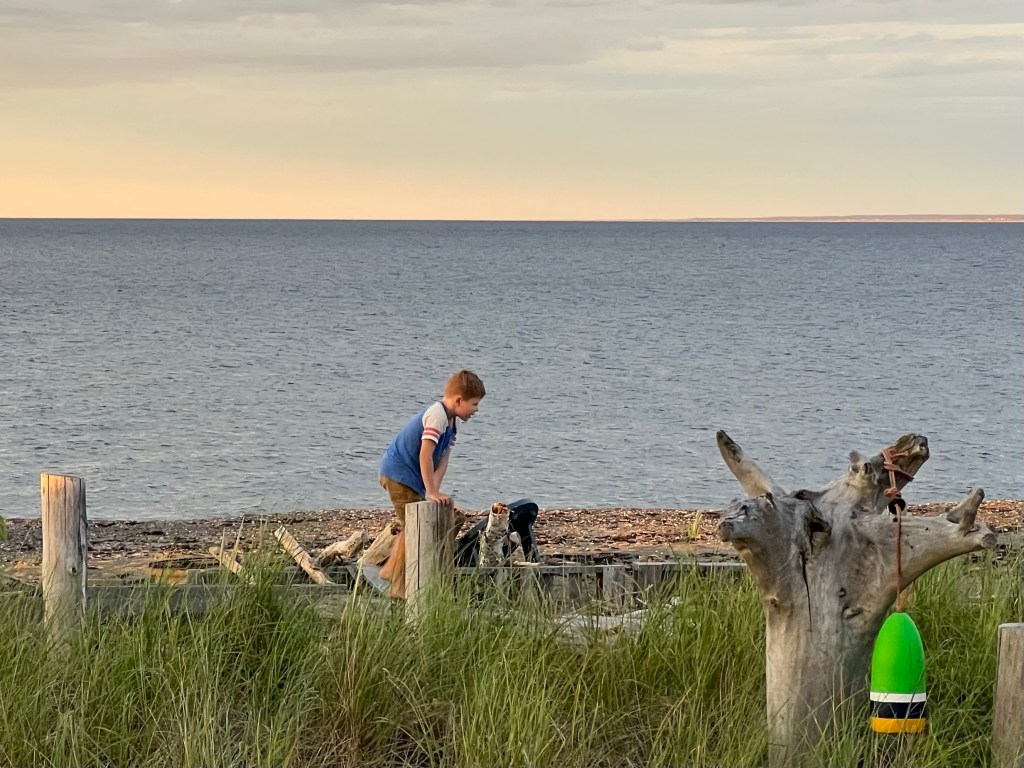
For the rest of the afternoon, T and A played together by the beach.
He showed her the fort he had built beforehand.
After dinner, we were blessed with a spectacular cotton candy sunset.
The oppressive heat from the last few days cooled and it was a comfortable evening.
When night came, we reminded T about the sleepover rules: Respect his cousin’s personal space – something he struggles with – and to listen to his Aunt; otherwise, he would be sent inside.
He changed into his PJs and initiated teeth brushing with little fuss.
When he got inside the tent and the sleeping bag, he had the biggest heartwarming smile.
He then gave the hubby and I a big hug, before climbing back into the sleeping bag.
Part of me felt sad he was sleeping away from us, even though it was just outside. After I walked inside the cottage, I sang excitedly, “Freedom!”
When you feel like you’re being pulled under by chaos, it may be best to go with the flow.
We’re still at the hubby’s parents for our annual summer vacation – and T is having a blast with his grandparents and vice versa.
While T has made so many gains since last summer, his use of inappropriate language has increased.
During dinner on Tuesday, after repeatedly telling T to stop saying things like “Shut up,” “Shut your mouth,” and “Be quiet,” I had enough and took away his tablet for the evening.
T got angry, screamed at me and even threatened me with his fork.
I kept my cool – and everyone around the dinner table did as well – and our disregulated child soon calmed down.
Raising a child with FASD can feel like you’re being washed down a never-ending river.
Some moments are very frantic and you feel like you’re going to drown.
When we recognize it is T’s brain – impaired with a lack of impulse control and emotional regulation – and not “bad” behaviour, we can stay calm, ride it out, and things quiet down again.
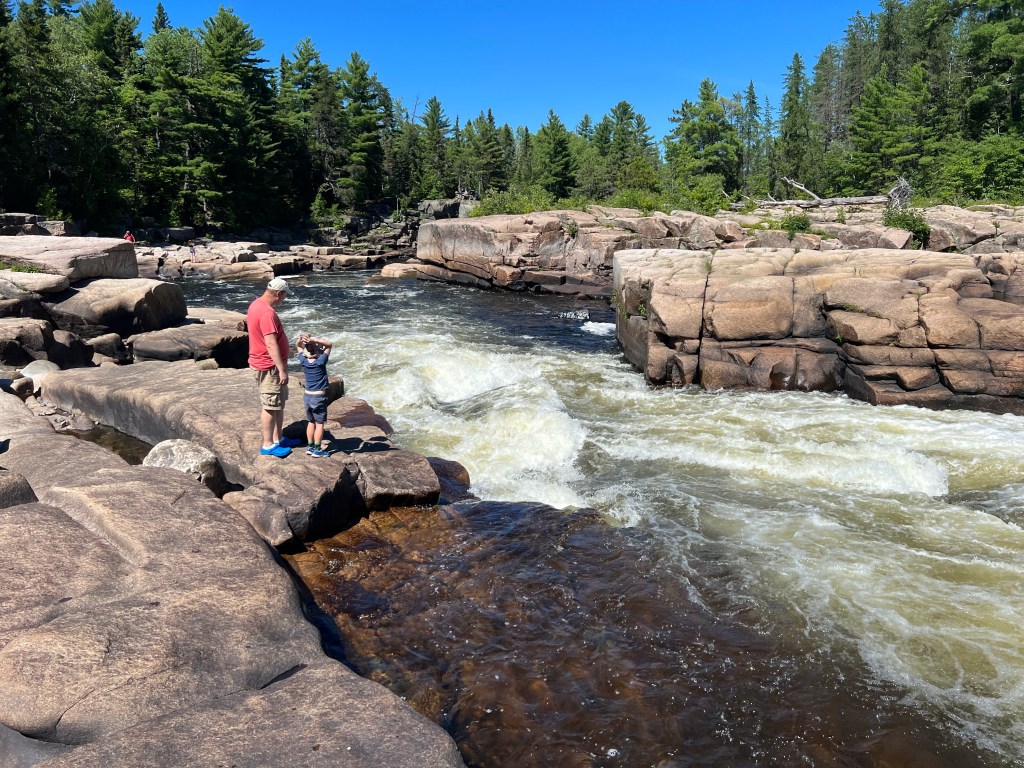
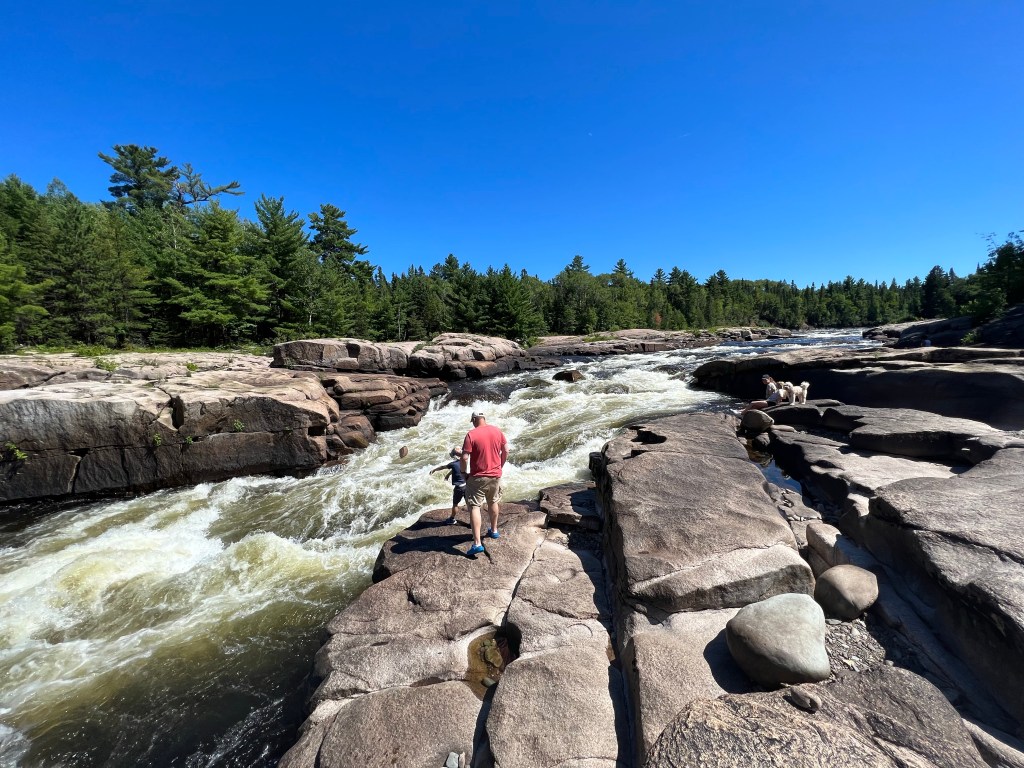
The following day, we enjoyed an afternoon hike at beautiful Pabineau Falls.
The hubby and I last visited in summer 2015, when my Ma joined us for our annual visit.
This was T’s first visit. He quickly found large rocks to throw into the gushing water.
T is a natural curious explorer and he wanted to venture further down the river – something neither the hubby, his parents nor I have done in the many times we’ve visited.
As we hiked down the river, I reflected on the previous evening.
For those unfamiliar with FASD, T’s shortlived outburst and threat may seem horrifying.
I thought instead about how T was able to deescalate, thanks to everyone staying calm, when the intuitive thing to do was to respond and reprimand.
This is not always the case: I’m human and I don’t always stay calm; the hubby’s parents have in the past said things in the heat of a moment.
So this was a winning moment of teamwork.
Our journey down the river of life with T often leads us to unfamiliar territory.
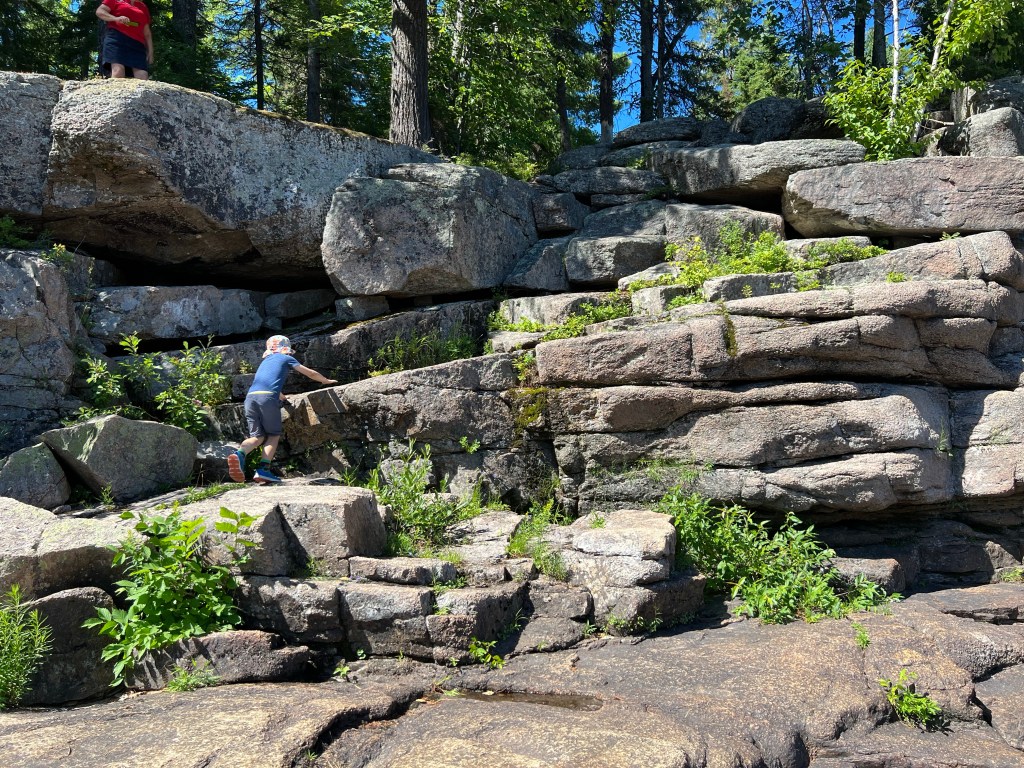
When we leave ourselves open, we encounter the simple joys – like climbing rocks or wild blueberries quietly growing under tree canopy.
When we don’t resist against the futility of angry currents, we are led to calmer waters – like an unexpected swim spot enjoyed by locals of all ages.
During the calm moments, we are blessed with higher firmer ground to take stock of the path travelled and to prepare for the rushing waters inevitably around the corner.
When we returned home, the hubby and I made dinner to thank his parents for their hospitality, spending time with T and giving us a break.
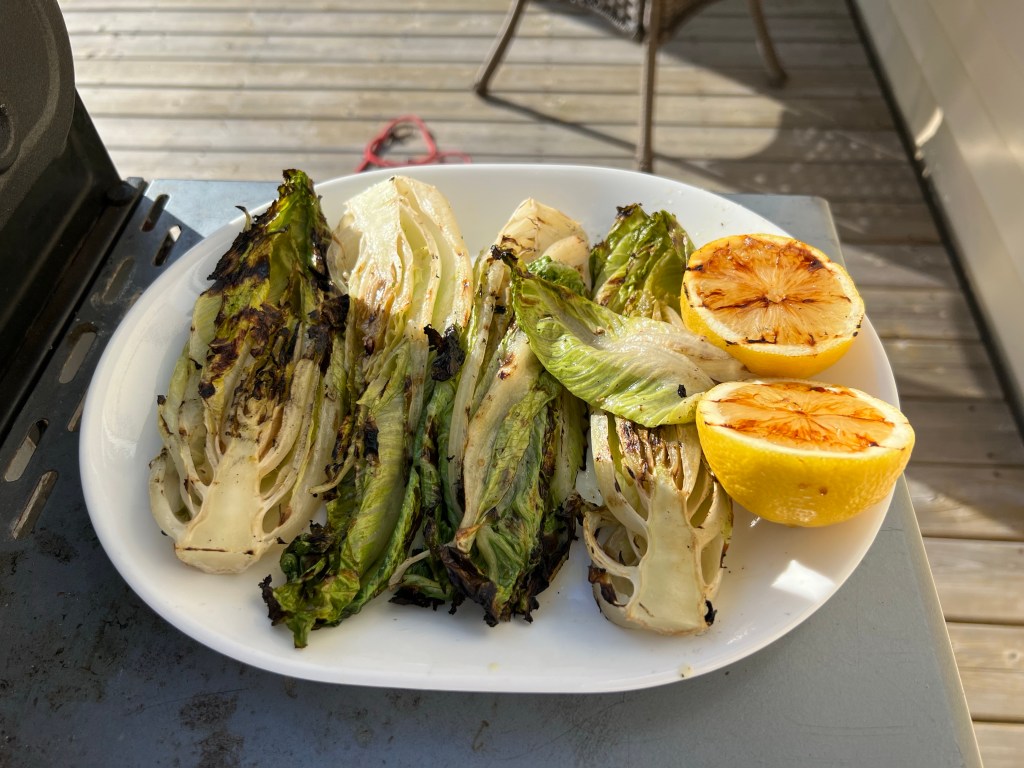
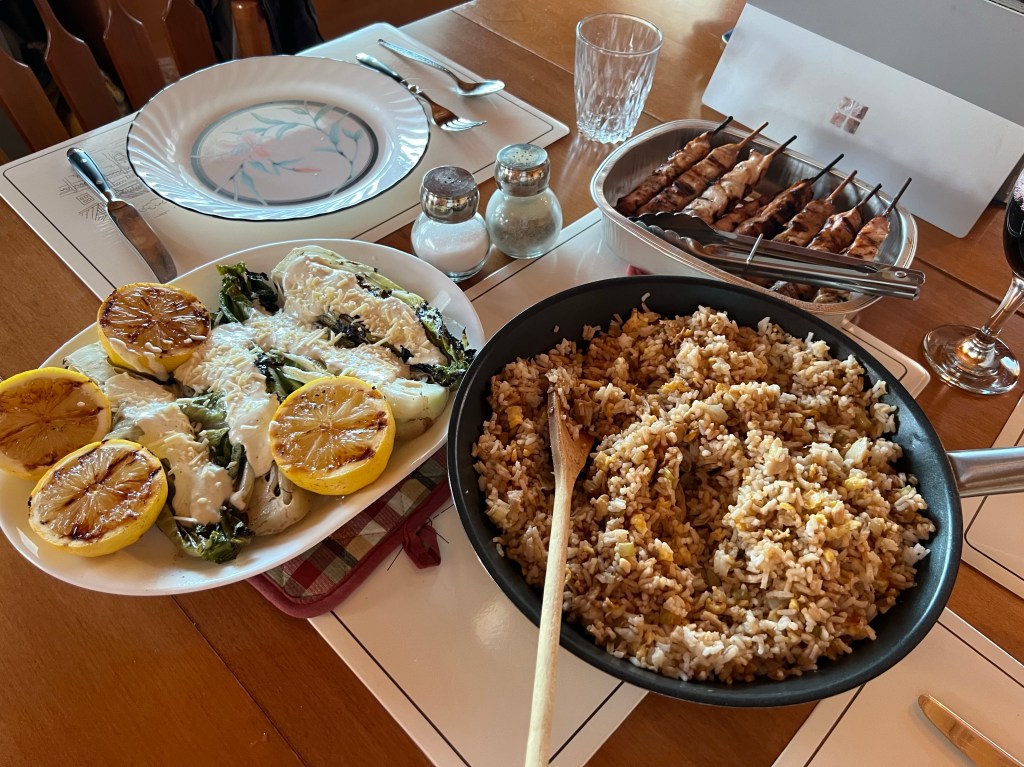
I barbecued chicken kebabs and romaine lettuce hearts, the latter I last made for the hubby’s 40th birthday pandemic celebration in 2020.
They went well with the hubby’s chicken fried rice.
A child’s ability to find fun and enjoyment is as limitless as their imagination.
The calming breezy saltwater bay ushered in the next wave of our family summer vacation.
After a short visit from T’s aunt and cousin, we headed off early Friday morning on a 16-hour drive for our annual visit with T’s grandparents, who live in a small Acadian town in New Brunswick.
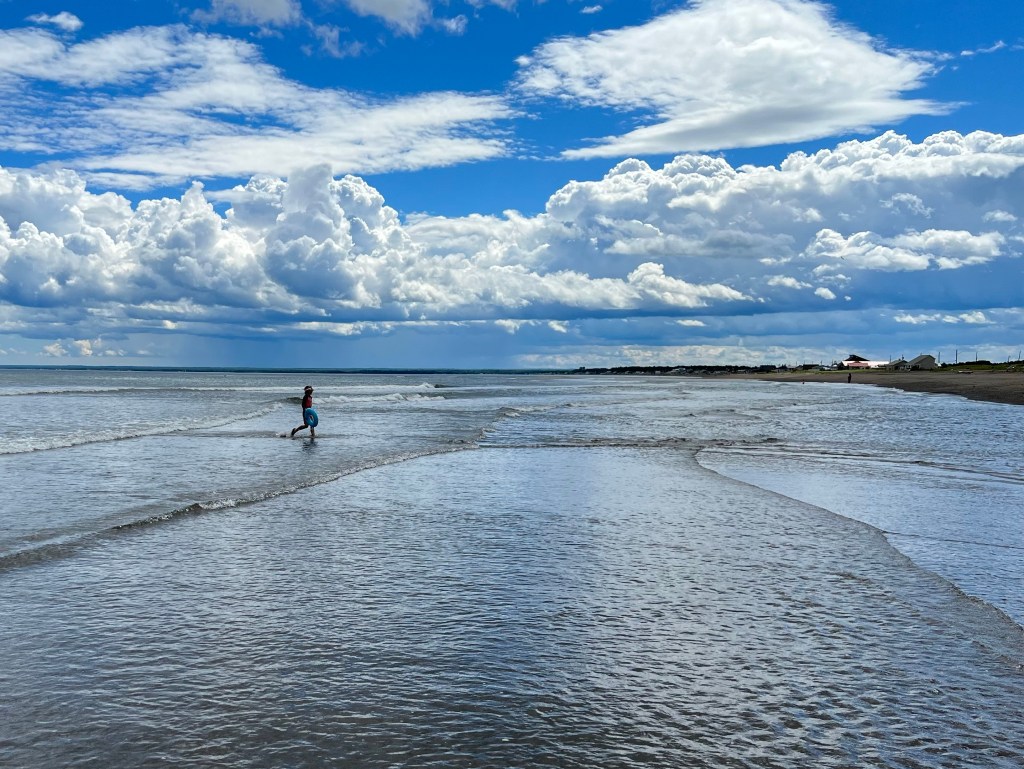
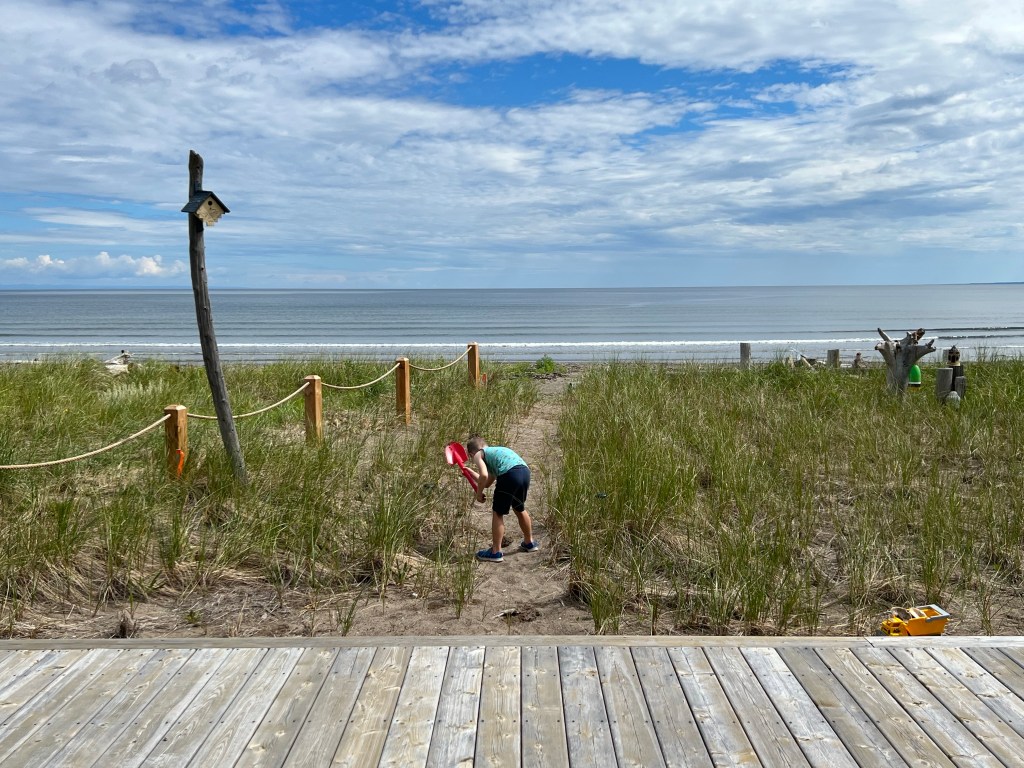
T loves it here, because his grandparents adore him and he enjoys running around the beach.
I believe in the soul-soothing healing qualities of saltwater air and the sound of waves.
Children like T need this calm from the storm – as do their parents! – and I am thankful for this break for T and us to create positive memories.
T quickly loses himself in play on the sand or throwing rocks into the water.
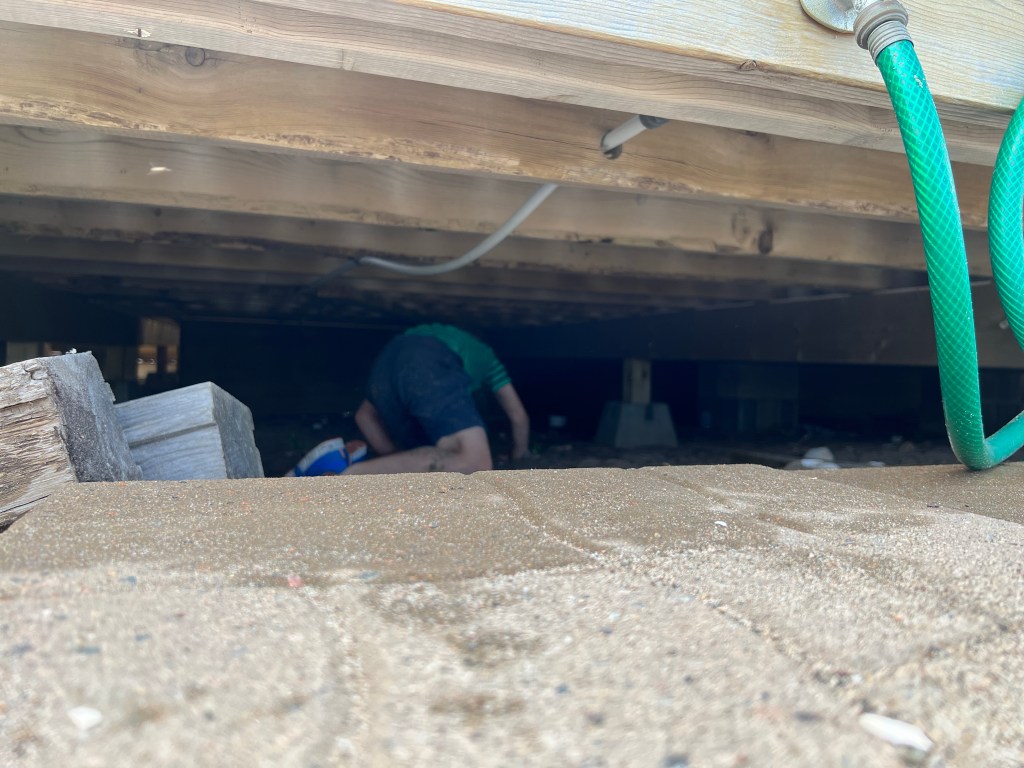
He even made himself comfortable in the crawl space under their deck – which transformed into a cave in his imagination.
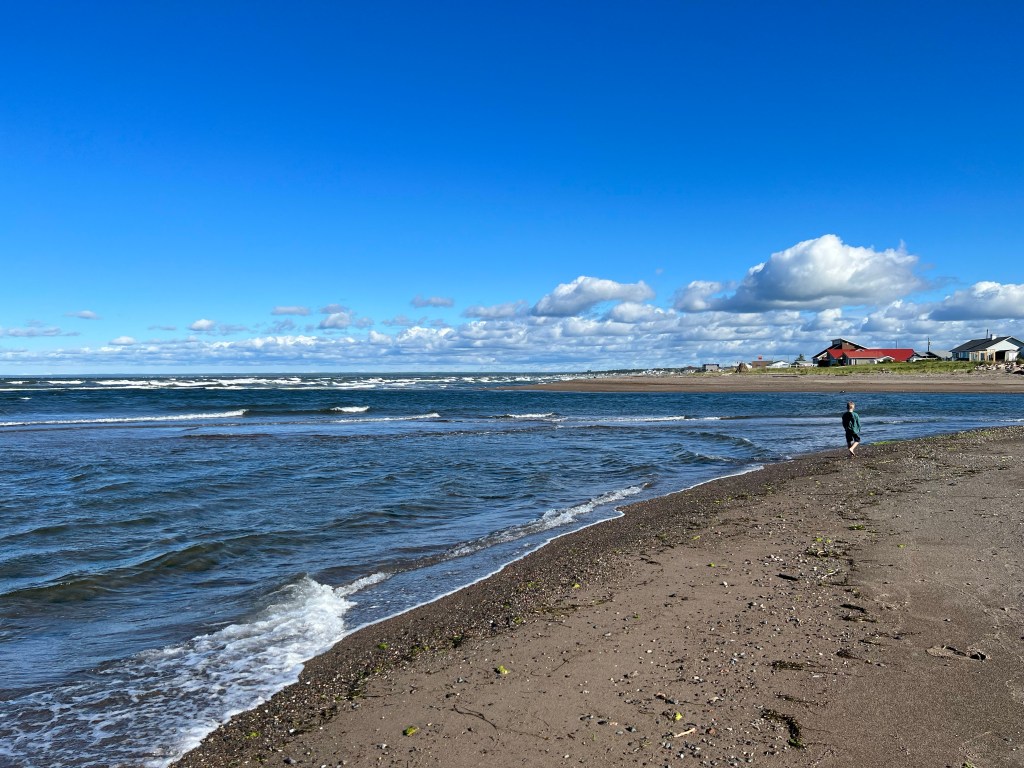
After breakfast one morning, T and I went for a long walk by the water.
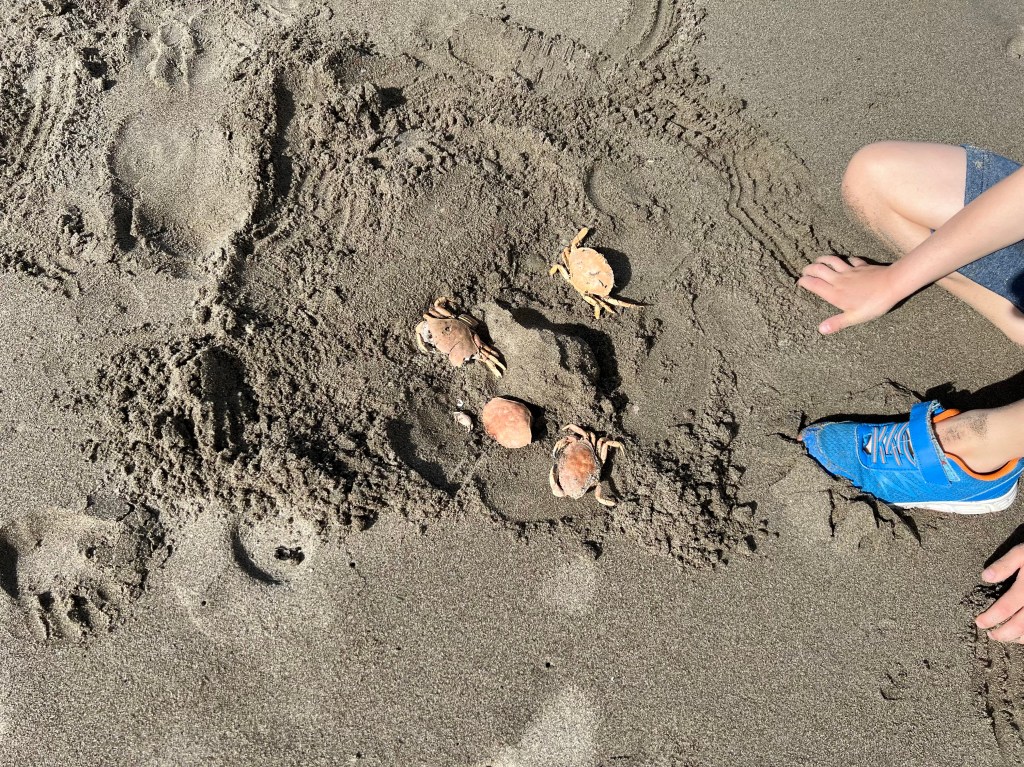
There’s always something interesting to find on the beach – shells, rocks, sea glass or dead crabs.
T decided to collect crabs and I helped him carry as many as I could.
Then T dug up several holes and buried them one by one in the ground.
He then found round pebbles and used them as tombstones for the crabs – humming The Bee Gees’ Staying Alive as he laid them out.
This kid has a wicked sense of humour, whether it was intentional or not.
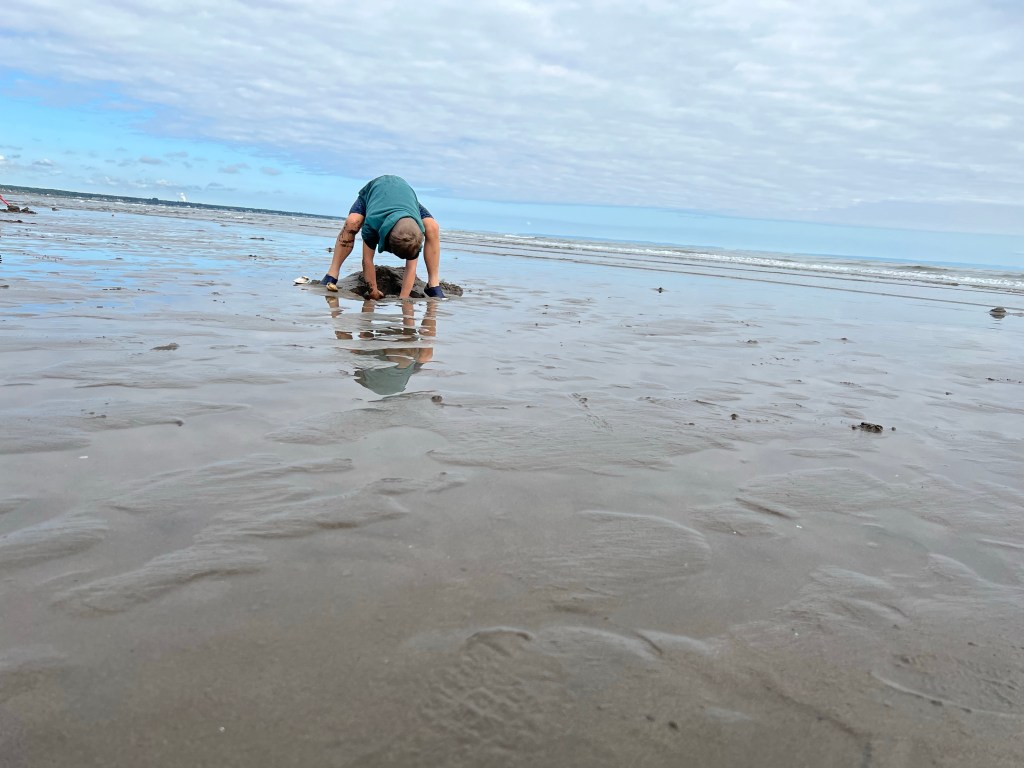
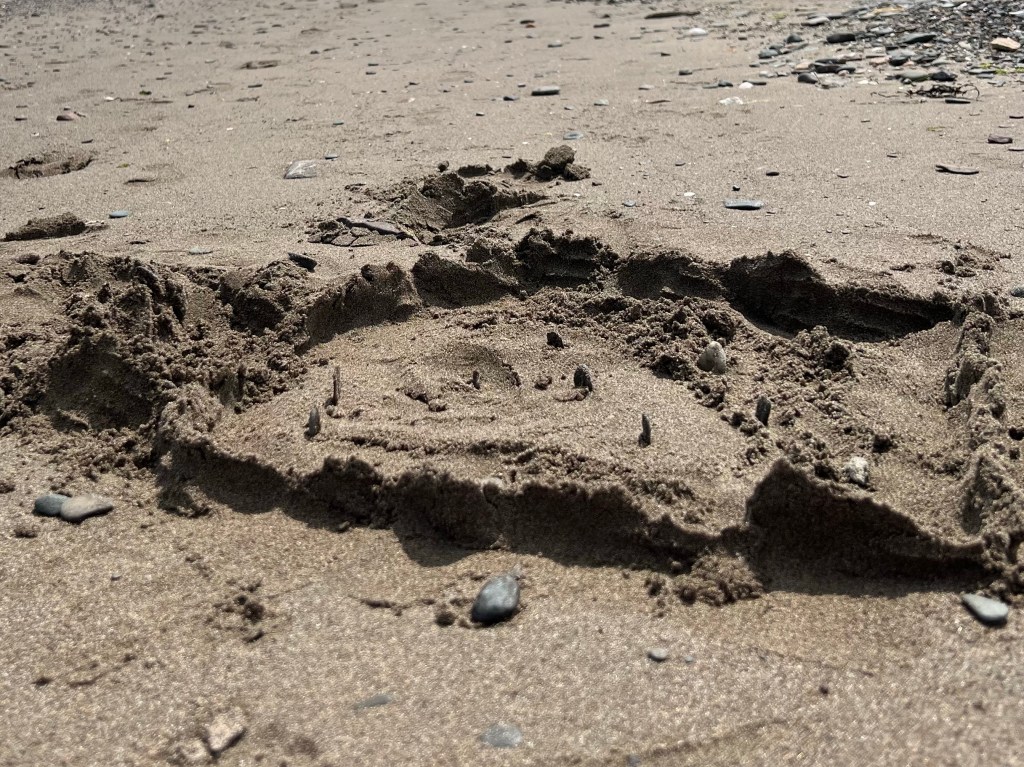
Afterwards, he found a flat patch of sand and used his fingers to spell out Crab Semetary (sic).
The next morning, T went out to look for his graveyard and said that it was gone.
I explained to him the tide must’ve come and washed it away.
Instead of getting crabby, the new day brought a clean slate for T to find another adventure for his imagination to run wild with.
Slowly, our little one’s innocence will be tempered with lessons about the hardships of the world.
On a drive home this weekend, we stopped at a red light and a disshelved man approached each car, with a cup in his hands.
We found two loonies in our car and I rolled down the window and put it in his cup.
T asked why he did that, so I explained the man was asking for money and it was important to help others when we are able to.
He asked why the man asked for money.
To keep it simple for a 7 year old, I explained the man was probably homeless.
“What does homeless mean?” He asked.
I explained that it means he probably doesn’t have a home to live in, which means he doesn’t have things that T has, like a bed, shower, or toilet.
“So he poos on the ground?” T asked in a bewildered tone.
The matter of fact way he said it made me chuckle, because it reinforced just how innocent his view of the world is.
The hubby explained he probably has to use a public washroom or borrow one at a restaurant.
T agreed that it was sad.
I often think about how fortunate we are that T has an innocent childhood.
As he gets older, he will undoubtedly be exposed to the uglier realities of the world.
As his parent, I want to hang onto his innocence, while providing him with the skills and knowledge to face those realities with grace and to do his part to making this world better.
The suddenness caught me off guard but I appreciated the hubby using the conversation to share this story – as we try to find opportunities to slowly piece T’s story in his mind.
As with the other times when we talked about his birth mother, T took the news in silently.
We sat quietly in the car for the next few minutes, listening to music and watching the beautiful sunshine outside.
One blessing during the pandemic was spending more time together as a family.
When I was losing my mind with virtual schooling, I stopped to think when else could I take a break during work to go for a walk with T or to eat breakfast together when I’d normally be at work.
This summer, things have returned to as normal as they have been in two and a half years.
In June, I returned to the office on a hybrid work schedule, which I am very thankful for.
Let’s keep it real: getting up earlier and a 1-hour commute each way really suck.
But there are benefits: getting time to mentally transition into and out of work and in-person collaboration with colleagues whom I’ve missed.
For most of the last two years, my morning routine consisted of waving bye to T on our steps as he left for school or daycare with the hubby.
His car window would roll down as he screamed and waved, “BYE!”
It really is the simple things in life that bring the greatest happiness.
In the mornings I now head to the office, I often sneak a kiss on his cheek while he’s still in bed before I head out.
His breakfast, vitamins, his lunch and snack, and his “post it note” are all prepared beforehand.
One morning last week, T got up as I was leaving.
He walked out with me and stood on the front steps in his PJs, barefoot and waved as I left.
As I walked halfway and then all the way down the street, I turned around and saw him on the sidewalk, repeatedly screaming “BYE!” at 7:15, waking up the street.
I shouted back for him to get back in the house. But inside, I felt a warm fuzzy glow. It was certainly a wonderful way to start my work day.