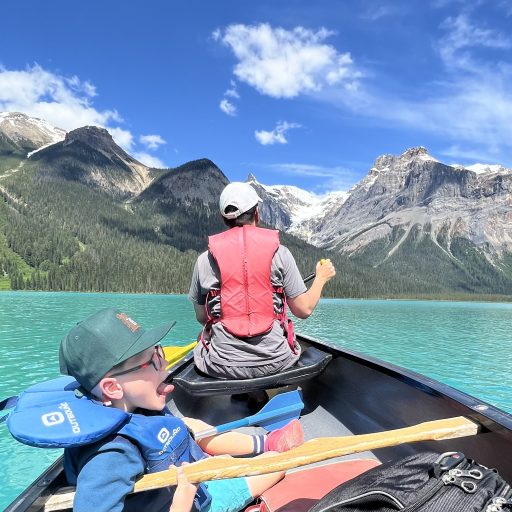
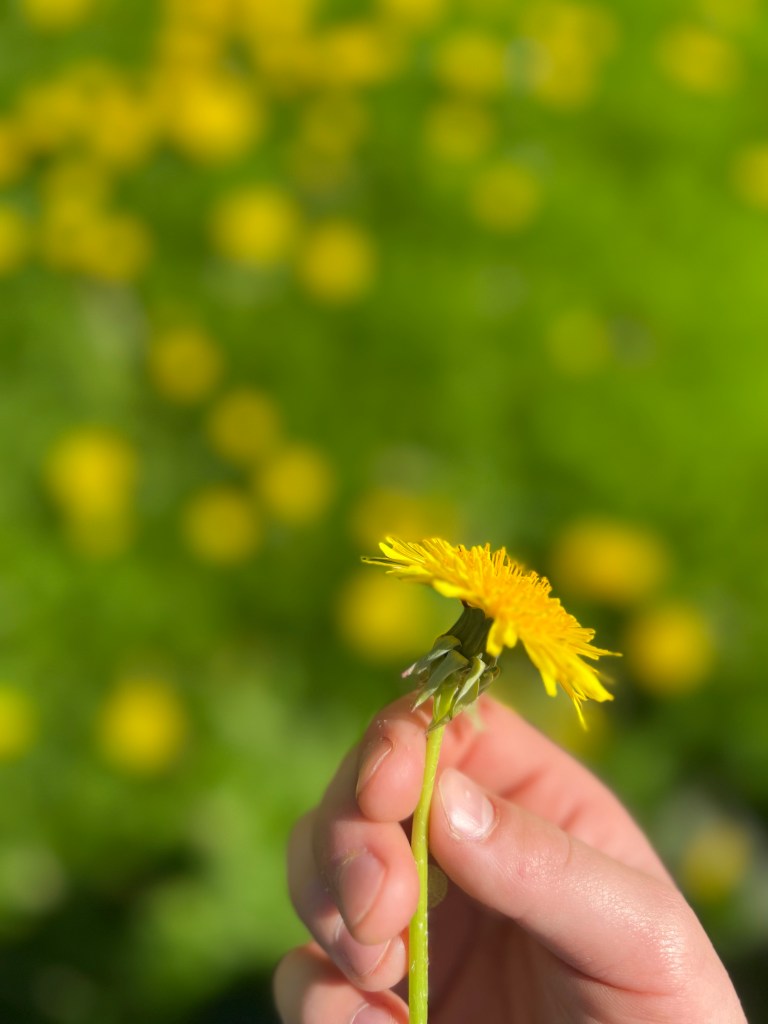
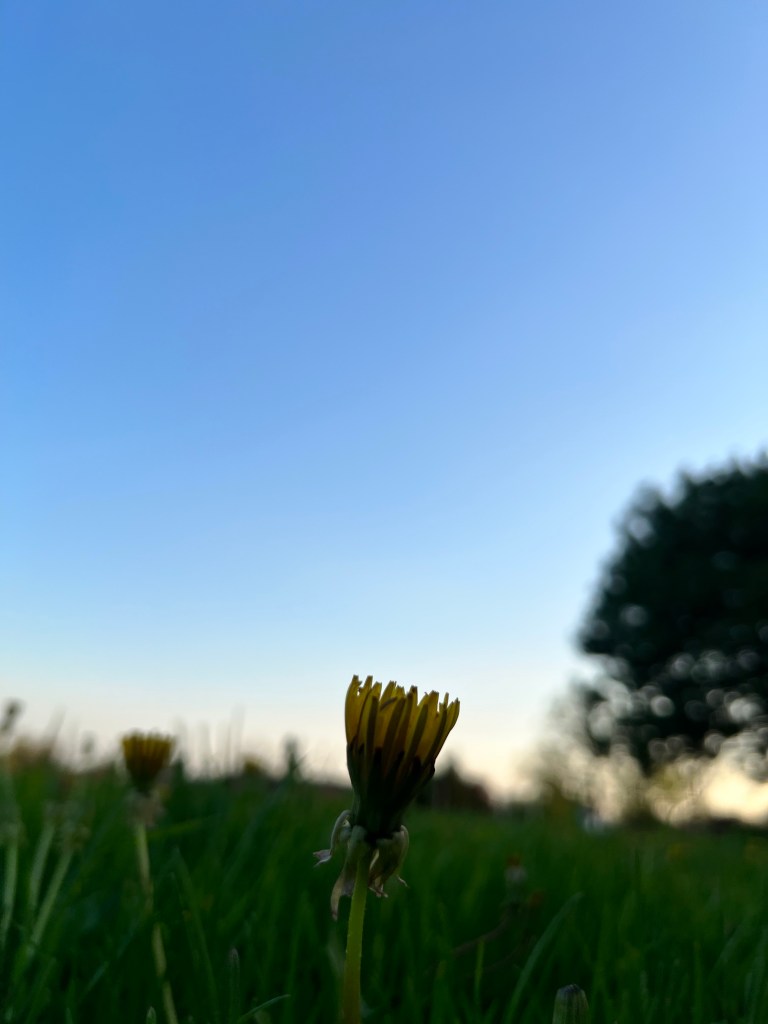
A single weed in a field of yellow can be magical.
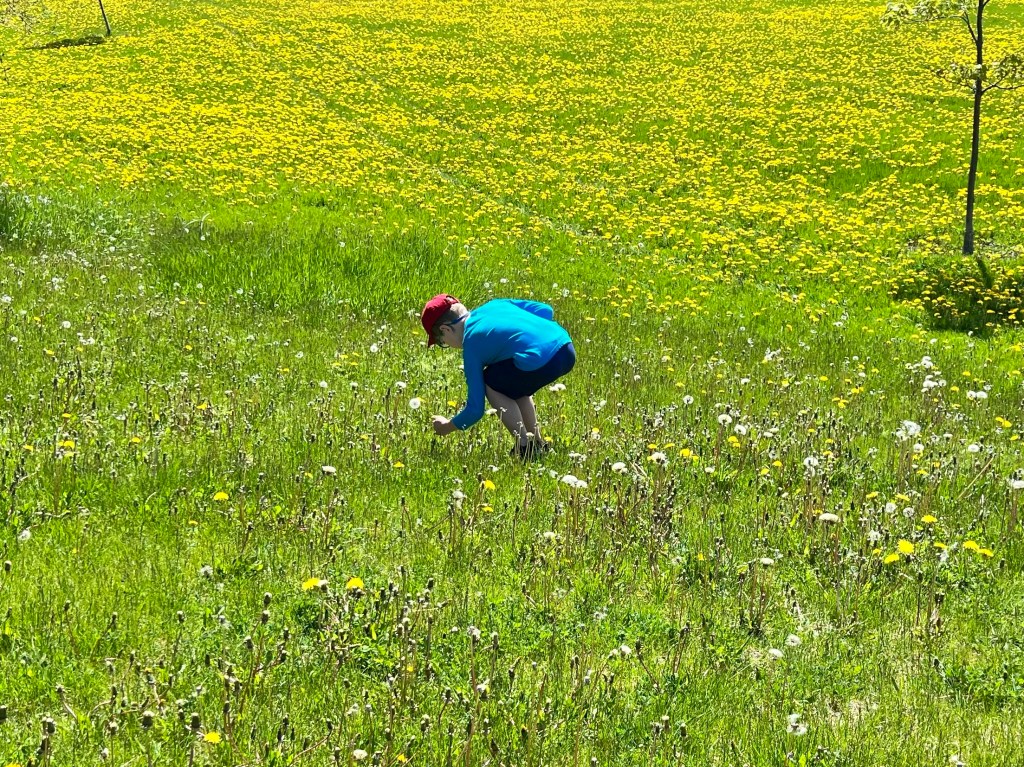
It’s that time in Spring when dandelions create a magical golden carpet on park fields.
T and I enjoyed a nice walk on Mothers Day. The sun was shining and it was warm enough for T-shirts, shorts and crocs.
“Oh my God, stop taking stupid pictures,” T screamed, because he wanted to play with me.
Seeing the futility in his whining, he asked if he could borrow my phone. Then he snapped this delightful photo.
Then he yanked up more dandelions.
Like many others, I enjoy looking at NASA photos of fascinating outer space places like Mars.
But I also think living on Mars would lose its novelty quickly.
I bet Martians would find dandelion fields enchanting – and if they end up being hostile, allergies will kill them off.
It really is about perspective – and one thing that helps ground me is gratitude.
I often start my day with prayer and give thanks for things I’m grateful for. This often clears the fog in my head, redirects stress and gives a boost of energy to step into my day.
To be clear, it’s not about ignoring challenges or pretending things are all ok.
It’s about choosing a mindset on how to deal with the good, bad and everything in between.
When raising a neurodiverse child, it’s an invitation to take a deep breath.
To reframe a challenge as an opportunity to grow.
To try differently not harder.
To see the blessings when it’s easier to focus on the disability.
To find laughter in the absurdity.
And I’d like to share a few things from the past week that I feel grateful for:
For T’s CYW, who is a Godsend. Thanks to her, T is growing academically and socially – and finding the confidence to participate more in class.
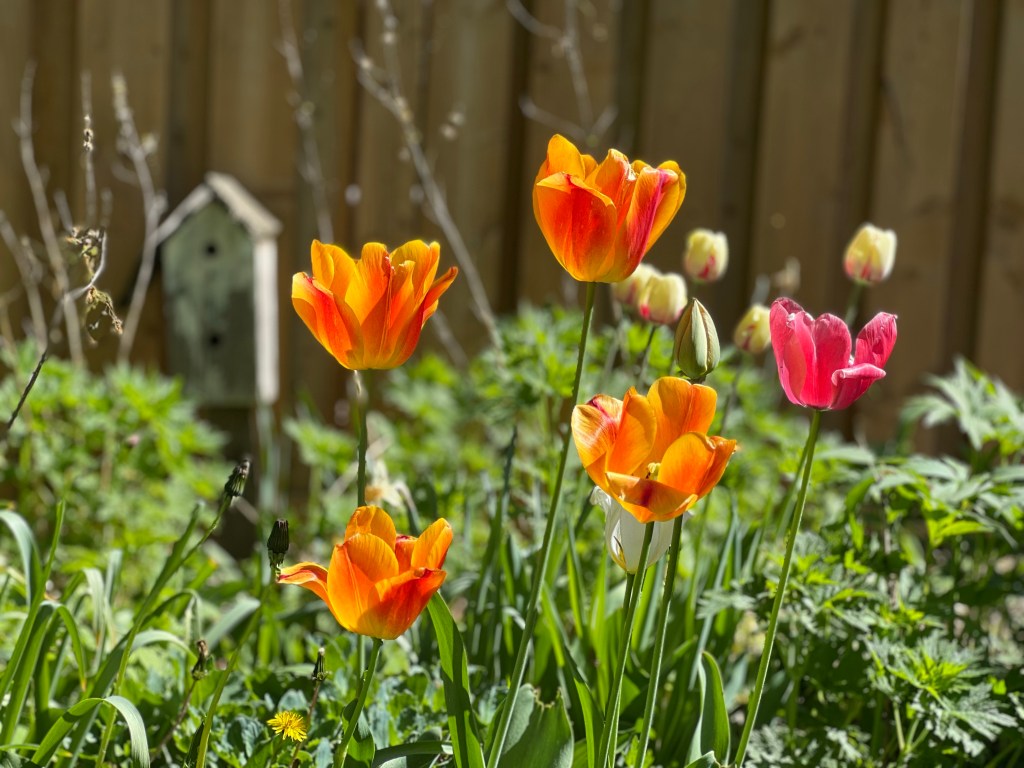
For the bright colours blooming in our garden.
For the announcement of new Kylie Minogue music on its way. Already in love with the look and sound of her upcoming era.
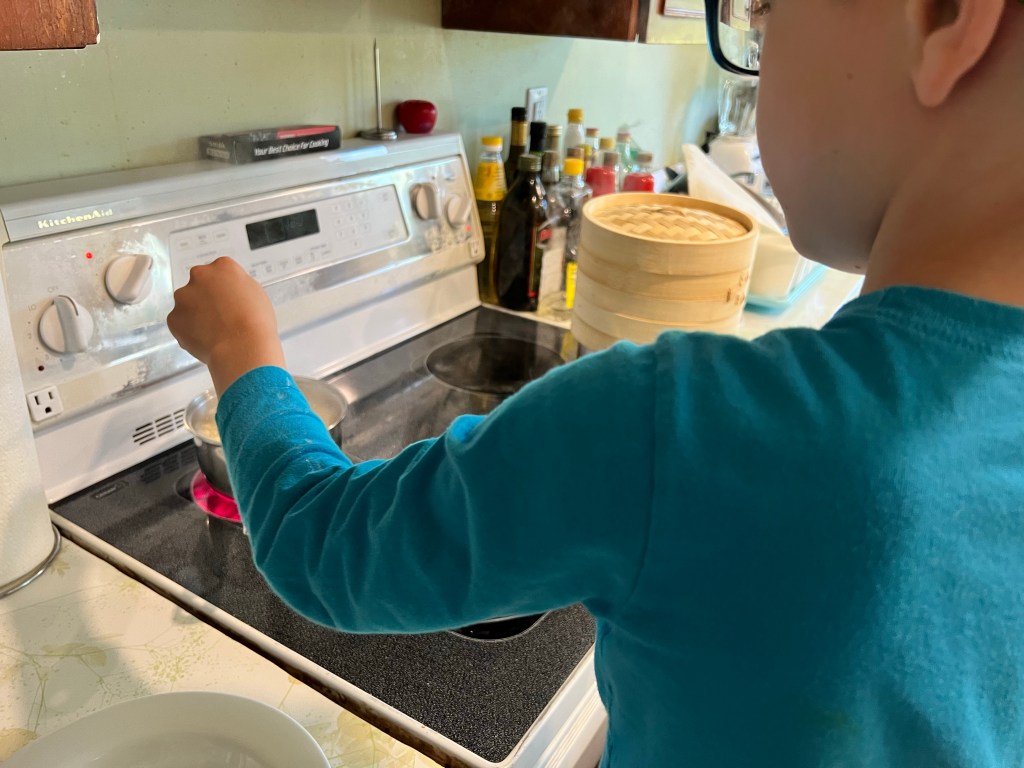
For moments when T wants to learn a new skill and help make his lunch.
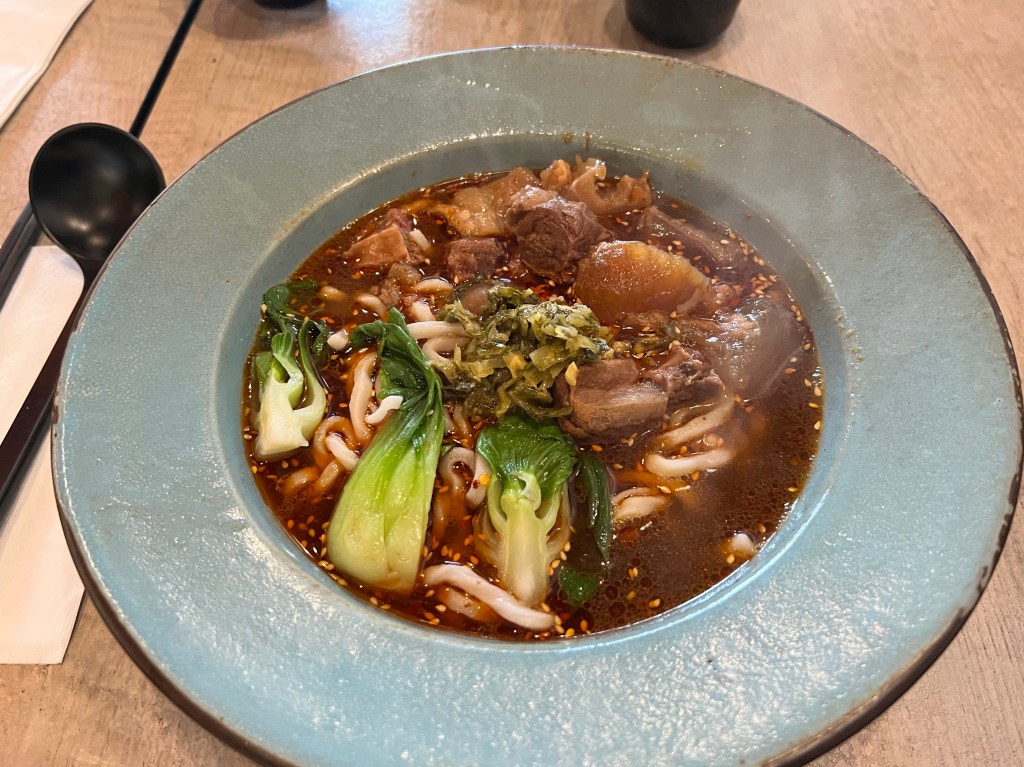
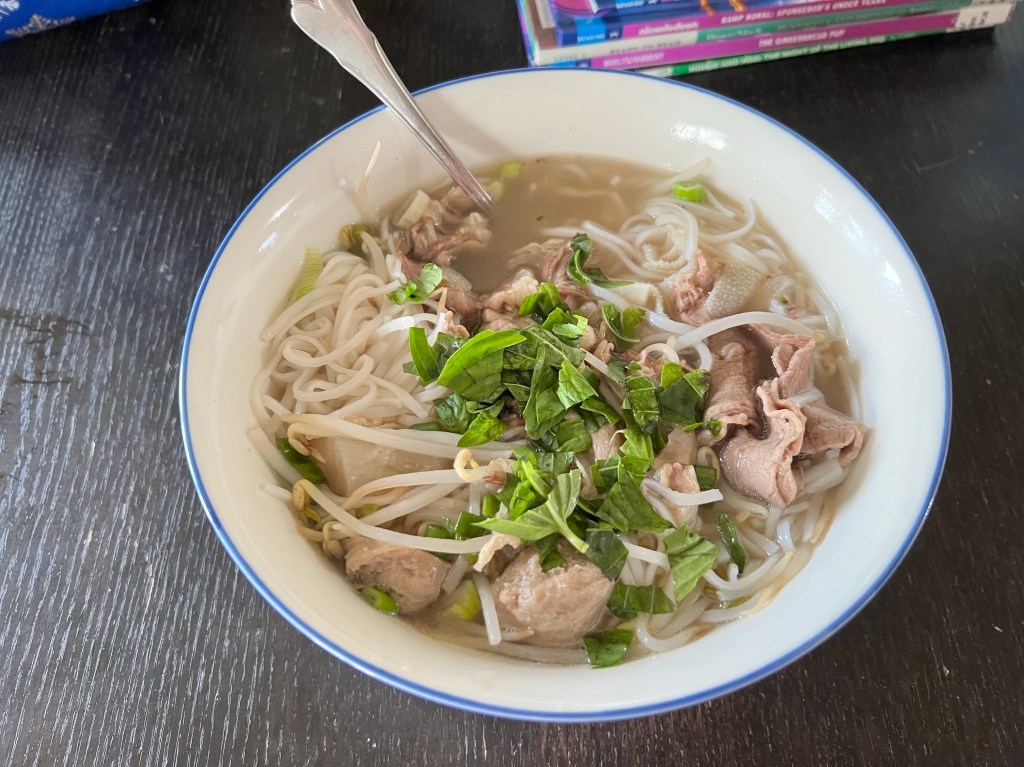
For this delicious bowl of spicy beef and tendon noodle soup that I enjoyed at a Taiwanese restaurant, where we took Ma and my aunt for dinner to celebrate Mothers’ Day.
I am thankful for the moments – it’s often the small moments – that remind me that when you view ordinary things from a different lens, a single weed can be the golden spark that lights up the dark.
Dinosaurs go extinct when they lose touch with their inner child.
Raising T, a child with endless energy and a disability called FASD, can feel like I’m aging in double time – but it keeps me young.
Even when I’m exhausted by T, I am amused by his imagination, as he turns our home into his creative playground – one day a fort, another day a race track or a McDonald’s drive thru.
Playing with T energizes my mind and brings a different perspective to other areas of my life, be it personal or work.
I recently reflected about the importance of not losing touch with our inner child – and how we can keep that spirit alive.
In my early 40s, I still love my comics, childhood shows, horror movies, and video games.
I’ve tried with limited success to pass onto T my childhood interests – such as the Power Rangers. Despite the dinosaur themes, T has shown no interest so far. 😆
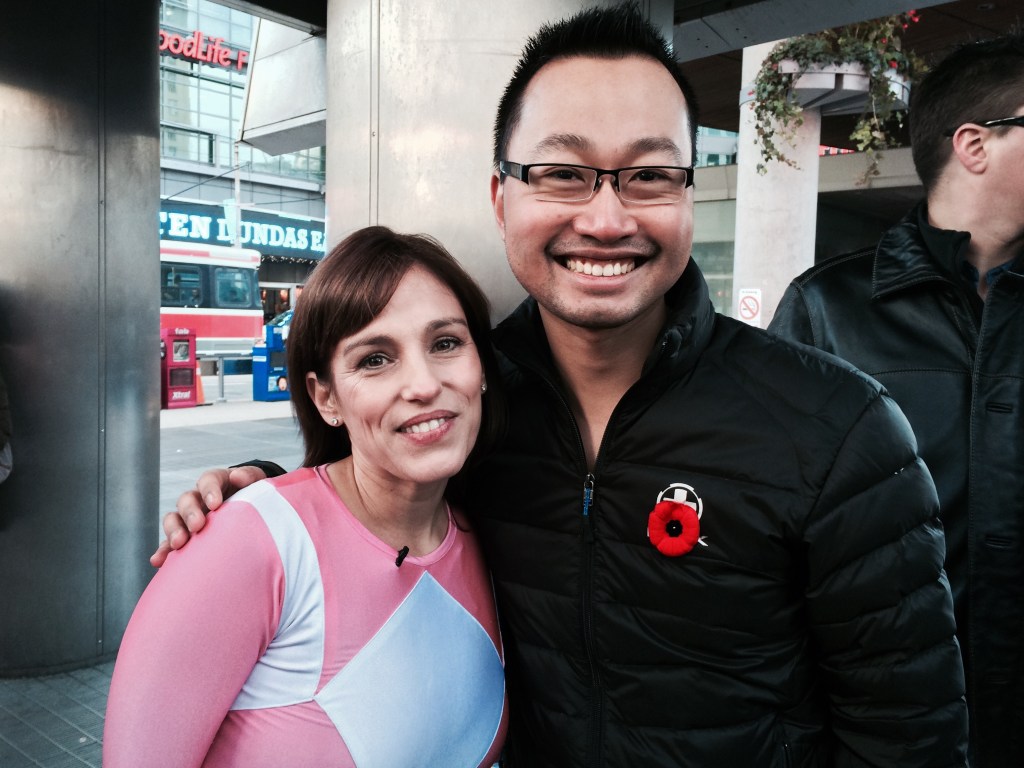
Meeting Amy Jo Johnson, the original Pink Power Ranger, in 2014. She also lives in Toronto and after losing a bet with a costar, she showed up in costume at Dundas Square to play her guitar.
It’s about staying curious about what’s current and being open to trying things out.
It’s about doing our best to not let hardships chip away at our childlike optimism – while staying grounded and pragmatic.
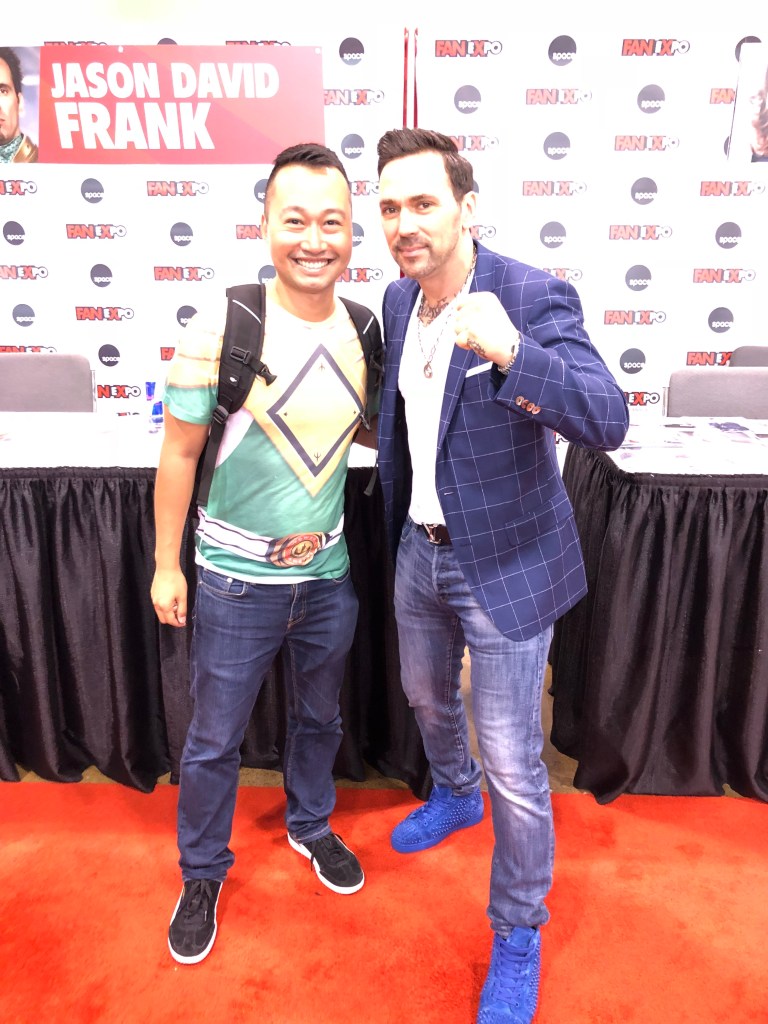
Meeting the late Jason David Frank, who played the popular Green Power Ranger, Tommy, at Fan Expo in 2018. I can’t wait to take T to his first fan convention event. He will surely love it.
Two weekends ago, the hubby and I introduced T to the original Jurassic Park movie, which came out 30 years ago.
I remember watching it around T’s age and finding it scary – so this would be T’s first horror movie.
He loved it! Although we watched it over two days, after he stopped it during the intense T-Rex scene and chastised us, “Did you want to give me nightmares!?” 😆
After he finished the movie, we played Everest, this time we were taking a drive through Jurassic Park and were being attacked by the T-Rex.
Did you want to guess who roleplayed as the loud and destructive T-Rex?
At the Royal Ontario Museum last summer.
Being T’s parent teaches me so much about resiliency, especially when things feel hard, exhausting or overwhelming.
One of T’s strengths is his ability to bounce back from things – every day is a new day.
Whether that’s because he’s a child or because of his disability, it’s a good lesson for me to stay the course and keep the faith.
This past Friday, we received a lovely email from his teacher. Each student created a video related to a reading and writing assignment about dinosaurs.
This was T’s work. He did awesome! Hearing his sweet voice reading, and the growth in his skills, was a wonderful way to start the weekend!
One of the hardest lessons in life is learning to say goodbye to good friends.
Two weeks ago, a bomb dropped in the middle of T’s day when he learned that his best friend – his one good friend at school – was moving and that his last day would be in two days that Friday.
His CYW texted us the heads up in the middle of our work day when she learned the news and we strategized on how tell T.
He ended up being told by his CYW and principal. My one request was to make it clear that his friend moving was not a result of anything T did.
The suddenness of the news shocked T and we felt his immediate despair. He cried himself to sleep leading up to the Friday.
As a parent, you absorb every high and low your child goes through – you experience their emotions like osmosis – and this was heartbreaking.
T is still processing the recent death of his Aunt and to layer this on top felt cruel.
There was nothing we could do other than to be there with him, listen and validate, and allow him to feel all his feels.
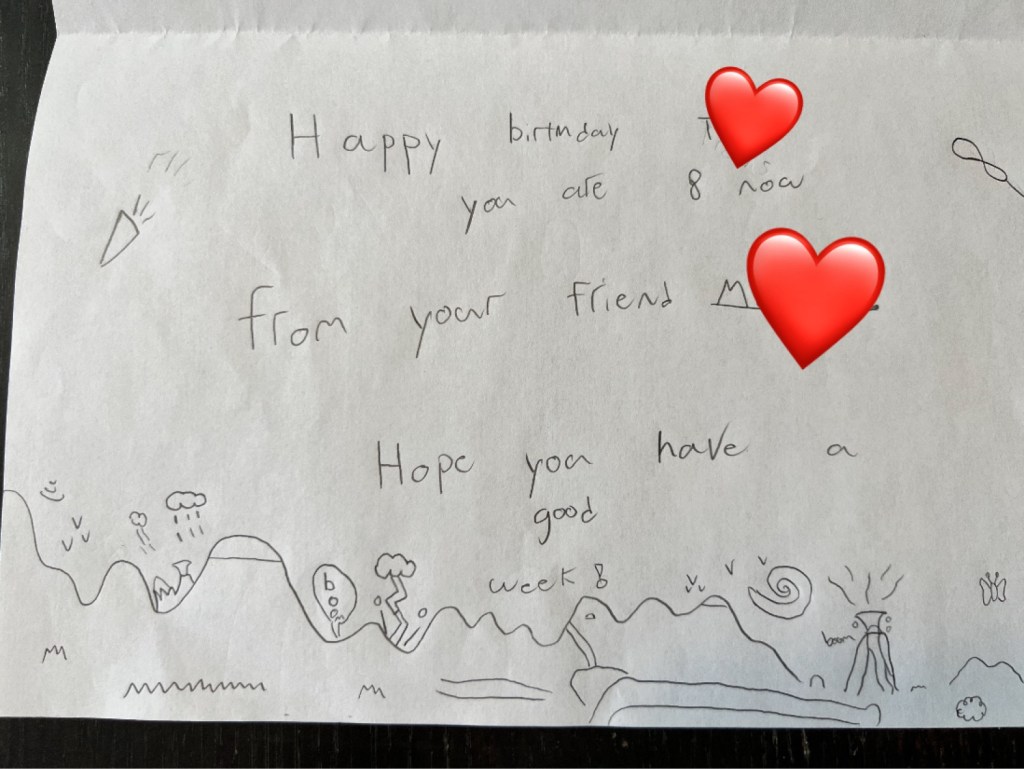
The hubby had the great idea to encourage T to draw a goodbye card for his friend, which he did with great enthusiasm the morning before.
The CYW also worked with the friend’s teacher to ensure they got to spend extra time together leading up to and on the last day.
On the big day, we all learned his friend would be staying for another week – 5 extra days – as his mother wanted him to end the month in one school and start fresh in May.
This helped soften the sudden blow and while we knew it was only delaying the inevitable, it gave T the gift of extra time to process this loss.
It is surreal to watch a child process loss; they rarely tell you but rather show you how they feel.
There were and are very challenging moments – irritability, anger, name calling, screaming – leading up to and after the eventual last day.
It is very hard not to take any of it personally – especially when I get the brunt of it rather than the hubby – but I remind myself this is not about me.
Easier said than done – trust me. There are moments when I lose my patience with T’s rudeness.
On the last day, last Friday, we were blessed with an activity the school had already planned – a visit by the community police.
This provided T with a much-needed distraction and he enjoyed petting the police dog and sitting in the driver’s seat of his car.
His CYW told us T was all over the place that day and understandably so – and he was in quite the foul mood at daycare after school.
That afternoon, T got to skip a period of class to attend his friend’s goodbye party.
His CYW sent us a photo she took of T and his friend sharing a goodbye hug.
I will not share this photo, as it truly felt like a sacred special moment – but the look of sadness and love on T’s face, his eyes closed and hands wrapped tightly around his friend, is equally heartbreaking and heart filling.
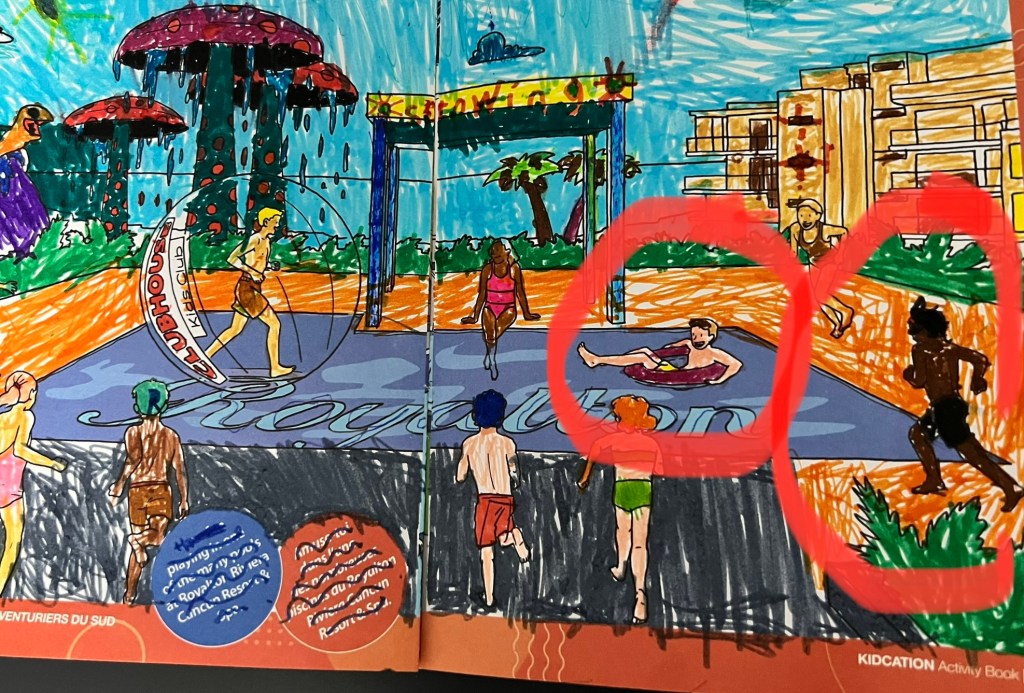
A few weeks ago, T coloured this page from an activity book he got from our recent trip to Mexico. I circled (digitally) in red the two boys that T decided would be him and his friend playing by the pool.
This experience with T made me reflect on the revolving doors of life – and it made me think about two polar opposite and extreme reactions.
On one end, we can hang on and try not to let go of loved ones and on the other, we can close ourselves off from others so we protect ourselves from experiencing eventual loss and pain.
As with everything in life, the truth really lies in the gradient in between.
The one constant thing in life is change. We say hello and goodbye to family, friends, colleagues, pets, homes.
We do our best to stay in touch but also recognize that some goodbyes are final.
So all we can do is to live in the moment, treasure each other while we can, and have the memories when a chapter in our lives close.
This is a hard message for an 8-year-old boy – one that struggles with abstract concepts and emotional regulation – to understand right now.
So this story continues.
The past weekend was gray and rain filled. T said the skies were crying because of his friend.
This kid certainly has my flair for the dramatics.
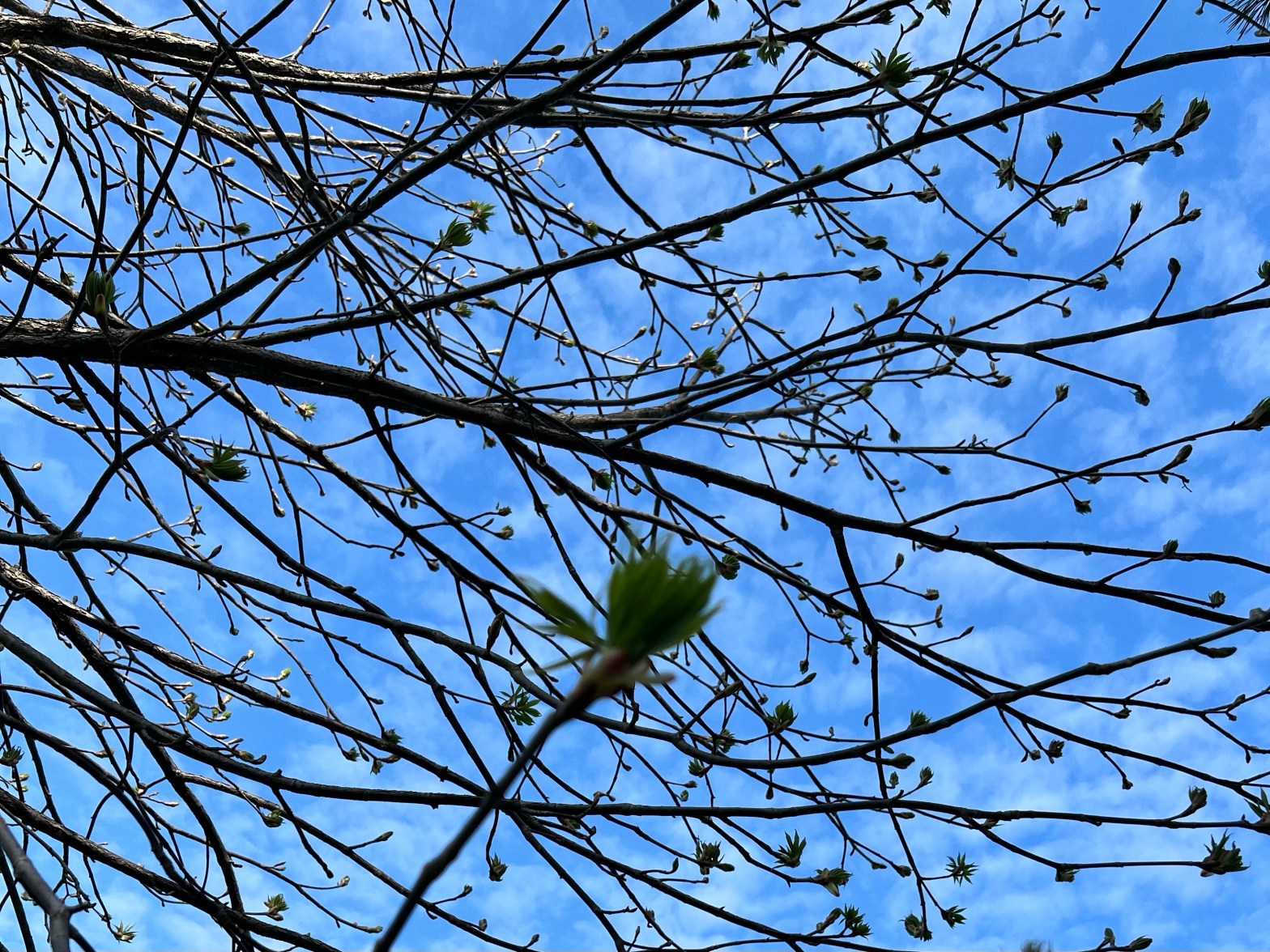
But Spring is in the air. The tulips are sprouting in our garden and our cherry tree (pictured at top) is in bloom. I’m going to enjoy them for the week or so days we get them every year.
Nature provides a wonderful mirror to reflect on our daily walks in life.
By recently plugging away from screentime, we’re finding more ways to connect as a family.
It all started a few weeks ago when T, in a disregulated fit, hurled his first F-bomb at the hubby.
We grounded him from his tablet for a week; which got extended into two.
I remember telling the hubby what the heck he got us into, because giving T his tablet was a way for us to get time to ourselves. Grounding him was also punishing us! 😆
So yes, it was a hard initial few days but we were pleasantly surprised by how good it’s been for all of us since we reduced T’s screentime.
He was calmer, less irritable, and he filled the time with play. And yes, it was more taxing on us, but the extra time together was wonderful.
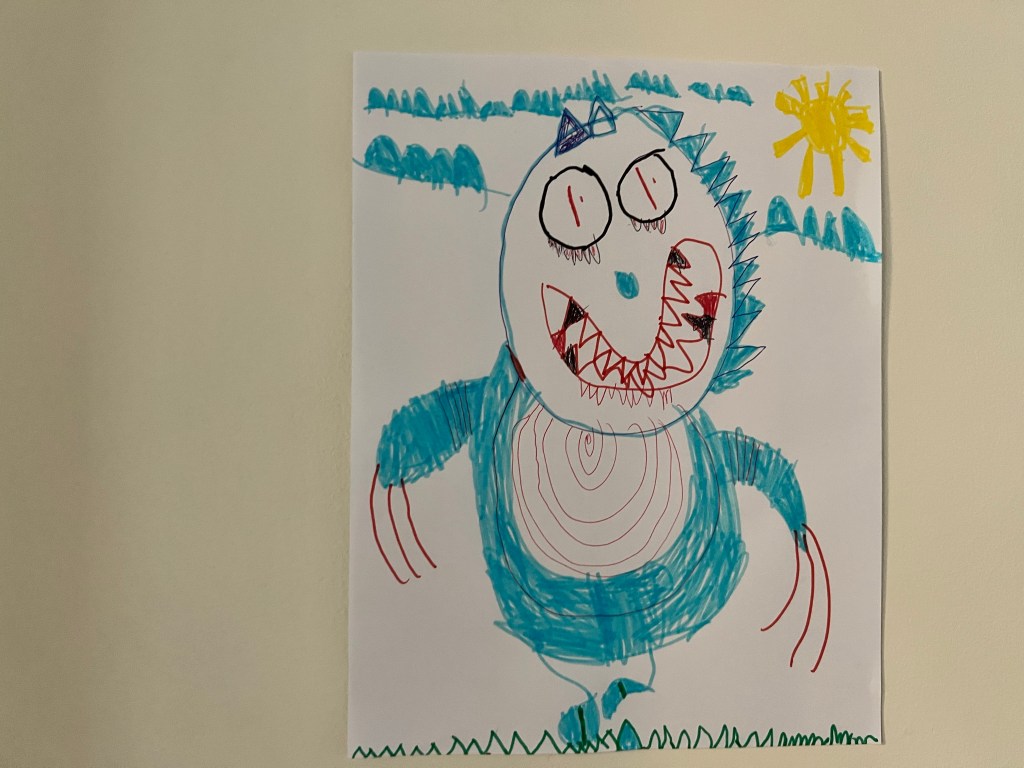
The biggest surprise was T really took on drawing as a hobby, spending lots of time working quietly on his sketches.
I love watching him get creative – and he’s shown so much improvement in his drawing; fine motor skills is something the school and the Occupational Therapist assigned to work with him had been practicing with him.
So we dedicated a wall in our living and dining room as T’s gallery space. I love watching it slowly fill up – and so does T.
Maybe it’s a placebo effect or the novelty of drawing – but I like the correlated effect of reduced screen time on T.
So as T’s punishment period neared its end, the hubby and I decided that we’d use the return of T’s tablet as an opportunity to set new ground rules:
No tablet during school days
No tablet during meals
Only 1 hour of tablet each in the morning and in the afternoon; no tablet in the evening
Immediate timeout from the tablet for using inappropriate language
T whined about it at first, but we explained that we were making these changes, because T has shown such positive changes and that we would use the freed up time for other fun activities, such as more outdoor play and drawing.
He’s been receptive to the changes so far.
And we’re glad – because frankly, we could all unplug from the rhythm of screens, doom scrolling, social media, virtual worlds more and connect more with those in front of us and nature.
Last December, as a Christmas gift to myself, I finally deleted my Twitter after 14 years.
I’ve had enough of the doom scrolling, incivility and toxicity that has infected social media.
I only keep my Facebook to stay connected with family and friends – and don’t have other accounts.
And I don’t miss it one bit.
I often wonder about the digital world that T will grow up in – the innovations and transformations to the way we communicate and connect.
I hope that T will thrive in it safely and successfully; that it’d be just one aspect of his life, rather than something he’s consumed by.
The teen years will be interesting for sure.
All we can do is focus on the here and now and help develop good digital habits and nourish his days with moments unchained from the rhythm.
When the hubby and my parents first met each other 20 years ago, it started quite comically.
A few seconds into meeting, Ma started talking about the time she and her siblings drove by New Brunswick, where my in laws live, and didn’t think much of it because she didn’t see any flowers.
It was not meant in a bad way, just her usual Asian frankness. Over the years, my father in law would egg her on by sending photos of flowers to share with Ma. 😆
All jokes aside, we’ve been blessed to have loving parents who get along.
Whenever my in laws visited, we would get together with my parents – taking them to Chinese restaurants to try something different.
I remember when a dimsum server was wheeling beef balls around, my mother in law muttered, “That’s not what I think it is, is it?” 😆
Eight years ago, before T joined our family, Ma joined the hubby and I for our summer roadtrip to visit my in-laws at their cottage in New Brunswick.
The hubby’s parents took Ma and us on a boat ride to fish for mackerel. We all had fun!
I’m glad the hubby got to know my Pa before he passed away.
I chuckle thinking about the first time the hubby slept over, when I still lived with my parents. Pa opened the door and the first thing he said was the hubby was sleeping in my sister’s room. 😂
But the hubby won him over by always coming over with a lottery ticket for him. That charmer!
I often wish Pa lived long enough to meet T – the two of them would’ve adored each other, in the same way our remaining parents adore T and he adores them.
His Ama, Grammy and Grandad didn’t first grasp his disability, but they’ve all been open to learn and most importantly, they love T unconditionally despite his challenging moments.
On Tuesday, T walked in the house after school and asked, “Why does it smell different?”
I replied, “Because it’s clean.” 🤣
The hubby’s parents were arriving that night to stay for a few days – en route to home after snowbirding in the States.
We spent the weekend cleaning the house top to bottom. Even T helped – because he was excited to see his Grammy and Grandad, his first time since last summer.
It was therapeutic cleaning our guest room, as it was the first time someone was staying in there after my sister lived with us last fall.
As a special needs and working parent, housework becomes lower priority despite our best efforts.
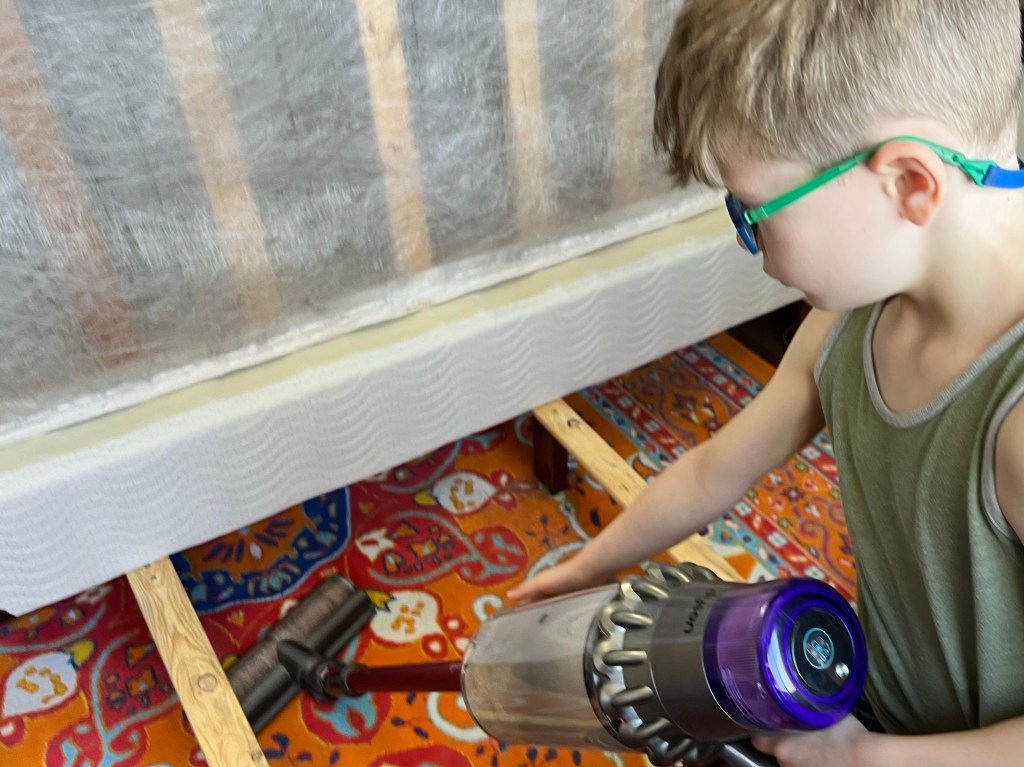
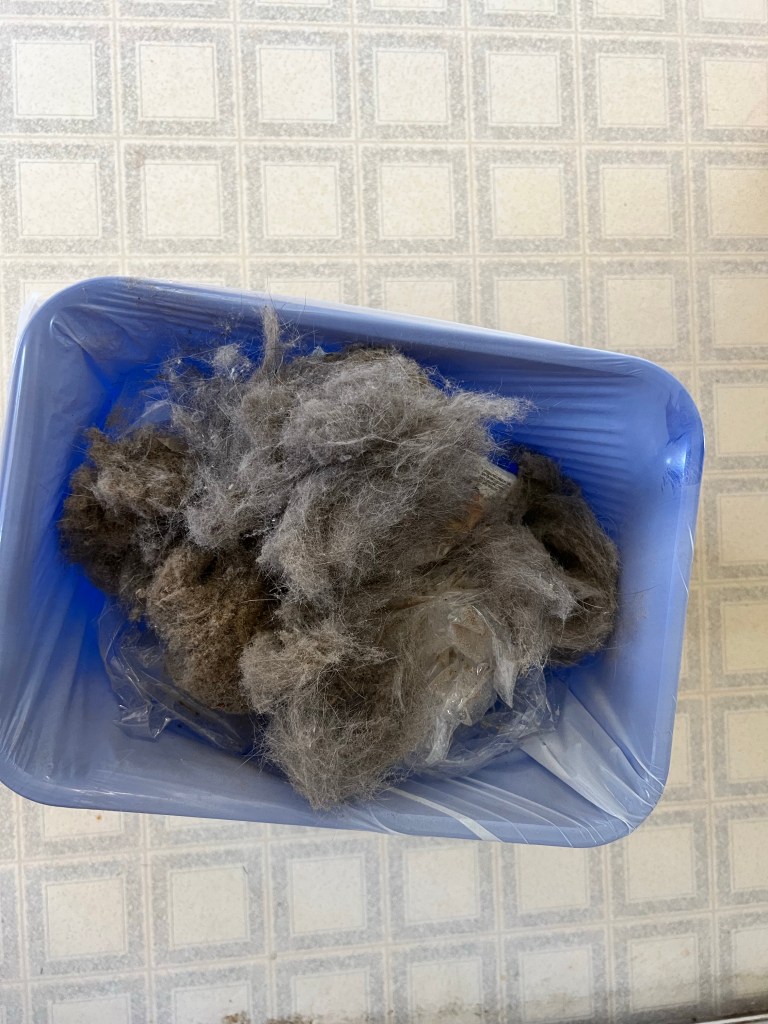
We could’ve made a new cat with the fur and dust we vacuumed up from our guest room!
Early Tuesday night, T ran screaming excitedly in our bedroom, “They’re here, they’re here!”
T ran to the door to give them a big welcome hug.
It was nice to have them stay with us. The hubby was able to take the rest of the week off work but I was not, as I had just taken March Break off. But it was nice to give them alone time together.
T enjoyed playing with his grandparents at night and it was very helpful to have their help with making dinner for us while they were here.
We took T out of his after school program on Friday so he could spend more time with his grandparents.
We took them to Dragon Legend for dinner, so they could try out a unique buffet experience. Ma was supposed to join but felt under the weather.
After dinner, we went for a sunset walk around the neighbourhood.
The following Saturday morning, we all got up very early to wish T’s grandparents off as they left early for their long drive home.
T waved enthusiastically from our front steps as the car drove off, screaming “I love you!” at the top of his lungs.
Pretending to be a Siberian husky to my 8-year-old is something I never thought I’d treasure.
Any parent to a young child will likely be familiar with Paw Patrol, a cartoon about six dogs saving the day at Adventure Bay.
T has outgrown this show, but one character has stuck with him: Everest, a Siberian husky that first appeared in Season 2.
A day often doesn’t go by without him asking me, “Papa, let’s play Everest.”
Playing Everest is T’s code for “let’s hang out.”
It often involves pretend play, stuffed pets and building a fort. Frequently, he incorporates things he’s thinking about – like his Aunt’s recent death – into the play.
It could also be simply just us sitting next to each other and talking.
It amuses me to think of T imagining me being a husky. He often corrects me when I break character and says I’m a dog, not a human.
Playing Everest could take place indoors or outdoors at the park or playground.
We live in an old 1960s home and since moving in four years ago, we’re slowly saving up to renovate.
In the meantime, our unfurnished living room is an empty canvas for T to bring to life with his infectious creativity and endless imagination.
I once read that kids don’t ask you to talk about things; instead, they ask you to play with them. And this has always stuck with me.
I know T’s days are filled with ups and downs at school, on the bus and at daycare – and it is often painful for me think of about this.
So I try my best to make time to be Everest, even when I myself feel drained and need time to myself.
I treasure these moments, because I know childhood flies by and it won’t always be like this.
I especially value these moments, because these are the moments in each day when T is at his purest, kindest and joyful best.
It balances the moments when he can be moody or disregulated.
At a recent team building exercise at work, my colleague led a session about the importance of reflecting on the things that bring us joy.
Each person was asked to talk about one thing that brings them joy.
I chose being Everest and when I spoke about for the brief minute I had, I felt joy and gratitude.
As the Paw Patrol would often say, “No job too big, no pup too small…”
I didn’t get my driver’s license until my 30s and after failing the final road test twice.
When I finally got it, it was a good reminder that some things that may seem out of reach at first may not always stay that way.
As a parent of a child with FASD, I often think and blog about growth mindset.
The program coordinator at SNAP, which the hubby, T and I are participating in this Spring, shared a great picture book called “The Magical Yet” that speaks about growth mindset.
It reminds me to focus on effort not perfection, on the long term not a moment in time, and on growing not being static.
Just because you can’t do it yet, doesn’t mean you can’t one day.
I’m also a pragmatist. For me, it’s important to temper this message with the reality that there are many things that each of us will simply not able to be good at – neurodiverse or not – and that’s ok.
We tell T the most important thing to do is to have an open mind, give everything a good try, and have fun.
For me, cooking was something I was never good at growing up but I now enjoy as a hobby and therapy – and it’s been fun to grow my skills in this area.
Mapo tofu is one my fave dishes to make. Seemed hard before but hooray for online videos.
For T, participation in school is often a challenge.
Thanks to support from his CYW, and solid effort from T himself, he’s made positive gains this year.
In his daily communications book, we now often see updates about him raising his hand.
Last Thursday, our long weekend got off to a great start when his CYW texted us a heartwarming video of him in dance class.
She said that dance may be in his future and based on how awesome he was, she may be on to something!
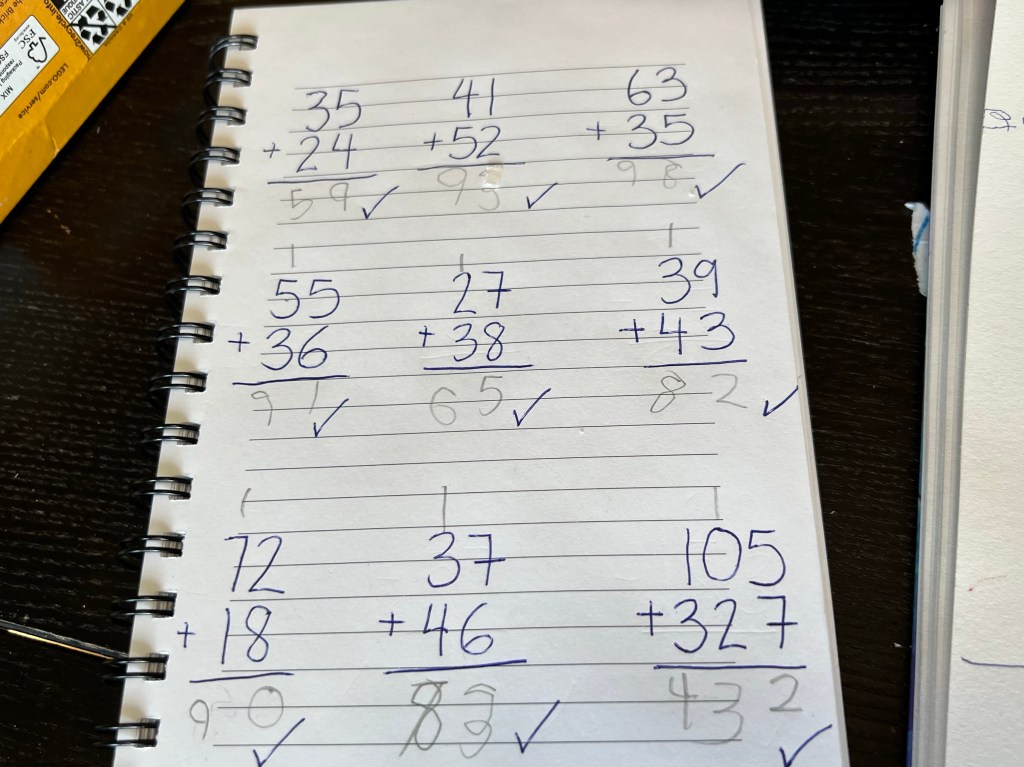
I feel proud about the gains he’s making with reading, printing, and math.
Two and even three digit addition, with carrying, seemed daunting to try with him a year ago.
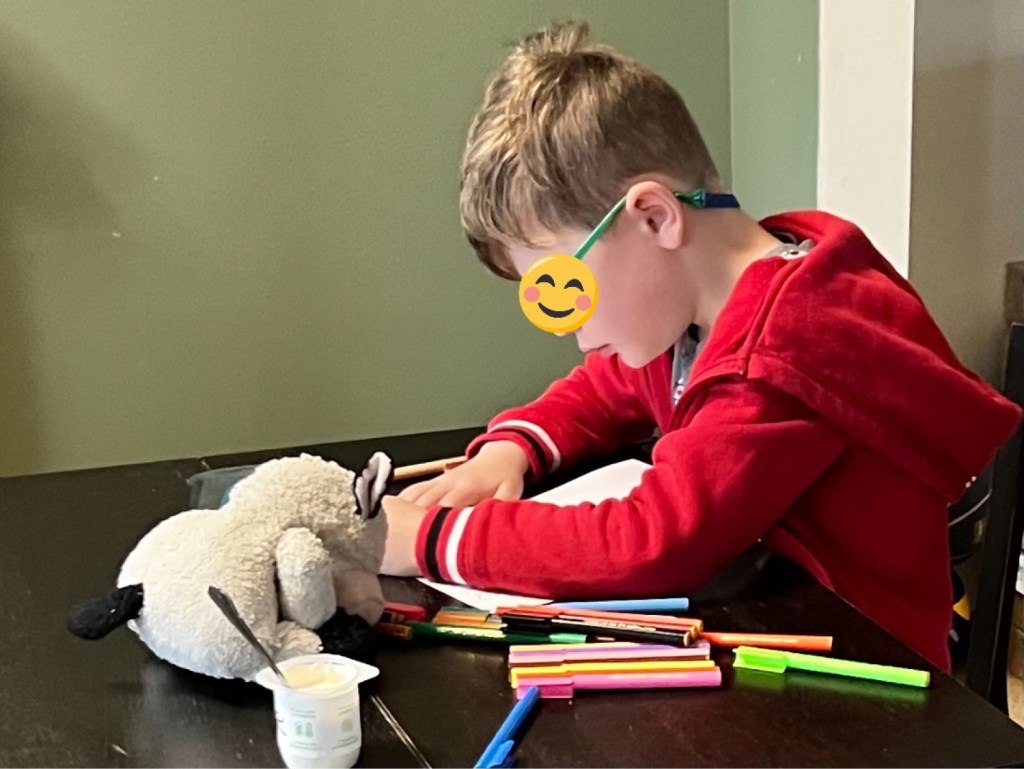
T has also shown more interest in drawing – and I love how he sits quietly by the dining table with his sketchpad while I make dinner.
Reminds me of how I entertained myself as a kid on Friday evenings while Pa worked.
Ocean Spray did not pay for this post. I was just trying to take a discrete photo. 😆
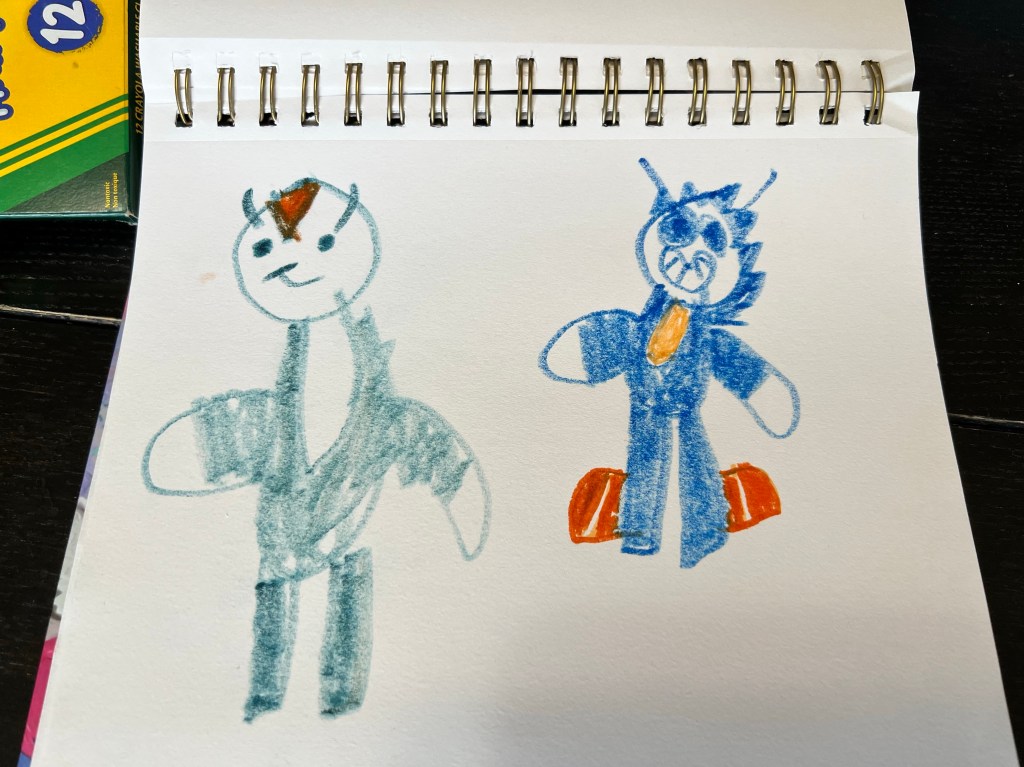
I love seeing the greater detail in his art and more importantly, him having fun with it.
Characters from Sonic the Hedgehog
When we have our challenging moments with T, I remind myself about his many gains and to focus on the magical yet.
I’ve always been mindful of my diet and exercise, and this year, the hubby’s come onboard the health train too.
The good news, as we’re finding, is it takes just a few tweaks to start seeing and feeling gains.
A Healthy Start to the Day
I got the hubby to switch to oatmeal with me – cutting out sugary cereal.
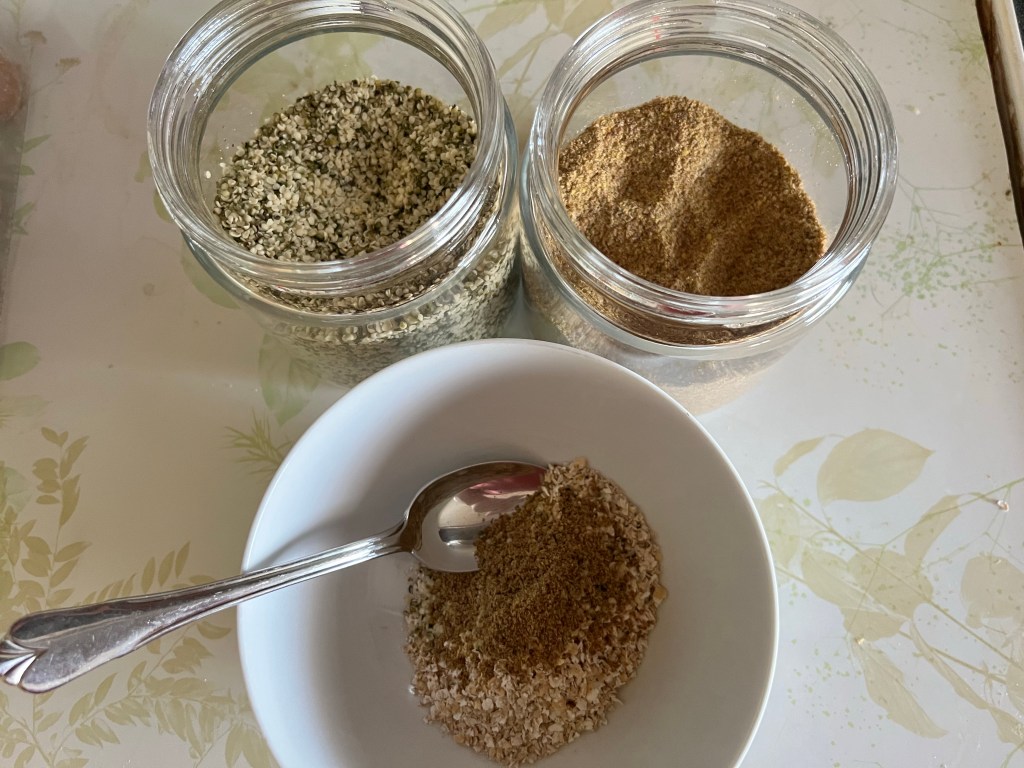
I bought ground flax seed and hemp seed from the bulk store and add a spoonful of joylessness to each breakfast.
We match this high-fiber meal with yogurt and banana – and twice a week, an added treat of smoked salmon.
Cut Back But Not Cut Out Carbs
We love rice and pasta so it’s not realistic to cut them out completely but we do carb less meals every other day.
We’ve been using the Air Fryer, a Christmas gift from my cousin, which helps increase protein-rich meals and reduce time for cleanup.
Make Better Decisions About Food
I do the groceries, so I decide what comes home.
With the hubby’s buy-in, I cut out our one weekly treat (candy or pop for him; chips for me). We also cut out juice and increased milk (I drink sugar free soy milk).
Maximizing Sleep and Outdoor Time
I’m a stickler for 8-9 hours of sleep – and 9-10 for T – and the hubby is making more effort to sleep more than his usual 6-7 hours.
Getting fresh air is important. We enjoyed a nice Spring walk with my family at Port Credit on Easter Sunday (above).
Exercise, Exercise, Exercise
I struggled a lot in the fall, because I could not find time or energy to go to the gym, as my late sister, through no fault of her own, kept me up at night as she struggled with declining health.
I try to alternate between cardio and weights every other day – with one rest day a week – as a healthy heart and body are important, especially now that I’m in my 40s.
Exercising regularly is one area I’m still trying to get the hubby to commit to, but he’ll get there!
Easter is about egg hunts and bunny fun – it is also about renewal and resilience.
T woke up on Sunday to find a surprise from the Easter Bunny. I love that he still believes in this.
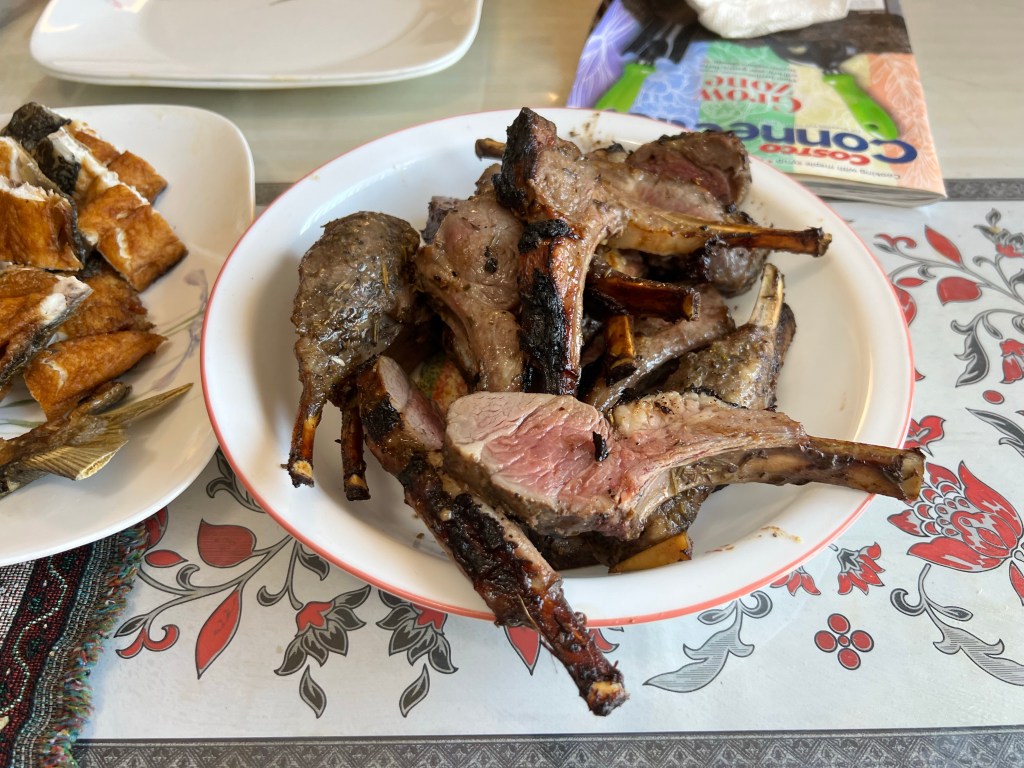
We then had lunch at my Uncle’s home – and my Aunt made grilled lambchops; always a treat!
We then went for a walk at Port Credit lakeshore – and the fresh air and sunshine were soul soothing.
Since we made the few changes to our diet, fitness and sleep routines, the hubby’s reached 35% of his weight loss goal and I feel mostly energized again.
The daily life of a special needs parents can batter you down, so it is especially important for me to take care of my health, as I want to be as available and present for T as possible.
We’ve also used the recent changes as an opportunity to remind T of the importance of making healthy decisions and teamwork.
Life with T often provides humorous reminders about staying grounded and not to take things too seriously.
When I recently praised the hubby after a recent weigh in, I asked T if he was proud of Daddy.
T said, “Not yet, he’s still fat!”
But his warm smile told us otherwise.
After a long winter, the flowers are ready to emerge and bloom under the sun once again.
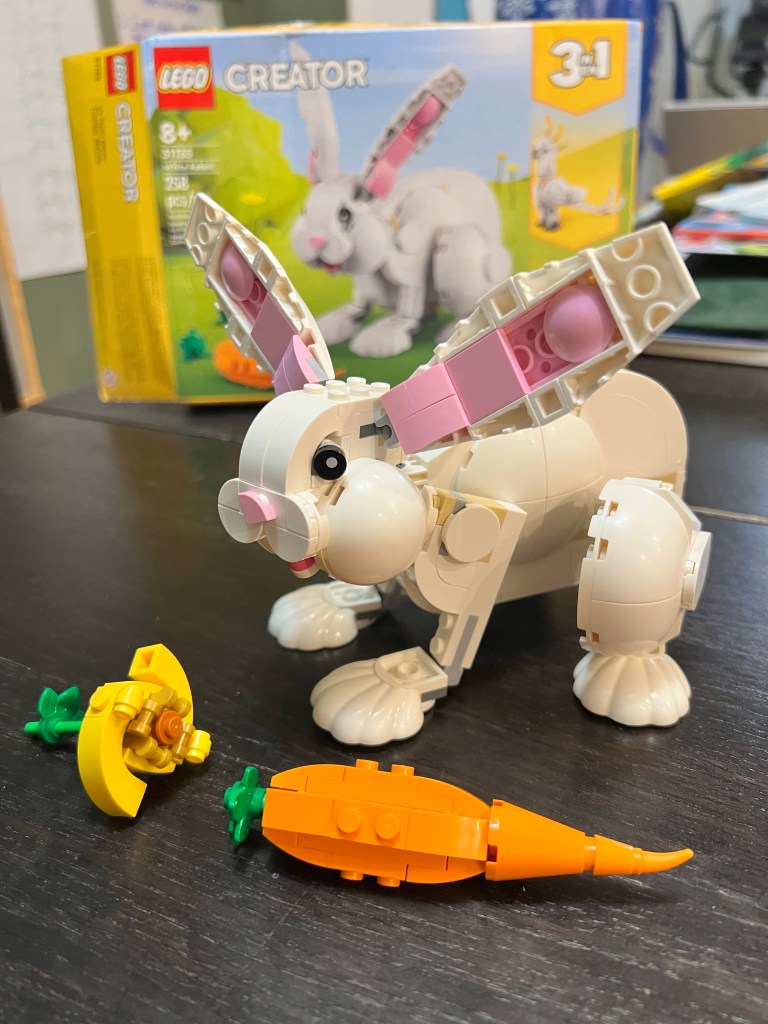
A Lego bunny for Easter that the hubby and I worked on, with some help from T.
The best way to apologize is through changed behaviour.
I reflected on this nugget of wisdom after last week’s session of SNAP.
The hubby, T and I are halfway through the SNAP program and it’s been great so far.
We’re learning behaviour intervention and co-regulation strategies and while it’s never perfect, we’re applying them with noticeable gains.
Last week’s session for the boys’ group was about apologizing – which T struggles with as he sometimes does not correlate his actions with the effect they cause.
As we look ahead to Easter weekend – a time to often reflect on forgiveness – I’d like to share three reflections about the word “sorry.”
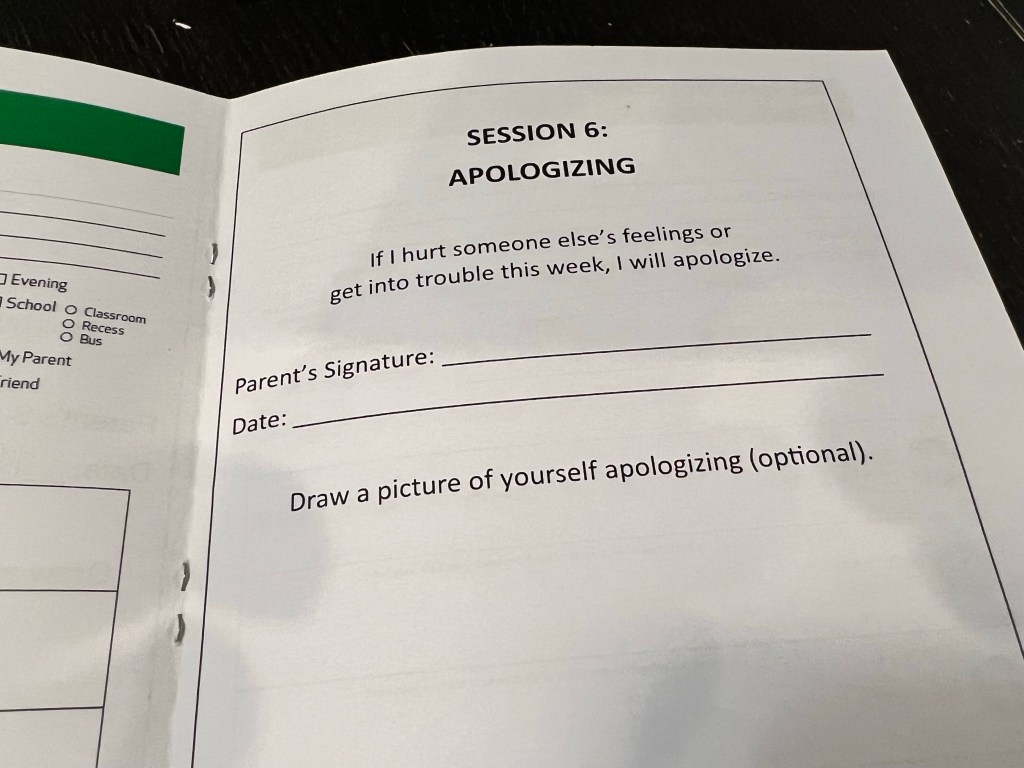
T’s recent “Code Mission” homework from the SNAP program.
I’ve learned that changed behaviour is the best way to say sorry
We work hard to remind T to say sorry when he’s done something to cause hurt to others and that the best way to say sorry is to not do it again.
We keep in mind that learning from mistakes and understanding consequences is often hard for kids with FASD.
T is good at pointing out a perceived fault in others but often doesn’t recognize the same in himself.
It’s as frustrating as it sounds – and there are lots of Groundhog Day-like conversations – but we know it’s his brain. And we’re working on it.
Recently, the hubby and I are struggling with bad language. T started to drop f-bombs at home and daycare.
I’m pretty sure he picked it up from older kids on the school bus and using it as attention seeking behaviour but it needs to be addressed.
After screaming “F-you” to the hubby mid-last week, we grounded him from his tablet for the rest of the week.
And yes, it’s as much of a punishment for us as it is for him too!
Madonna’s “Sorry” from her 2005 album “Confessions on a Dancefloor” ruminates on empty apologies.
I’ve learned to stop saying sorry for my child’s disability.
Last fall, I received a call from T’s teacher who let me know that T had been talking rudely at the rotating support staff that work with him.
I quickly apologized and said I’d talk to him.
But when I reflected on the incident, I came to the conclusion that I didn’t need to apologize – because first of all, I wasn’t the one who talked rudely.
Secondly, when I dissected the situation more, T needs structure and routine and he was being helped by different changing faces, often two different people a day, telling him what to do. Of course, he’d get disregulated.
And I said as much when this was discussed at a School Services Team meeting. We were very grateful for the support but the inconsistent structure is counter-productive for kids like T.
If there is a genuine reason for me to apologize, I will – but I refuse to apologize for things caused by T’s disability, unless the school board apologizes for not being more FASD-aware, for not recognizing FASD as an exceptionality and for not doing more to train their staff about FASD.
What I do instead when issues get raised is I validate their point (e.g. Yes, I understand why this may be concerning) but I ask questions and get them to view the context from the perspective of a child with a disability.
I’m not unreasonable but as one of T’s two biggest advocates, I also recognize that kids with FASD are often guilty until proven innocent, which is so unfair and frustrating.
Thankfully, we have a respectful relationship with T’s principal and teacher. We may not see eye to eye on everything but I think they get where we’re coming from.
And there is a good ending to the incidents last Fall. T now has a regular CYW supporting him in the classroom until the end of this year.
I thank God for her on a regular basis, because she has been so good for T.
The 2023 remix of Madonna’s “Sorry” by Toronto DJ Blondish is a lovely take on the song.
I’ve learned to stop being so hard on myself.
I really struggled with T’s disability in the earlier years, especially when I don’t respond with calm in his stormy moments. The guilt ate at me.
In my prayers, I ask that my loved ones and I can be our best versions and that we can forgive ourselves and each other when we are not.
I’m becoming better at forgiving myself for the many moments I’m not my best self.
This Fatherly article writes that “learning how to forgive yourself for big and small errors is important for personal growth. It also teaches your children crucial lessons: how to be vulnerable, how to accept and move on, and how not to be overly critical. And it helps you lead a better life.”
When we recently grounded T, we were clear that we removed the tablet because of his actions and not because of anything else.
While we anticipated it to be a torturous few days, it proved to be surprisingly positive. T entertained himself with his toys and colored an activity book. It was a joy to see him stretch his imagination.
Last Friday, we had a rare dinner together – whereas we usually get T fed first then eat later – and enjoyed a delightful conversation together, without the tablet usually in front of T’s plate.
The weekend was also wonderful and reminded me that every day is a new day and to let go of yesterday and focus on the here and now.
When we randomly came upon a photo of my late sister last weekend, T started to cry.
It caught me by surprise, because while he’s expressed sadness about her death, this was the first time he’s cried.
It was a reminder that grief is a process and that while so much has happened in the last three months, the wounds are fresh.
I recently learned about the concept of liminal space – which is described as “the place a person is in during a transitional period. It’s a gap, and can be physical (like a doorway), emotional (like a divorce) or metaphorical (like a decision).”
These in-between spaces appeared in different ways in my life in recent years: the transitions to and from remote work during the pandemic, Ma’s stroke and recovery, my sister’s cancer diagnosis and recent death.
This Forbes article provides a wonderful overview of liminal space as well as practical tips on how to best navigate through them.
I encourage you to read it but here are a few tips that stood out to me:
Ask “Why Not?” instead of “What If?”
Learn to meditate
Practice acceptance and being present
Remember positive experiences
Focus on what you can control not what you can’t
As a parent of a child with FASD, you often feel like you’re in constant liminal space.
You’re always learning about and facing different challenges brought on by a complex invisible disability that is often misunderstood and comes with so much stigma.
Practicing self care, remembering to be kind with yourself and each other and having a sense of humour are so important to navigate these spaces – as are advocacy and educating yourself and others about FASD.
In general, transitions are hard for individuals with FASD as a result of impairments related to executive functioning.
Transitions are a work in progress for T and effective strategies include providing advance notice and reminders, breaking tasks down into smaller simple steps, giving him time to process the instructions, and being patient.
Now that I think about it, these also provide a great model for how we should live in the liminal spaces that we find ourselves in.
When I learned late last year that my sister’s cancer was essentially terminal, I decided to reduce my personal and professional load, including stepping off work committees not core to my portfolio.
I explained to colleagues, who were understanding, that 2023 was going to be a transition year (I didn’t know the term liminal space yet!) and I want to create space to transition through these changes.
The recent experience with T crying over the photo was a great reminder about who T is at his core – a child who is genuinely kind and full of love – and that he too is going through liminal spaces.
When we allow ourselves to journey through the in-between spaces, we also open ourselves up to the surprises tucked within.
Peeking through the fence during a visit to Riverdale Farm at age 2. Time flies!
I celebrated another lap around the sun the same week an iconic soap opera celebrated its 50th.
More so than ever, I’m most thankful for my family, friends, health, and the opportunities to do things and be with those I love.
While I am lowkey about my birthday, I appreciate when people remember to send a greeting and to those who bring smiles to our days, like my thoughtful teammates who decorated my office!
And to the hubby who gave me my annual night off parenting – with pho for dinner too!
I used the time off to enjoy the latest episode of the excellent Star Trek: Picard.
And yes, T did write, “Happy birthday Ab” on his handmade card.
In fairness, I signed his recent birthday card as, “Love, Ab” – cuz parenting brain does that!
It’s very fitting The Young and the Restless celebrated its 50th anniversary the same day as my birthday because this iconic daytime drama has been a huge part of my life – 32 years to be exact.
I first stumbled upon the show in Grade 4 summer, because there was nothing to do at home by myself and my parents couldn’t afford to put me in camp.
The Lauren-Sheila baby switch storyline got me hooked and the show inspired me to want to be a writer.
I started writing my own soap opera scripts using a 286 computer and Word Perfect 5.1.
My first creation was a show titled “Life is A Library.” Little did I know back in Grade 4 the huge role libraries would play in my life!
I chuckle as I think back to how I wrote 2-3 page episode recaps during the daily journal writing time in school. My Grade 6 teacher’s reactions to my entries are hilarious to read as an adult. 😆
This was fun to look back at on this rainy Saturday.
In Grade 6, I wrote a letter to Y&R headwriter and executive producer, the late and great Bill Bell, asking to join his writing team and attached my grade 6 photo and a sample script. I never heard back. 😂
When I was in high school and through my university years when I studied journalism, I ran one of the first Y&R fan sites. I coded HTML line by line using Notepad. None of the fancy tools like WordPress that we have today!
It was the very first fan-run site to feature original content, such as interviews with actors and sometimes even out-scooped the media. I fondly remember actress Jess Walton (Jill Abbott) sending me a very nice email about the site.
I’d hunt down actors/publicists – this was before social media made celebrities accessible – and call them and they’d be like, “Who is this?” 😆
One of my favourite memories was when I was working as a customer service job in 2001.
The late Kristoff St John (Neil Winters) was doing an appearance at a nearby mall. I ran to catch his appearance during my lunch break, got a few quotes, and it was up on my site that evening.
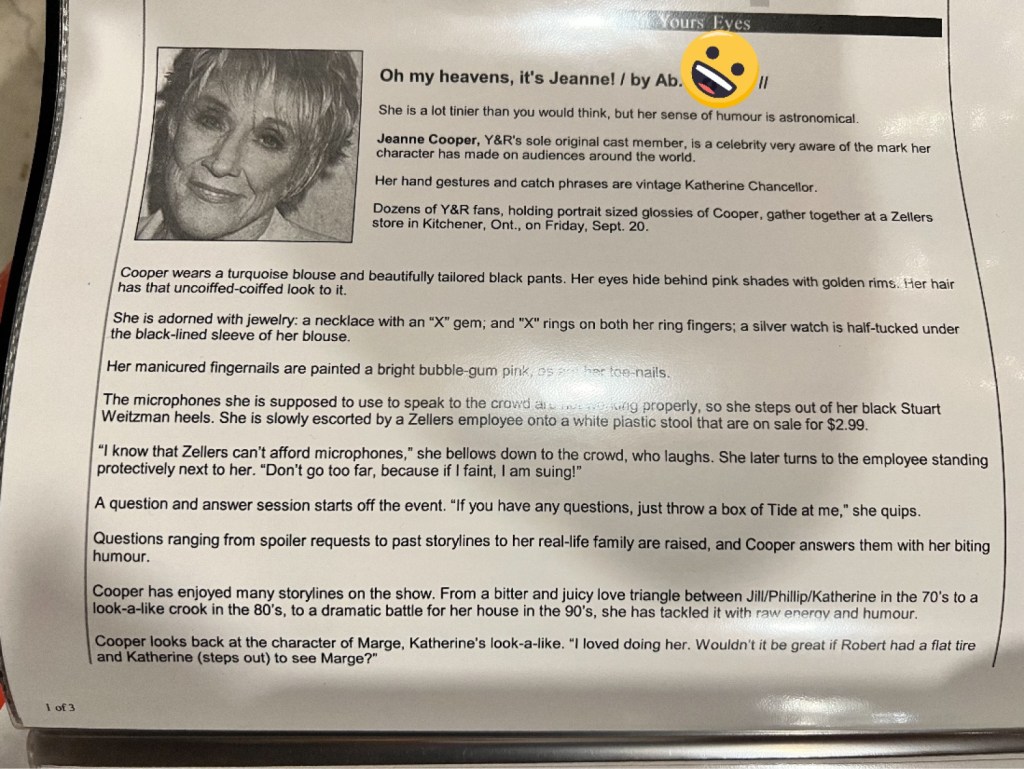
Getting to meet “Katherine Chancellor” and write about it for my fan site was amazing.
I think back so fondly to these memories and I wonder where did all this free time and where did my hustle go?
Now in my 40s, I still feel young but I don’t feel as restless. I feel comfortable in my skin and have shifted my priorities towards my family.
All the skills and life experiences I’ve made are now used to make life as positive as possible for T.
A fun article about soaps I wrote during an internship at the National Post.
I spent this weekend enjoying the 50th anniversary episodes of Y&R – and enjoyed the trip down memory lane.
When we learned T was moving into our former tiny condo with us, I created livable space by whittling down my boxes of Y&R magazines to just a handful of issues I wanted to keep for warm memories on rainy days like today!
So many happy life experiences and academic, professional and personal opportunities were directly and indirectly made possible because of the love of writing that this show sparked in me.
Happy 50th anniversary, Y&R. May the trials and tribulations of Genoa City continue on for many more decades to come!
Y&R unveiled a new opening this week. Love that Tracey E Bregman (Lauren) leads it. She’ll always be my favourite.
While waiting for our flight home, an older man with a cross necklace sat in front of us.
The airport was packed and very noisy and T was overstimulated and stimming (digging hands) and eating his Pringle chips messily.
We told T to stop eating and save the rest for the flight and was met with a snarky “Shut up.”
Then he turned to the woman next to me, who briefly made eye contact with him, and told her to stop looking at him.
She gave a polite laugh and told him she was just looking around.
The poor hubby was flustered and I could tell he was embarrassed.
I knew I had to ride it out, because anything I did or said would be fueling a disregulated child.
“Nature is beauty
Beauty is nature
We are engineers
But who engineered us?”
– Anahera
The older man sitting across from us opened up his bag and told T he wanted to show him something.
T leaned closer as the man took out his own tall tube of Pringles and told him he loved chips too – and T smiled.
The man then looked at the hubby and I and said, “Sometimes, we are given a gift that teaches us about patience and kindness.”
All I could do was smile back – but I thought about these words during the flight on Friday and this weekend.
In moments of chaos – such as the last 30 minutes of our flight when T was acting like a little shit – it’s easy to forget what a blessing he is.
T indeed teaches us much about patience and kindness, on a daily basis, often at the expense of our sanity.
I’m not a religious person but I believe in a Creator – and that there are no coincidences.
I have an incredible story about T’s mother that reinforces this belief – and it’s a story I’ll only share once it’s been shared with T first.
We were always meant to be with this frenetic ball of joy and chaos.
During breakfast today, I looked at T and told him, “Do you know what I love about you?”
Before I could tell him that I love that every day is a new day with him to try again, T interrupted me and said, “That I’m cute, funny and smart.”
Anahera means “Angel” and is a name of Maori origin. It’s also the name of one of my favorite trance songs – a guaranteed pick-me-up – and I listened to it during our flight home to re-centre myself.
One chatty mammal met another chatty mammal during a delightful afternoon in the water.
The excursion van picked us up late afternoon and took us for a short drive through downtown Cancun and dropped us off at the marina.
We put on lifejackets and were escorted down the dock to where the dolphins were.
T was very anxious and scared at first. But once he got into the water, he warmed up and let the dolphins approach him.
The staff were excellent and T followed their instructions closely.
He laughed heartily as the dolphins splashed water at us with their fins and tails and he had the most endearing smile as they swam up to him and allowed T to press his cheeks against theirs.
We enjoyed letting the dolphins circle us. T gently petted them, carefully following the instructions to not pet them on their faces.
We then did a “stunt” with them, letting them come up behind us and lift us up by our feet.
T was very hesitant at first but warmed up to the idea. He swam out by himself and waited patiently for the dolphins to lift him up.
Look at how high he went!
We were so amazed and while T would not admit it out loud, the look on his face as he swam back to the dock told us he felt very proud.
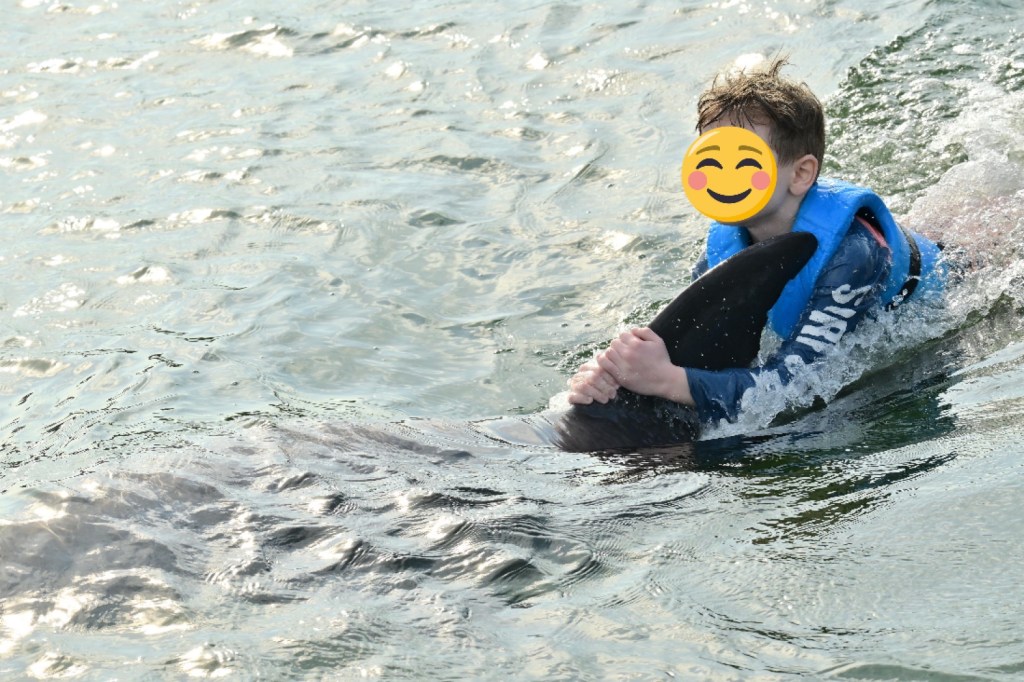
T got to do an extra activity, the dorsal swim (below), and went for a short ride by hanging onto the dolphin’s fin.
I’m tempted to share the full photo because the look of sheer joy on his face was heartmelting.
You’ll just have to take my word for it.
This has been an unforgettable family vacation – and one that is coming to an end when he head home tomorrow afternoon.
Despite the few hair-raising meltdowns T had, I am very thankful for the time away and together – and for the wonderful memories we’ll treasure forever.
We’re spending March Break with T in Cancun and the wait has been so worth it.
The past few months have been very challenging and knowing this family trip to Mexico was in the distance gave us the motivation to hang on.
The hubby and I are part of a support group for caregivers of kids with FASD and a recent guest shared this video by life coach Mel Merritt on self care: Life has shitty moments and one way to get through them is to focus on the good stuff.
I know many will find her advice simplistic and idealistic. Viewing it as an FASD parent, I think that metaphorical jug containing the zest of life is missing cracks and leaks.
Nonetheless, the video resonated, because that’s always been my approach as T’s parents.
We knew at an early age life was going to be ups and downs.
So we do our best to balance life with moments and experiences that bring us joy, whether they are smaller scale, like our daily walks or play time or larger scale treats, like a family trip.
Because life with T is always a balancing act.
When we arrived at the resort, T was tired and disregulated, bouncing a water bottle on the ground repeatedly during check in.
After repeatedly telling him to stop, I took the water bottle from him, which led to an outburst.
“You are so stupid!” He yelled very loudly, startling parents nearby who all turned to look at us. T kept going. “You suck! And you ruined my day!”
I tried to apply the co-regulation skills I learned from the SNAP program.
Counting backwards from 1,000 – they suggest 10 – I repeatedly told myself that going to prison for 30 years was not worth the 30 seconds of satisfaction I’d get from strangling him.
But like all explosive moments with our child, they pass – and I was not going to let this shitty moment muck up our trip.
And it’s been a blissful two days so far.
The amenities at the resort are amazing, including a waterpark for kids, which T has loved playing at.
I got in a nice hour at the gym by myself on Saturday night followed by a nice family meal at a Japanese restaurant. This tapioca dessert, with crème brûlée cracklings, was so good.
T and I spent this afternoon at the indoor trampoline – where he played very nicely with two boys for over two hours.
It was so heartwarming to see him have a great time – being a kid, free of the challenges from the last few weeks and months.
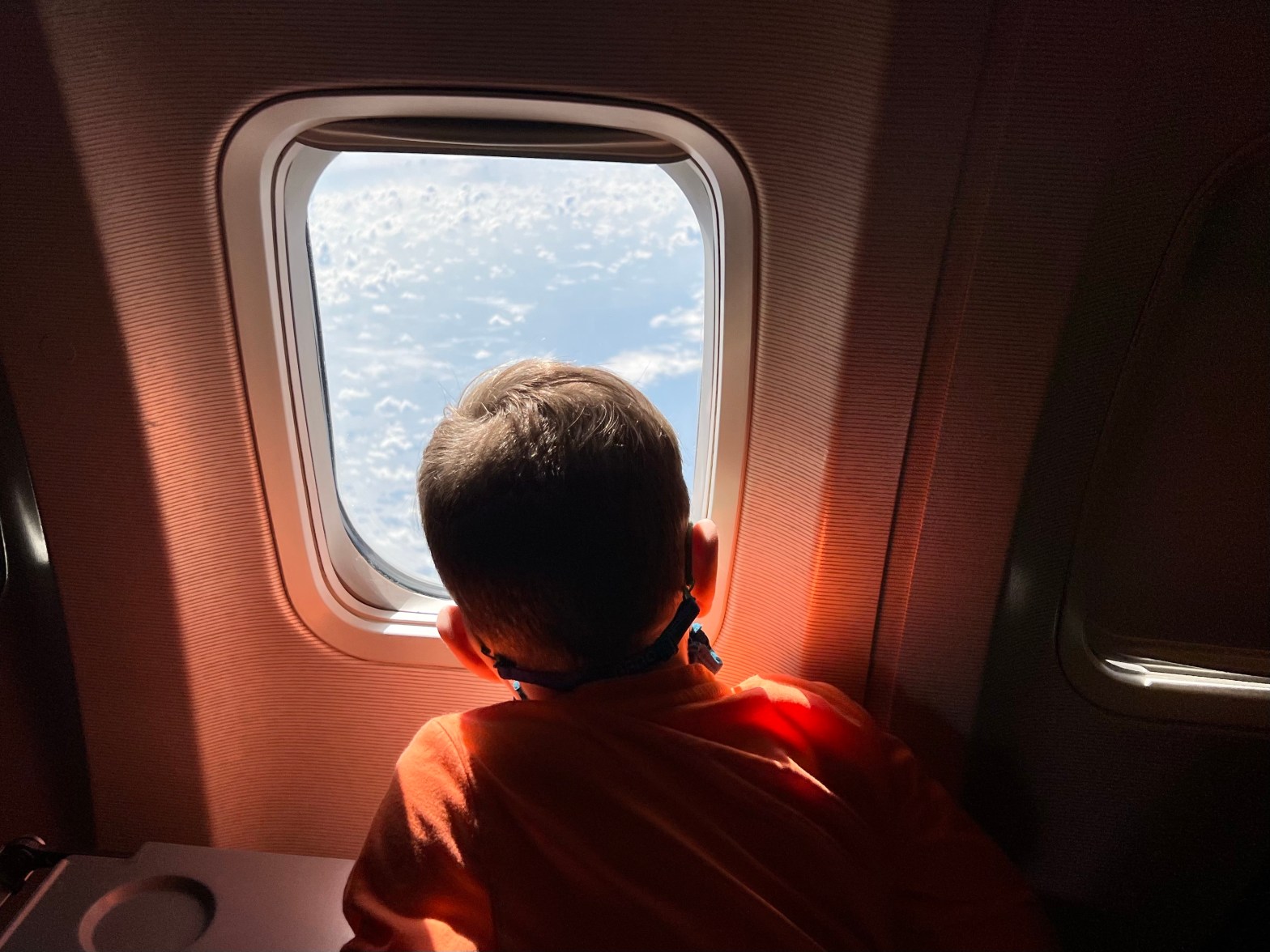
As he bounced high up into the air, I couldn’t help but think T was soaring up into the clouds in his imagination, as he often does.
T is the kid on the left.
I allowed myself to truly savour the moment, guilt free – because we all deserve to rise above the clouds from time to time.
Suddenly, the hubby and I are university students randomly meeting on a dance floor then start to date on March 8, 2003.
Suddenly, we’re moving in together then getting married. Suddenly, we have a little boy then navigating the horrors of a pandemic.
It’s impossible to capture all the memories from the last 20 years with someone I’ve spent nearly half my life with – and the cherished family and friends who were part of them.
So instead, for our anniversary today, I posted 20 photos, 1 photo highlighting each year.
It’s interesting to remember that there was a life before T – because, as a parent, you genuinely do forget you once had a life! 😂
A life before the words FASD became part of our vocabulary – and that despite the challenges, our lives are now richer thanks to T.
To be reminded that through all the highs and lows, we can count on each other – and that together, we are more.
And the steps the hubby and I took individually and together before we became T’s parents will help us through this rollercoaster life with T.
And here are a few highlights from our life of suddenlies:
2003 – Our first Pride together. I sort of miss staying out late and buying sausages for $3 at 3 am from the street corner and covering it with lots of pickles – or going for cheap Chinatown eats at 4 am. If I did that now, I’d need a week to recover.
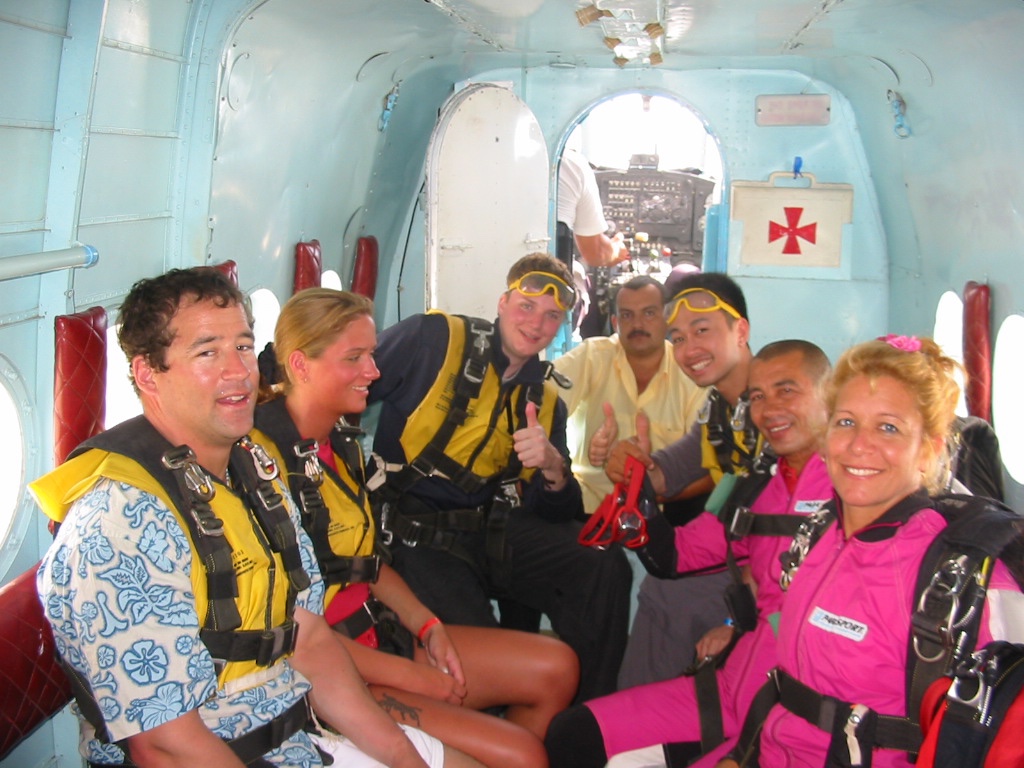
2004 – We celebrated graduating from university with our first trip together – and tandem skydiving in Cuba. I made the embarrassing mistake of asking the woman in the pink if she was the mother helping out in the office. She told me I was jumping off the plane with her. 😂 Good thing she didn’t untether me up in the sky.
2008 – Our first overseas trip together – visiting Beijing, Hong Kong and Philippines. The Great Wall of China was amazing. My Pa, who is a proud Chinese, passed away two months before our trip. He would’ve enjoyed hearing about our trip.
2010 – Our first time visiting Europe – stopping by Paris and Switzerland. Ma came with us! 🙂 This was on a tram traveling up the breathtaking Alps to Jungfraujoch, 8,000 feet above sea level.
I recently thought about a bedtime story called “The Bundle of Sticks” that Pa used to tell me.
As this Aesop’s Fable goes, an old man gathers his 20 dysfunctional sons as he nears his death.
He gives them each a stick and asks them to break it – and they each do so with ease.
Then he puts 20 sticks together and asks each son to take a turn at breaking the bundle – and they are unable to do so.
And so, the old man imparts an important lesson about unity.
Blogger Vickie Rubin recently wrote about the trick that keeps her marriage working – and for my family, and raising a child with FASD, it’s about making or breaking it together.
The hubby, T and I recently started a 13-week program called SNAP.
So what does SNAP stand for?
It’s not the Bend and Snap, unfortunately.
It’s not this either.
SNAP stands for Stop Now And Plan and it is “an evidence-based cognitive behavioural model that provides a framework for teaching children struggling with behaviour issues, and their parents, effective emotional regulation, self-control and problem-solving skills.”
It’s a referral-based program with a long waitlist – we waited a year – and we are so thankful for the recommendation from Surrey Place.
Taking place once a week, T is in a play and learn based group with three similarly-aged kids while the hubby and I are with three other couples.
The weekly subjects covered hit on so many skills that we want T to learn – including emotional regulation, playing in groups and even covers topics such as bullying.
Three weeks in, I’ve been enjoying the sessions; it’s so refreshing to meet other parents, in person, who just get it with zero judgment.
We get home late in the evening, so we made a few changes to our routine – we get takeout, no reading homework, no bath – so T gets to bed at the same time without meltdowns.
Yes, it is as time consuming as it sounds and I need something else on my plate like I need another gray hair – but I think it will be worth our time.
During a recent drive home from SNAP, I thought back to 2011 when the hubby and I took a multi-week course called Papas and Daddies To Be, offered by a 2SLGBTQ+ organization.
It was a journey, an investment of time, and so worth it as it helped inform our adoption journey.
I’m hopeful for a similar experience with SNAP.
It’s also nice that T’s CYW is trained in SNAP and uses it at school. We connected her and the SNAP team together for mutual goal setting.
Life with a child with FASD is filled with ups and downs – and there are days where I do feel like I will snap from how hard it is.
What keeps me together is remembering that the hubby, T and I are in this together – through thick and thin.
Individually, we’re thin and susceptible to snapping – but together, we are more; thicker and stronger.
We support each other through the lows and we celebrate together our many highs.
Recently, during bedtime, the hubby was trying to get T to finish showering, one of his favourite activities that he could spend forever doing.
Cue the screaming fit.
I reminded the hubby about SNAP. “Count to ten and take deep breaths,” I said, with perhaps a bit of playful sarcasm.
“Replace those hot thoughts with cool thoughts. He’s acting this way because he’s having fun. He’s not trying to piss you off. Stop Now and Plan.”
The hubby, already quite irritated, stared at me with quite the look and said, “Fuck off.”
Did I mention having a sense of humour also helps?
Being thick skinned takes work, whether it comes to parenting or Air Frying pork belly.
When I cook, one of my self care routines, I find parallels with parenting a child with FASD.
My cousin gifted us an Air Fryer for Christmas and it’s been amazing to make recipes on my bucket list, most recently roasted pork belly.
I got a 1.5 pound cut of pork belly, with good distribution of skin, fat and meat.
I boiled the meat for 15 minutes to remove the impurities then rinsed it under cold water.
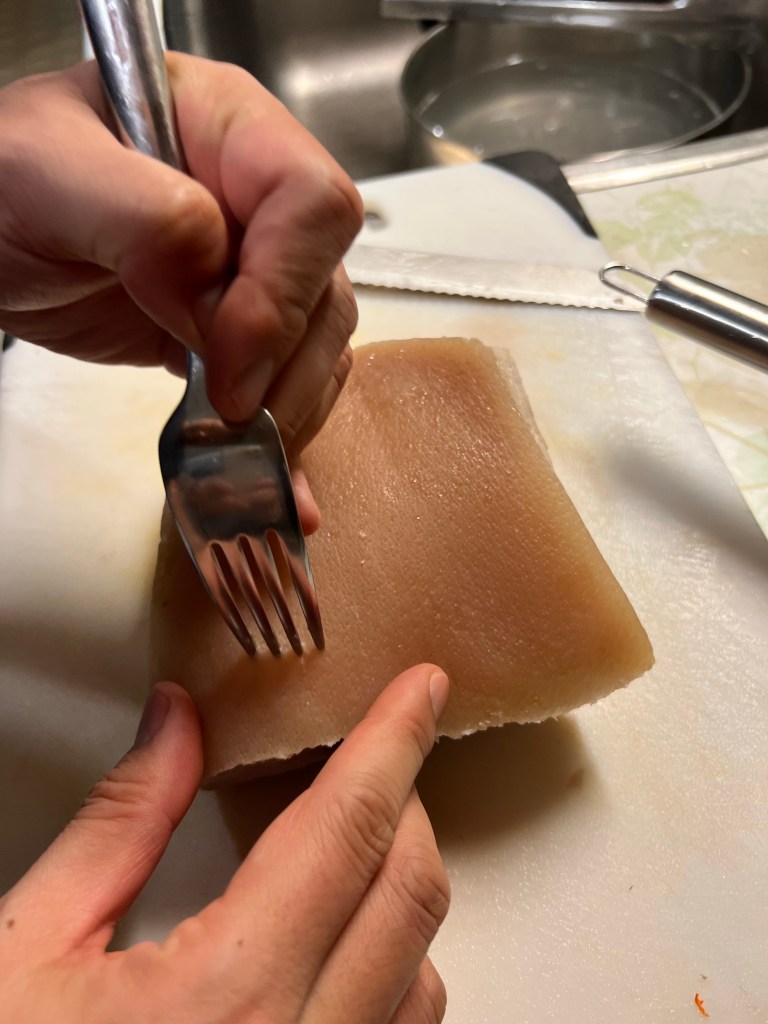
I then poked holes on the skin using a fork – you can use a toothpick or skewer – which allows for bubbly crispy skin.
Don’t poke into the meat or the meat juice will spoil the skin crisping.
For the skin to crisp up, it’s important to dry up the skin.
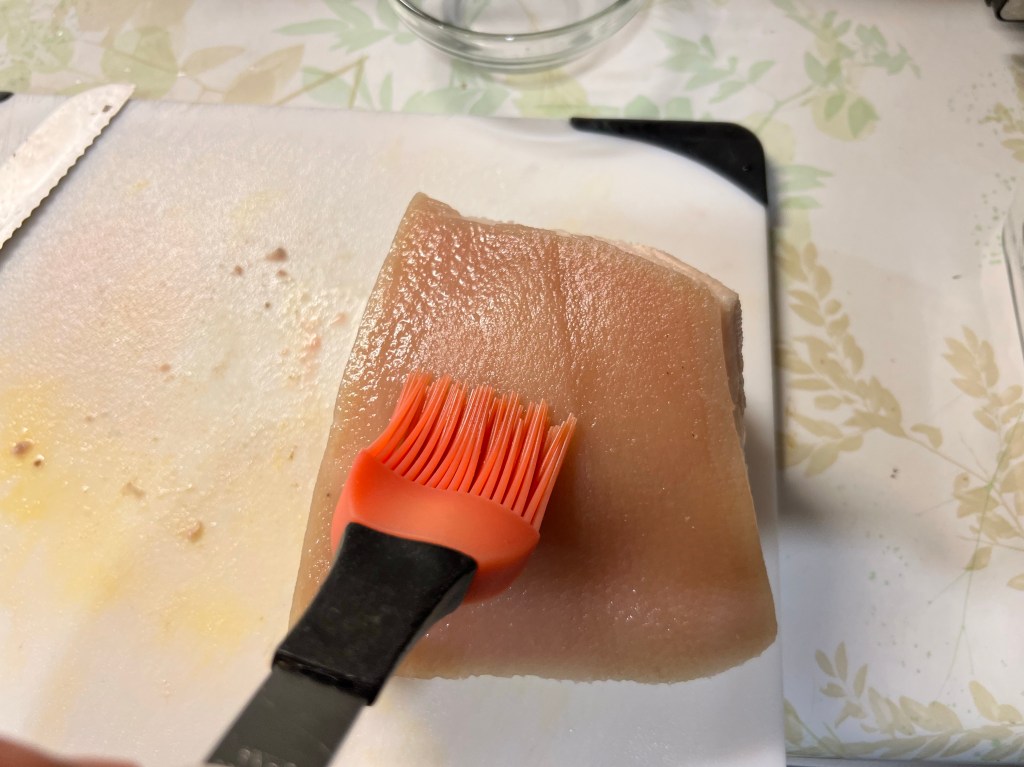
I brushed it with vinegar then salted generously to draw out the moisture.
I put it in the fridge uncovered for 48 hours, taking it out after a day to pat the skin dry and to score the meat in one inch squares; then seasoned the meat with five spice powder.
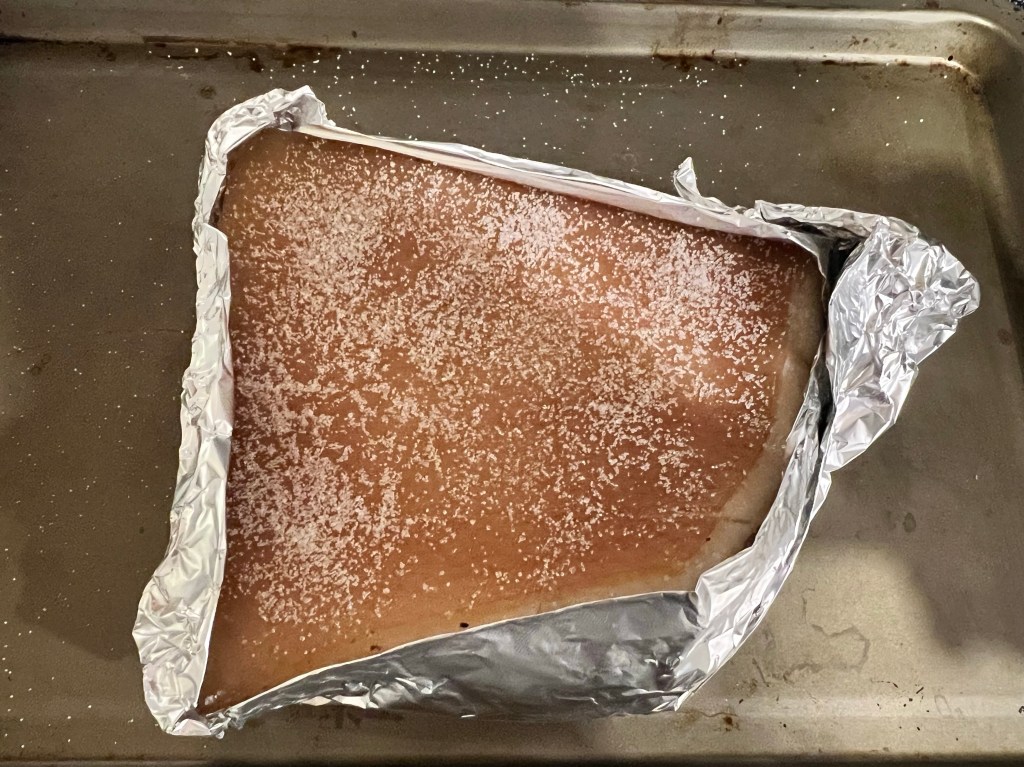
When I was ready to air fry, I wrapped the sides of the meat in foil then sprinkled more salt on top.
I roasted it for 40 minutes in 390 degrees Celsius.
And voila! It exceeded my expectations – the skin was so crispy and the meat was juicy.
Being a parent of a child with FASD can feel like a pig being slaughtered and roasted.
Many parents of kids with FASD often share challenges with verbal aggression – and the hubby and I are certainly not immune to it.
“Shut up” is T’s go-to phrase when he doesn’t get his way or when he’s refusing to comply. When he’s very disregulated, he will hurl threats or hurtful comments, such as “I hate you” or “you’re the worst.”
I’ve learned to be better at not taking it personally – and to reframe his behaviour as symptoms of his disability: impulsivity (says the first thing on his mind) combined with difficulty regulating his emotions (says the thing to inflict the most hurt).
I came across the very useful QTIP acronym on Jeff Noble’s FASD Caregivers Success Group.
But I’m only human. No matter how thick skinned I am, things get to me if I am consistently poked at – like pork belly – and it gets to me, because I parent with my heart wide open to T.
I feel horrible when I don’t react with calm and grace in moments I feel like I’m submerged in boiling water.
I’ve learned to be less bothered when the comments are directed at me. Because I know that in one moment, T could be screaming I’m the worst parent because I’m ending his bath then moments later, we’re snuggling with a book in bed and he tells me he loves me.
What bothers me are the reaction – said out loud and unsaid through body language – by people who see T at his worst.
I remember one family member remarking on T after he was so awesome throughout my sister’s funeral service. Instead of attributing it to maybe, just maybe, he’s a good kid, the comment was, “Did he take his medication?”
People are quick to judge and to label kids into black and white buckets based on disregulated moments and these overshadow the moments when T is good, kind, caring, funny, regulated, compliant and empathetic.
But unlike roasted pork belly, our skin and spirit do toughen up – and I choose to focus on the positive and the things I can control: advocating for T, raising awareness about FASD and increasing understanding, one heart and mind at a time.
Unlike roasted pork, I don’t want life as a special needs parent to make my exterior hard, coarse, crisped – and jaded and cynical.
So it means to not dwell on the small stuff and to brush myself not with vinegar and salt but with the good stuff that fill up my heart and spirit.
And that includes indulging in my cooking adventures.
Family Day is a special holiday, because it comes after Valentines and the anniversary of finalizing T’s adoption in court.
When T was a toddler, we loved reading Todd Parr’s Family Book, which spoke about families in all forms – nuclear, single parent or multi-generational households, same sex parents, adoption, bereaved families.
One thing that’s clearer as I get older is the importance of chosen family.
Family is not just defined by blood. It’s about bonds formed by choice over time, respect and love.
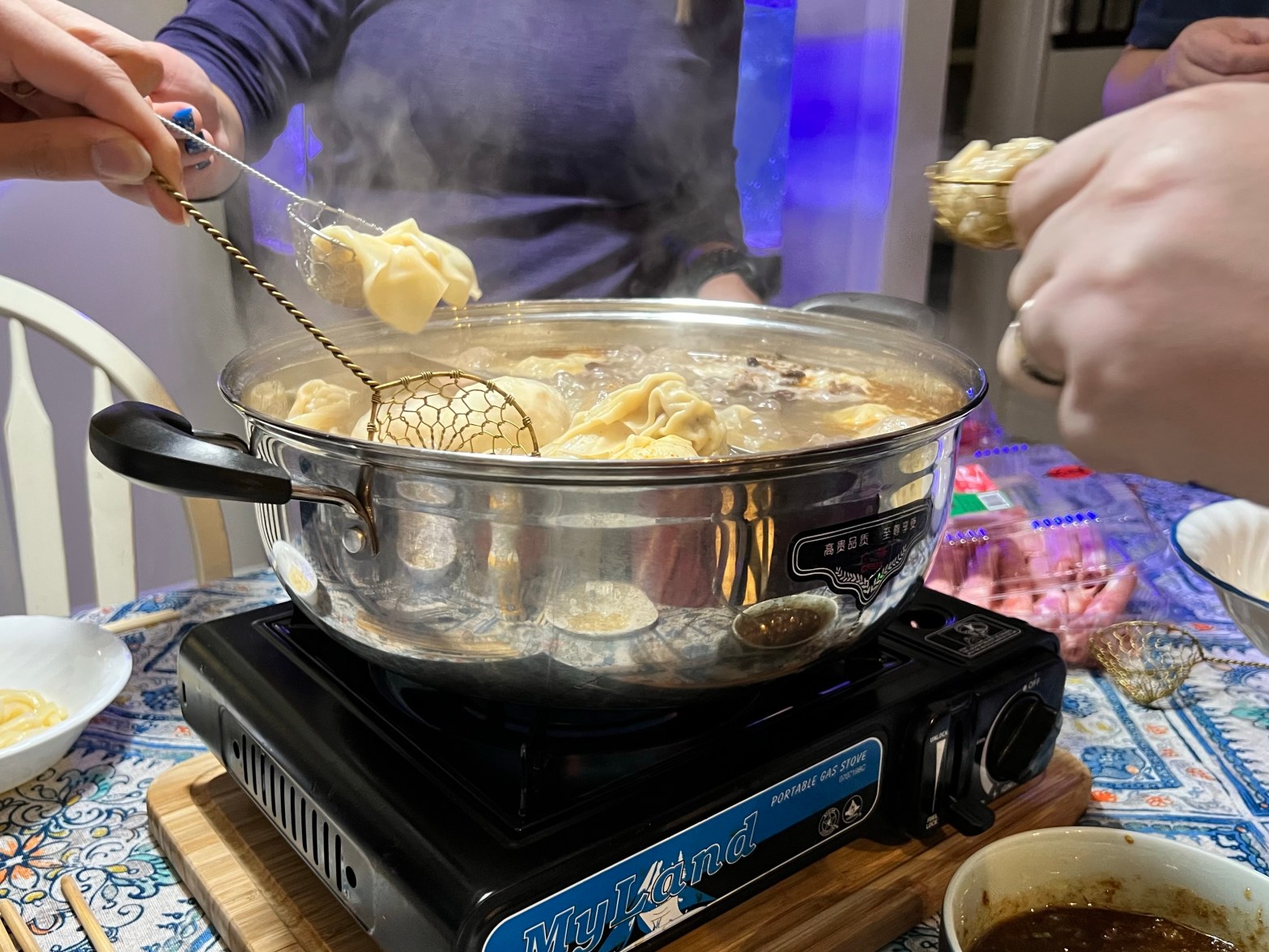
Last night, we enjoyed hotpot at a friend’s home – and the shared cooking and conversation felt wonderful and soothing.
T enjoyed playing with our friends’ teenaged kids, who were once much younger than T was.
As a parent of a child with FASD, quiet free time is a luxury and my circle – my chosen family – has tightened the last few years.
In many cases, the pandemic has created distance and in some cases, I decided to not spend my energy on fairweather relationships.
I am very thankful for the relationships that have endured through my parenting journey.
And I wish for T to be blessed, as I am, with his own chosen family as he moves through life – relationships that are respectful, soul-filling, lasting and that help keep him on the right path.
Six years ago today, also a Wednesday, T, the hubby and I became a forever family.
In many ways, it feels like a lifetime ago when our adoption was finalized in court – and in other ways, I think with awe, “Has it been only six years?!”
So many moments have happened since – joyous highs and crushing lows. But yet, like T, every day is a new day and we keep chugging along.
I love that this anniversary always falls after Valentines Day and before Family Day, because it is symbolic of what love and family mean to me.
Shining Together
This Sunday was Super Bowl Day and I was excited about Rihanna’s halftime show.
The hubby and I loved her music, as it played in the clubs when we started dating in our 20s.
I went on a binge of rediscovering her music last week – hits after hits – and it was fun introducing them to T during our drive to swim class.
After his lessons, we went to a birthday party for the daughter of the hubby’s friend and colleague.
It was the first party T got invited to in the last three years – and it reminded me of the guilt I mildly feel for not having yet done a birthday party for T, with the pandemic partly to blame.
T made a wonderful card for the birthday girl.
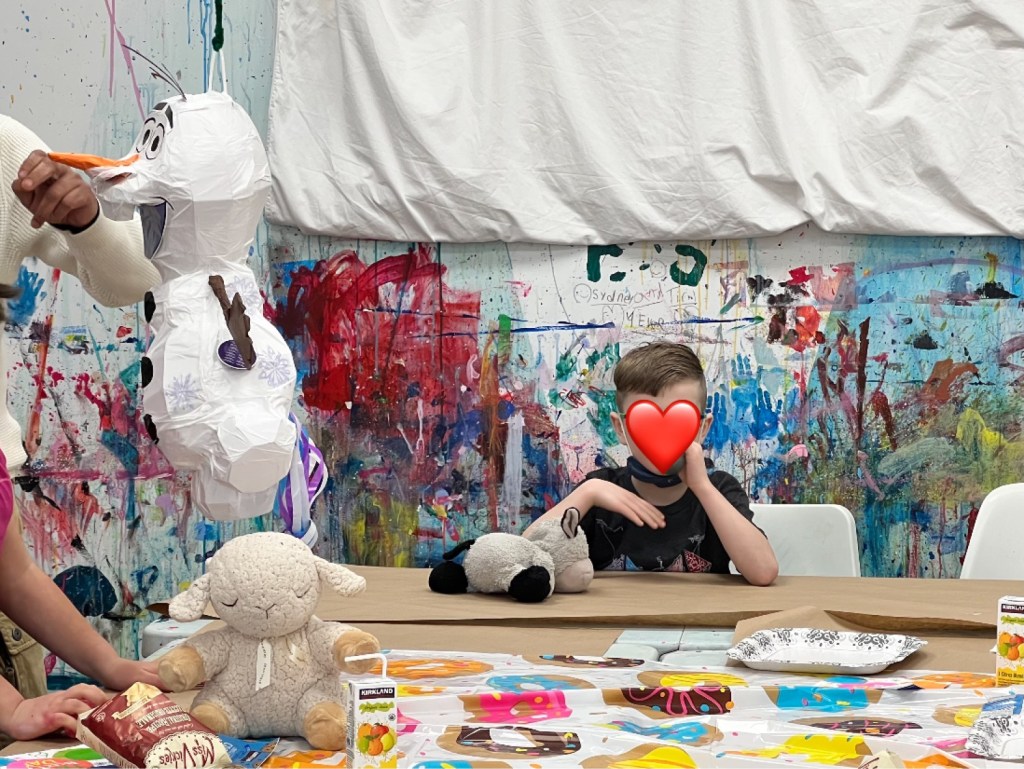
The party was hosted at a small art studio for kids, as you can see by the awesome creations below.
We regrettably arrived late and the kids had already started a group painting activity.
We encouraged T to participate, but the combination of arriving mid activity and him not knowing anyone other than the birthday girl made him feel reluctant and shy.
So he stayed outside the room and looked around the Studio. I wasn’t fussed but the hubby felt embarrassed and flustered.
The Studio staff were empathetic and offered to do an activity with T to pour small plastic balls into a deflated balloon to create a hand fidget toy.
Afterwards, the kids gathered to eat pizza. He was still reluctant to join, so we sat and ate outside.
Eventually, T warmed up and went inside – just in time for ice cream cake!
“When the sun shines, we shine together Told you I’ll be here forever Said I’ll always be your friend Took an oath, I’ma stick it out ’til the end Now that it’s raining more than ever Know that we’ll still have each other You can stand under my umbrella.”
– Rihanna, “Umbrella”
As an adult, I can find social events hard, so I can relate with a kid, FASD or not, navigating a party where he did not know anyone and he arrived late.
So you know what, T did awesome.
I loved when the host asked who wanted more cake and T said out loud, “(Birthday girl) should get a big piece because it’s her birthday.”
T brought Moo Moo with him and Moo Moo got to meet a fellow farm animal at the party! 😊
After the cake, it was piñata time. The kids lined up to each take a turn swinging at Olaf the snowman.
T didn’t want to line up and we could tell he felt anxious.
When the piñata broke and the kids grabbed the candy, T started tearing up. Thankfully, the host parent bundled up a bag and gave it to him.
We stood with T and stayed calm to help him calm down – and eventually he did.
And just like that, the party was over. As we exited the Studio, T pointed out his gift and card to the birthday girl.
The party experience, its ups and downs, sums up how I feel about parenting on this forever family day.
When the sun shines, we shine together. Told T we’ll be here forever. Said we’ll always be his friend. Took an oath, we’re gonna stick it out ’til the end. When it’s raining more than ever. Know that we’ll still have each other. He can stand under our umbrella.
Time flies. It’s hard to believe but our little guy turned lucky number 8 last weekend.
T had been counting down excitedly for weeks. But his birthday week got off to a rough start.
Last Monday, T woke up around midnight and threw up. A lot. Then woke up every hour after to throw up even more.
We kept him home for two days. It turned out a stomach bug went around his class, as his teacher and classmates also caught it.
Thankfully, he was fine by the weekend.
We did a Sonic the Hedgehog theme birthday, with matching balloon colours.
Blue for Sonic, orange for Tails, Red for Knuckles.
The hubby baked a homemade Sonic cake with cake toppers purchased online.
And the cake was yum!
T really wanted a party, but with my sister’s funeral taking all our energy, we didn’t have time to plan one. We made a pledge to do one, his first-ever party, for his 9th birthday next year.
But it was wonderful that his CYW gave him a gift and two classmates each made him a card.
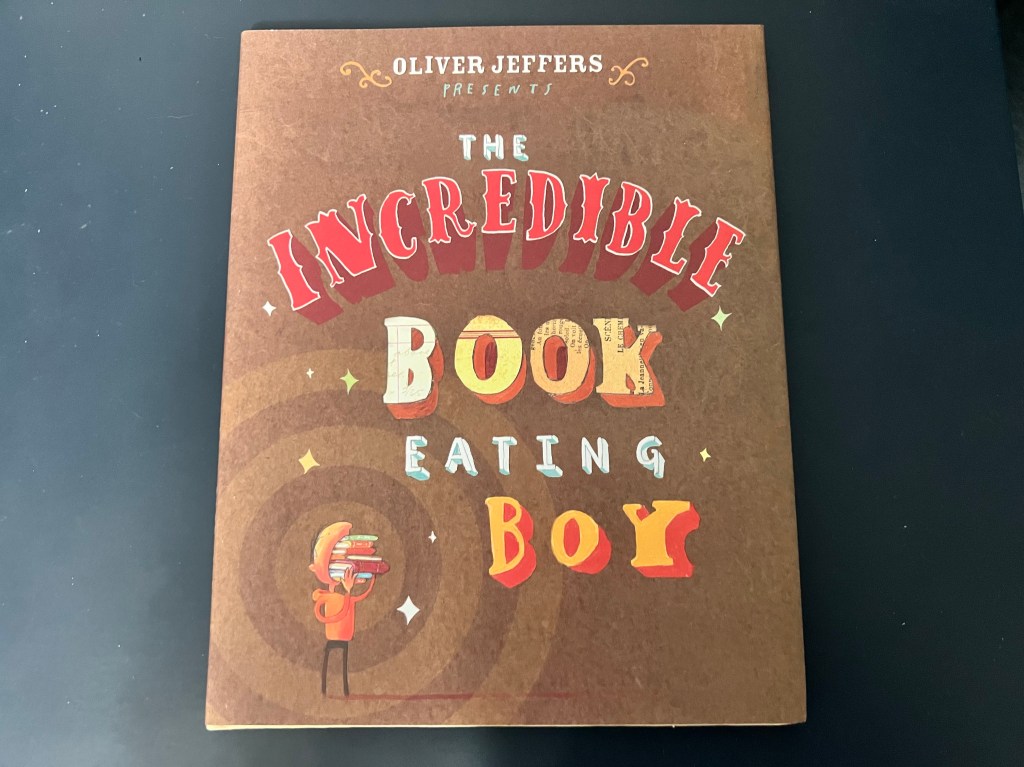
My good friend dropped off a book for T, another Oliver Jeffers book, which has become an annual tradition. Our family loves his books.
Instead of a party, we took T to Niagara for fun at the Fallsview waterpark.
The last time we were there was to celebrate T’s 5th birthday, with his foster parents and brother. Little did we know that a few weeks later, the world would forever change with the pandemic.
It was nice watching T have fun at the waterpark. What a difference three years makes. We didn’t need to supervise him closely this time.
We really needed this weekend as much as T did and it was a welcomed change from the challenging last while.
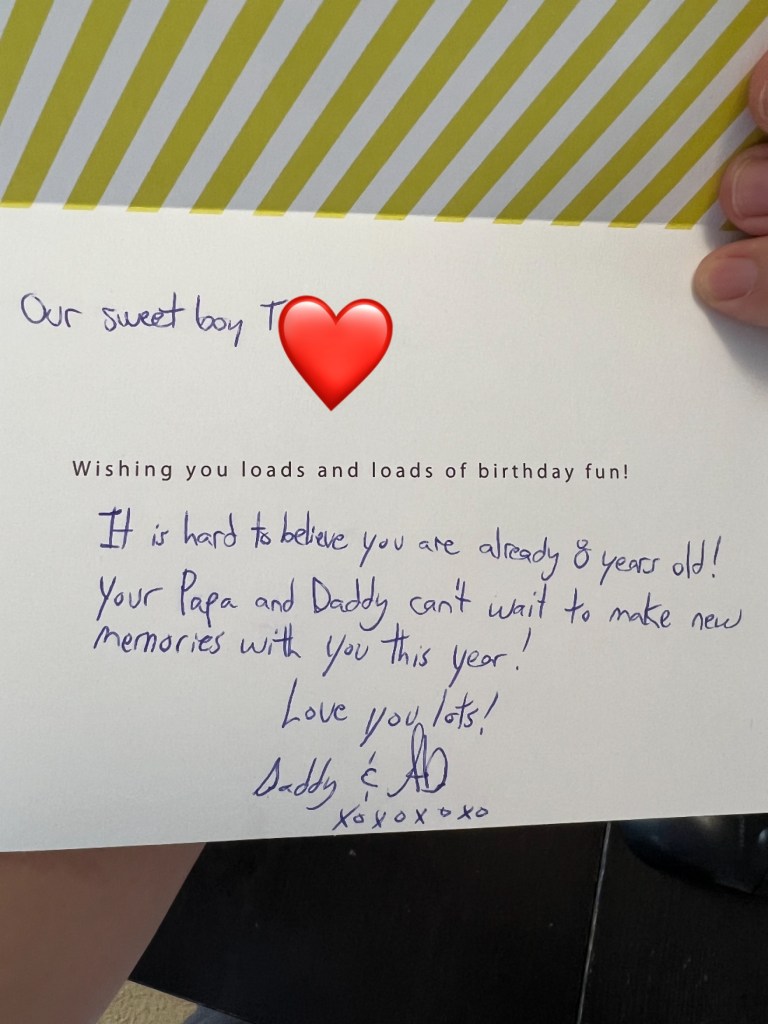
You know you’re exhausted when you sign a birthday card for your son using your first name instead of “Papa.” 😆
In Chinese culture, 8 is considered a lucky number, because it is often associated with wealth.
During the drive to and from Niagara, we played “Sweet Dreams (Are Made of This)” by Eurythmics.
I’m not sure where T first heard this song but it’s his current favorite and on repeat in the car. He calls it the “seven seas song.”
Growing up, we often heard our parents share their dreams. It often had to do with us being a doctor or having a well-paying job – because wealth was often associated with success and a good life.
As a grown up and a parent – and I’m not just viewing this through the lens of special needs – my dream for T is more simple and open ended.
In my prayers, I pray for T to grow up happy, healthy, self sufficient, to do something he loves, to have lasting friendships and relationships, to stay out of trouble, and to contribute light to this world.
How he does that – we’re open to all possibilities.
As life with T teaches us, there is no linear nor singular path to success.
Sweet dreams are not made of just this one thing.
As T noted while he was playing with his golden 8 balloon, 8 turned sideways is infinity.