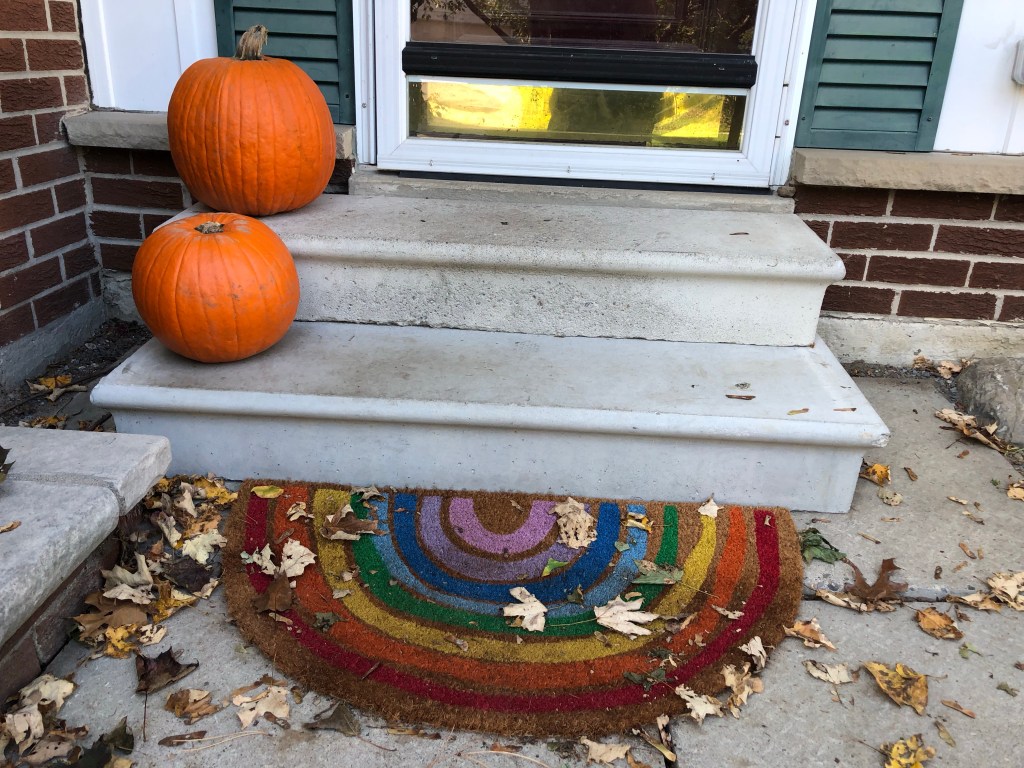
Golden Hour

Nature reminds us that magic exists before and right after the darkness.

Golden hour refers to the hour after sunrise and before sunset when the sun is softer and redder compared to when it’s higher in the sky.

Also called magic hour, it is a photographer and filmmaker’s dream.

I first noticed this in a visceral way during a walk with T in fall 2016.

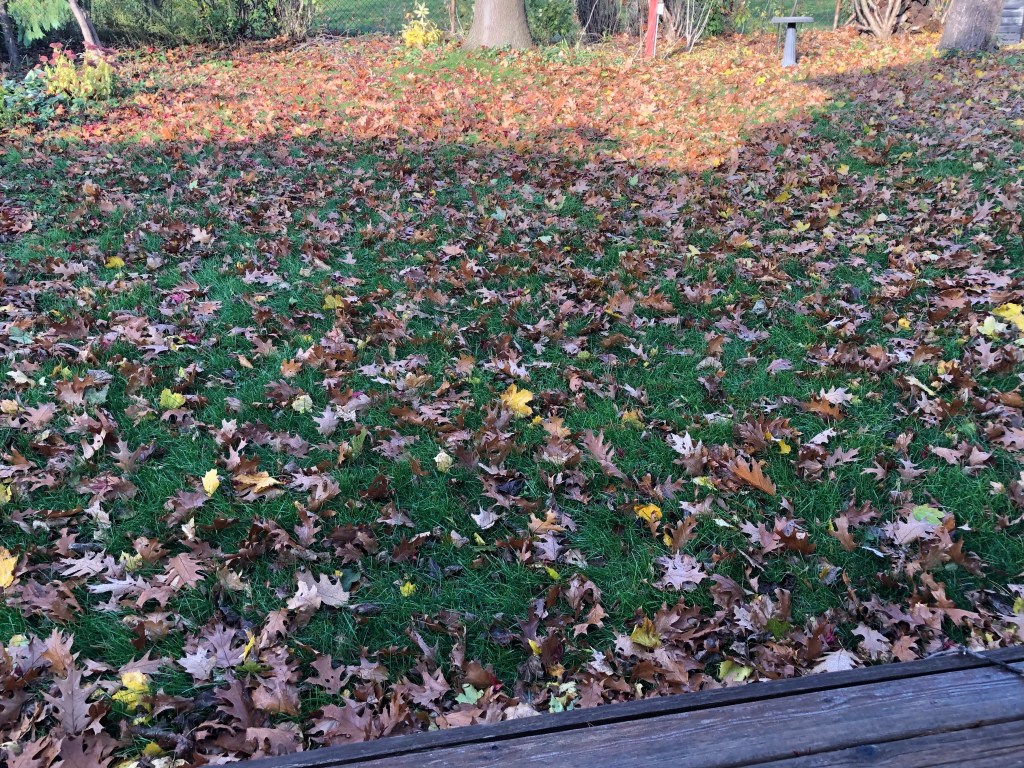
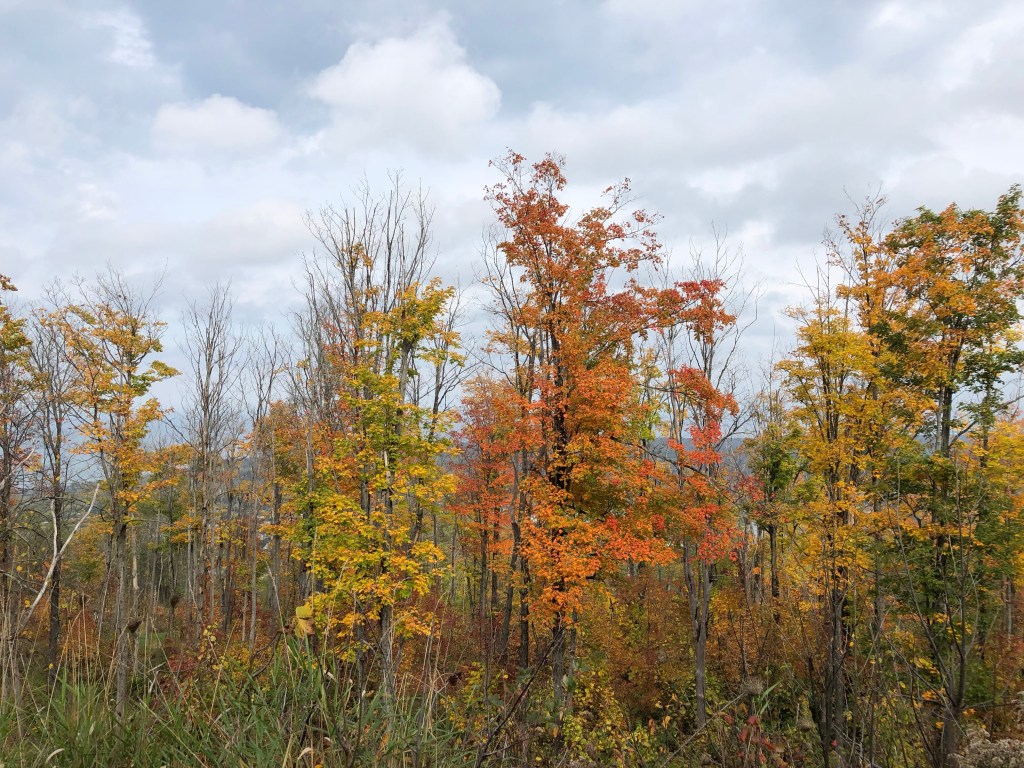
He still sat in a stroller and we were in our old neighbourhood. The leaves had turned fiery yellow, red and orange. It was a sunny late afternoon and kids played loudly in the park.

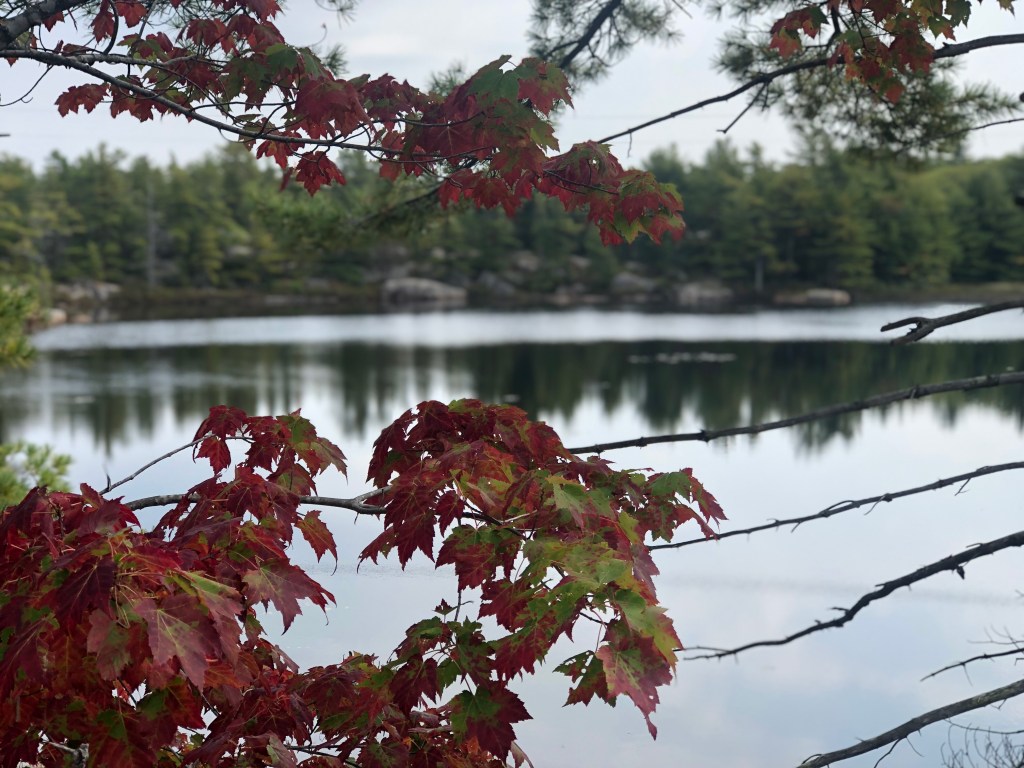
The sun cast this magical light on the leaves – pictured at the top and below – and it had this incredibly soothing effect.

Phone pictures never do nature justice. But they provide an imprint in our memories that help evoke a specific moment and feeling in time.

On this day, I was lamenting that I was 3/4 into my parental leave. I reminded myself that there was still a lot of quality fun time left with T.

And indeed, there was. Our first Christmas together, our first family trip (a friend’s destination wedding) and celebrating T’s birthday together for the first time – two days before I returned to work.

Conceptually, golden hour exists all around us.

Autumn gifts us with one last display of magic before the dark days of winter. Daylight gets longer in the early days of Spring.

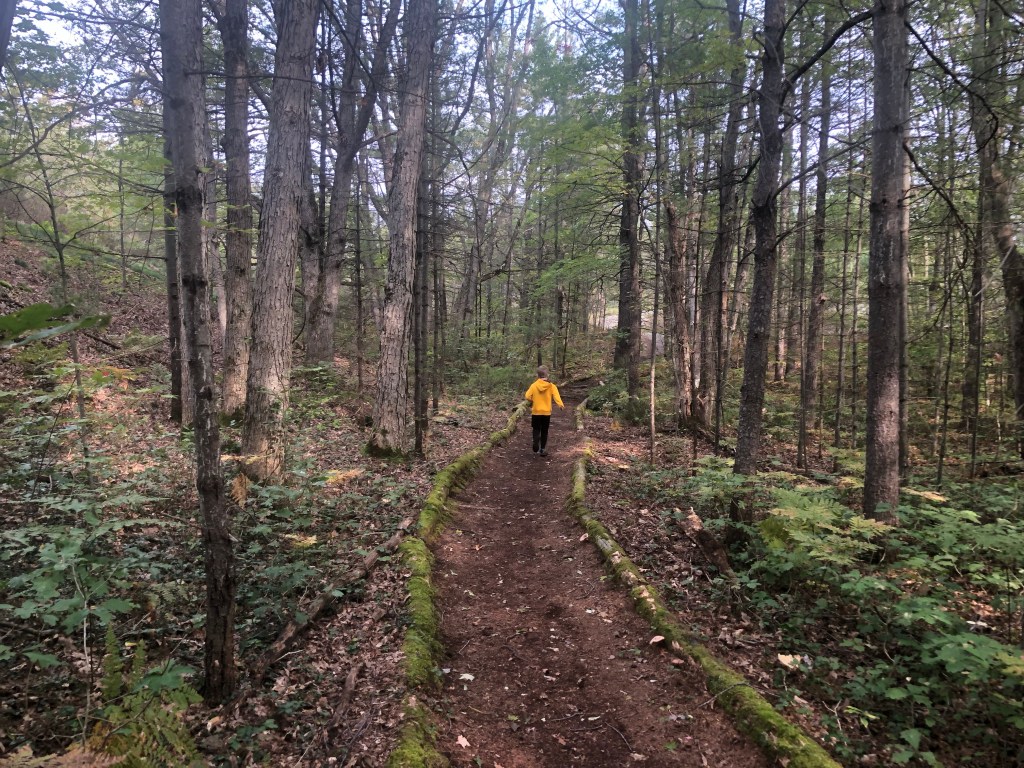
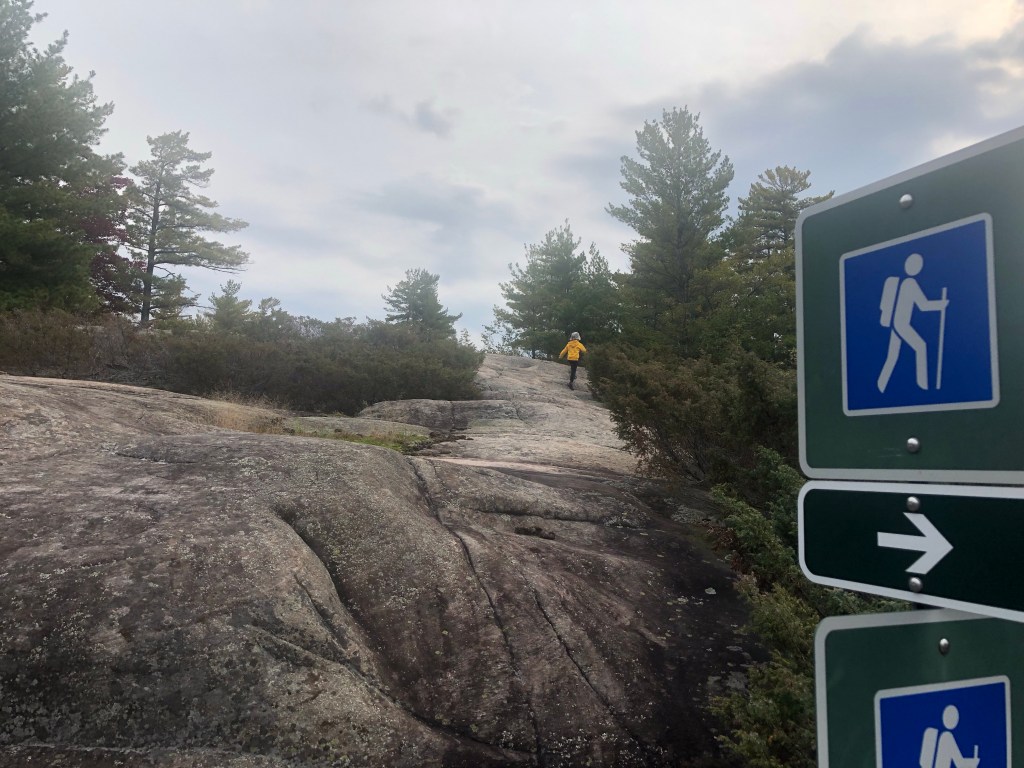
From T and my walk this Saturday.

Golden hour reminds me to not fear the darkness, in whatever forms it takes in our lives.

Because there is a golden light that precedes and immediately follows it.

It reminds me to let go of the dread of an end and to enjoy every last moment before the last grain of sand flows down through the hourglass.

This feels and looks like art to me.

The last two weeks, after I shut off my work laptop and came down from my upstairs office, I passed by our kitchen window, which overlooks our backyard.

On the sunny days, I noticed the golden hour light blanket the yellow leaves on our tall maple trees.

I stood and took in the fleeting moments before I went to pick T up from daycare.

Let’s Talk About Medication

The text from my pharmacy lets me know that my METH is ready for pick up.

It’s an auto-generated notification that includes the first four letters of the medication name in capital letters. I chuckle about this immaturely when the refill is made every few weeks.

In seriousness, I’m talking about methylphenidate – the generic drug more commonly known as Ritalin – which T started to take last July, shortly after receiving a diagnosis of ADHD.

I wrote at the time about feeling torn about the decision to start T on medication, including struggling over the potential stigma that may be attached with taking medication.

My apprehension grew during the initial weeks when we noticed T having rage moments and trouble with sleeping at night.

After consulting with his developmental pediatrician, we removed the third dose in the afternoon, which largely reduced the side effects.

Then it became routine for T and us – as well as his school and daycare, who administered the medication with our consent.

Over the last year, we adjusted the dosage, increasing the amount based on his weight and height.

To be honest, the hubby and I often discuss the efficacy of medication. On many days, T is still very hyperactive, impulsive and hard to focus.

We’ve inquired with his developmental pediatrician about doing a GeneSight test, because we’ve read on forums about parents who’ve done these tests which helps inform a medication plan best suited for the child.

We were advised this is likely not an effective route for kids with prenatal alcohol exposure.

I’m not an expert – and I encourage parents that read this post to consult with your pediatrician based on your child’s needs – but the hubby and I definitely notice when T is not on his medication; the rare time one of us forgets to give it to him.

A few weeks ago, T’s child and youth worker was not at school and T’s teacher sent an apologetic email saying she forgot to give the medication, a task the CYW looks after.

Let’s just say the teacher will never forget to do that again!

We are aware T’s response to medication will change over time as he gets bigger and that we’ll have to adjust and tweak along the way.

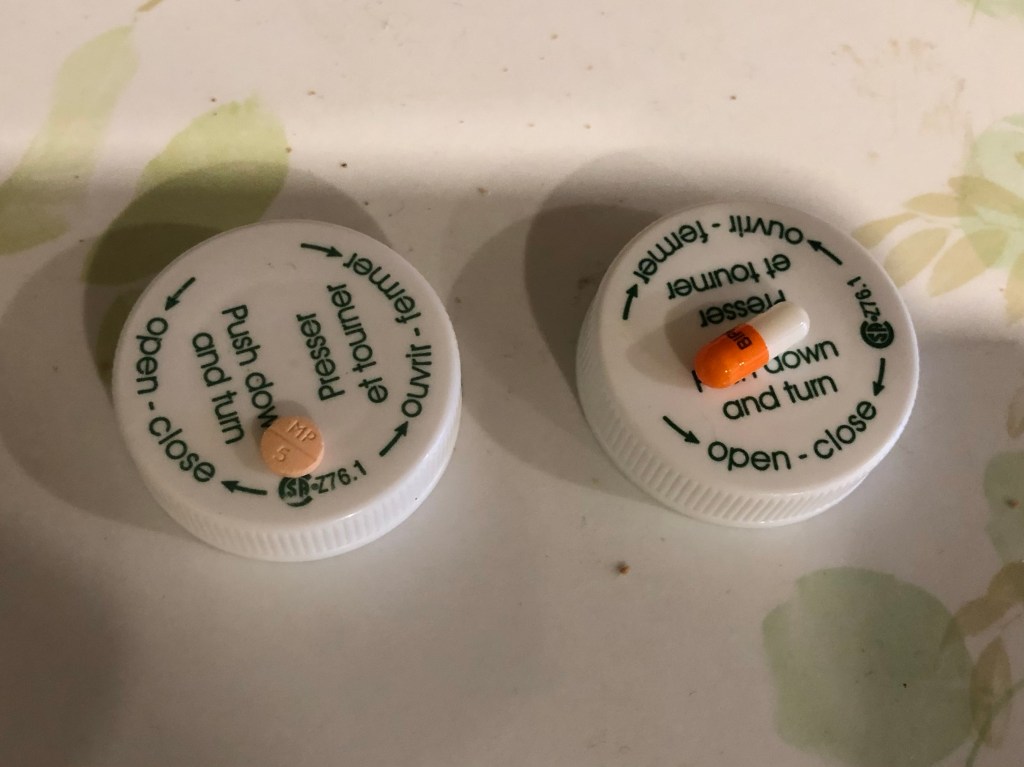
A methylphenidate pill (left) and a biphentin pill (right).

Last week, we consulted once again with his developmental pediatrician and explained the challenges T has been having around hyperactivity, focus and impulsivity.

So we decided to start T on a different medication: biphentin.

Our developmental pediatrician advised that it’s the same medication and dosage as methylphenidate. The difference is that T only needs to take it once a day and the medicine is time released over a 10-12 hour period.

So there won’t be the usual up and down in the middle of the day between his former two doses.

He suggested taking this earlier in the day to avoid potential sleep issues later in the day.

So another change is that we give the medicine at home in the morning and there is about an hour for it to kick in before T is in class; rather than giving it to him just before class starts.

We are just under one week into the new medication.

It’s way too early to tell its long term impact and I always remind myself that medication is not a one-stop magical fix. It is just one component of a larger toolkit to help T maximize his day.

But there are some early signs that make us feel hopeful.

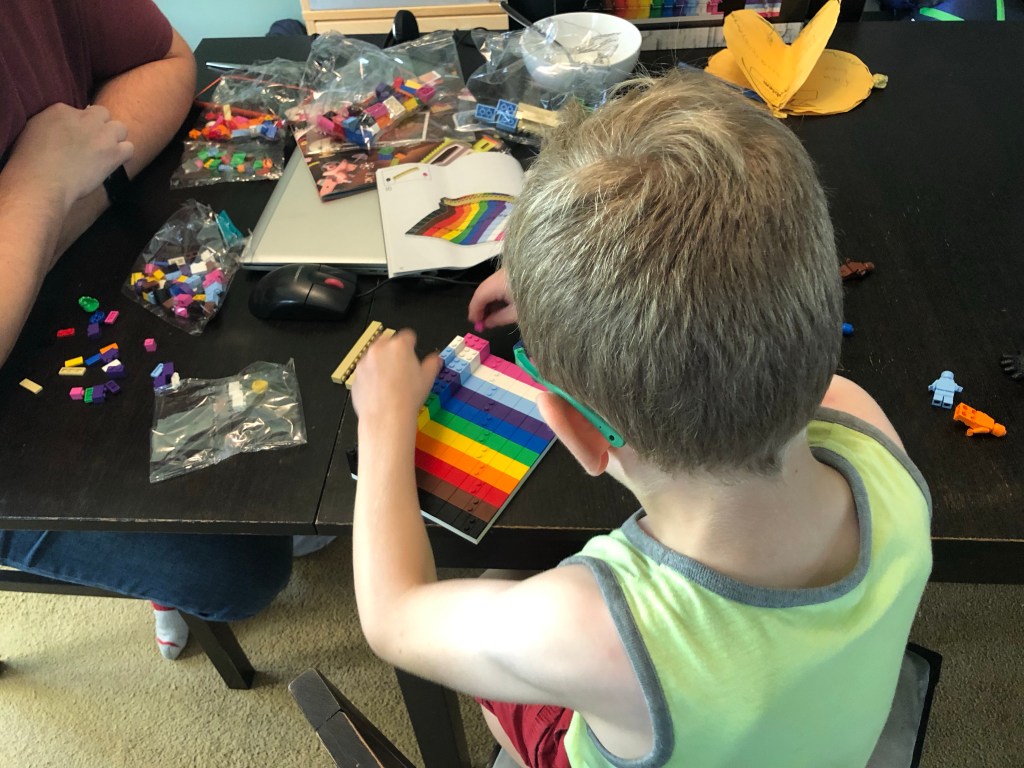
This past Sunday, T decided he wanted to work on the “Everyone Is Awesome” Pride 2021 Lego set the hubby had purchased in the Spring.

We hadn’t opened the box, because the idea of T having access to 346 small Lego pieces made us nervous, as our living room often looks like a tornado had flown through it with debris of his toys scattered everywhere.

T is capable of functional play but he also enjoys just throwing his toys randomly everywhere! I suspect it’s related to his impulsivity and a self soothing mechanism.

But T sat down for over 30 minutes working on the Lego set, with guidance from the hubby.

And he finished putting it together! There were no rage moments or sleep issues throughout Sunday and the day before when we first switched medication.

The school week has been ok so far too.

His CYW and teacher noted on the first day that he was sitting better during circle time.

After school daycare staff reported he sat down at the table during “work play” for the first time.

We will continue to monitor, adjust, support and stay hopeful. We’re realistic that the challenges will continue but it’s about trying to maximize the good and minimize issues.

As T reminds us everyday, even during the very trying moments, everyone is awesome.

It’s also true that some individuals may need help with medication and, speaking as a parent with some lived experience, I think that’s ok too!

T’s work sits on my desk at home. I look at it throughout the work day and it makes me smile.

Introducing My Son to Horror

Watching people get stabbed to death is one way that I like to relax.

Before anyone freaks out, I’m talking about horror movies!

I was 15 when I became a lifelong horror fan after watching Scream at a friend’s house.

It’s somehow therapeutic sitting through horrifying, intense and sometimes hilarious situations and coming out of it unscathed.

I love them all: slashers like Halloween, zombies like 28 Days Later, found footage like Blair Witch, foreign horror like Train to Busan and my favourite genre, paranormal like The Exorcist.

The best horror are those that make a social statement. Romero rebuked consumerism in Dawn of the Dead and the Australian film Babadook was a reflection about grief.

Don’t fall into the witch’s brew, T!

Now 6, T is at a fun age when he enjoys spooky and scary things.

He gets freaked out by the dark, but he loves turning off all the lights and playing ghost.

He knows monsters aren’t real, yet he has nightmares about being chased by mummies.

He loves songs that sound spooky to him and asks me to put them on repeat.

And next to Christmas and birthdays, Halloween is his favourite season.

T is way too young to watch the horror films that the hubby and I watch, but I look very forward to the day when I can introduce them to him. What bloody fun we will have together!

For now, PG-rated scavenger hunts will do!

This year’s pumpkins before they were butchered.

This year’s Halloween was subdued. T was home sick on Thursday and Friday with a bad cold and missed his school Halloween party.

We made it up to him by making an event out of pumpkin carving, with the two pumpkins we picked out last weekend.

As T helped the hubby carve them, he belted Britney Spears’ “Baby One More Time” from the top of his lungs.

All I will say is that pumpkins weren’t the only things being butchered that night.

Our family is home this Sunday with a cold and feeling generally blah. So we’re all taking it easy.

T and I watched the classic Home Alone. T may classify it as horror but I would file it under fantasy!

But we will still put candy out later for kids to help themselves to. And T will still put on his beekeeper costume and his daddy, the bee.

Me? I’m gonna be a jar of honey!

Happy Halloween, everyone!

Why I Set Personal Boundaries

As the gatekeeper to what enters your life, how do you set boundaries?

I reflected on this after I read this Facebook post about the difference between boundaries and rules on the fantastic FASD advocacy page Our Sacred Breath.

As a busy working special needs parent, I’ve learned the importance of setting boundaries with family, friends and work.

My Online Therapy states that setting boundaries means creating limits with other people to help make your relationships healthier.

For me, setting boundaries is about valuing your wellbeing by not overextending the finite time and energy in your life.

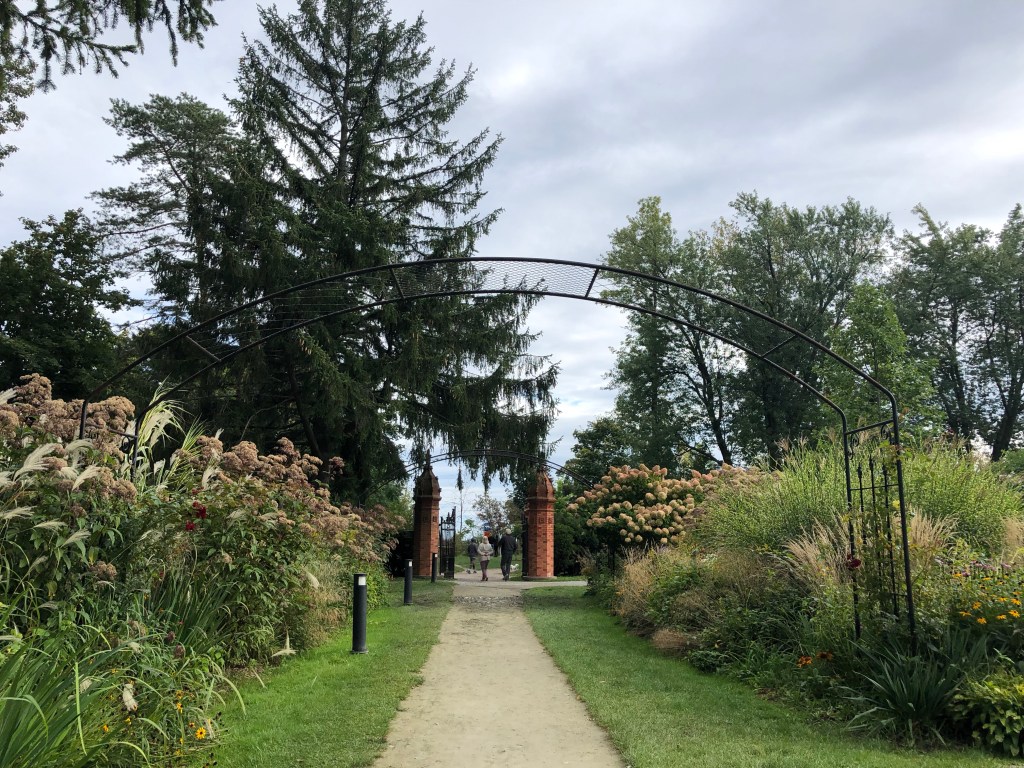
A fairy tale-like entranceway at Guildwood Park, enjoyed on a recent family hike.

Viewing this as a parent, it is about maximizing what I have to give of myself to T by minimizing things that take away from my finite capacity.

I don’t say yes to everything asked by family, I avoid “toxic friendships” and I strive to maintain a work-life separation. These are some healthy boundaries I’ve set.

The aforementioned Facebook post also made me reflect about the boundaries I set with T.

I’ve written many times about how his behaviour can be challenging.

This post was a good reminder about the difference between boundaries and rules.

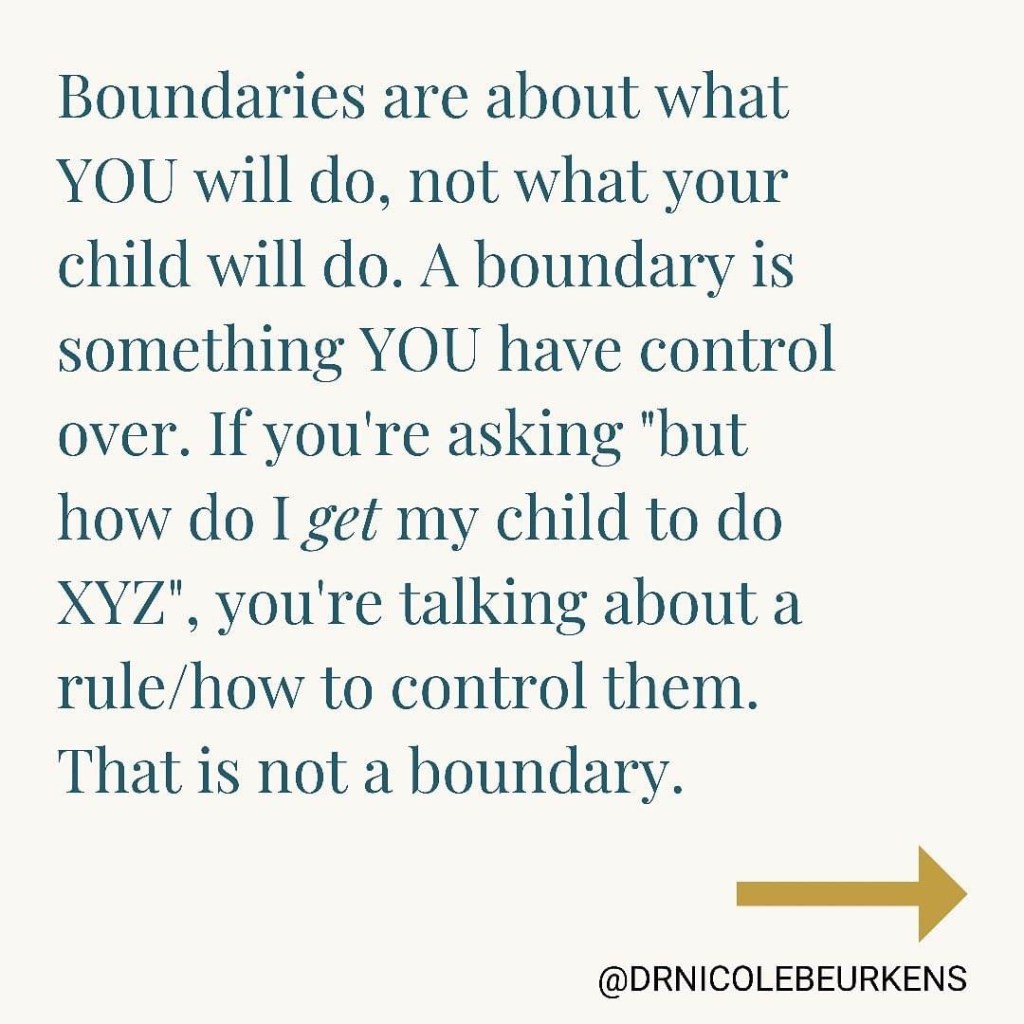
As stated on the above image, citing Dr Nicole Buerkens, boundaries are about what you will do, not what your child will do. A boundary is something that you have control over.

As noted on the image below, boundaries let kids know exactly what we will and won’t tolerate and how we will handle things.

This is solid advice that reinforces areas where we already do this and it reminds me of where the hubby and I can do better.

The hubby and I want to minimize our frustrating moments and maintain our capacity to do better for T. So it improves everyone’s wellbeing.

It’s easier in writing than in practice, of course, but it is important to keep trying!

A beautiful archway along a trail, and an entranceway in the distance, at Guildwood Park.

Pumpkin Pickin

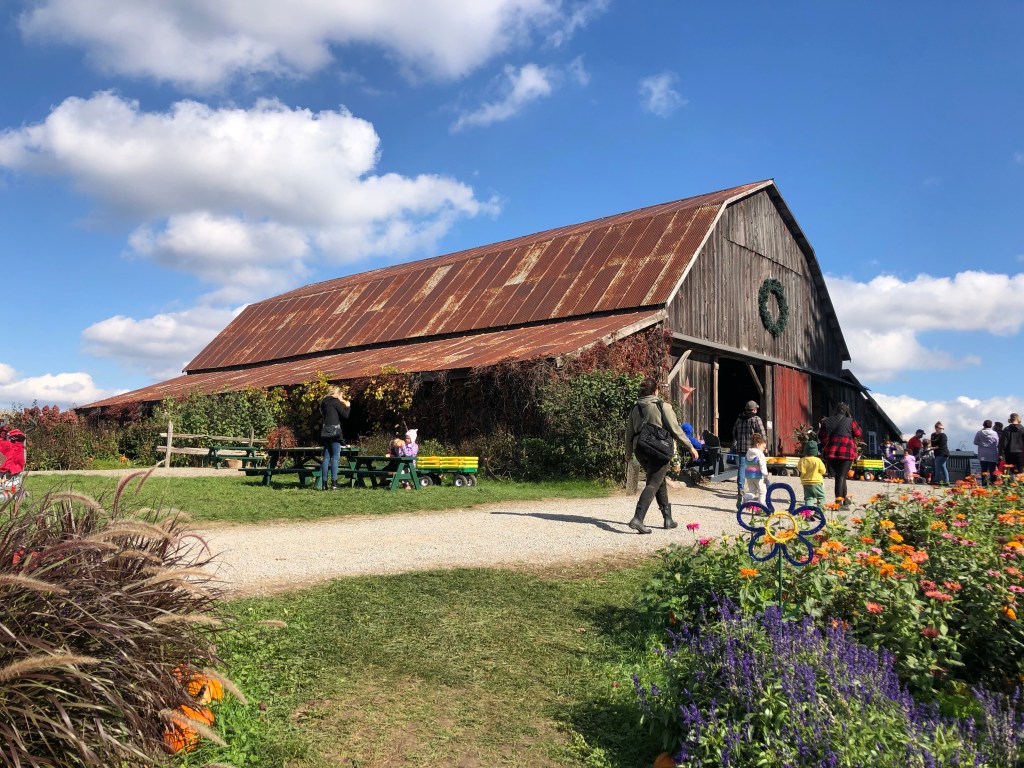
Sunday blessed us with a fun Papa and T date with animals and witches at a pumpkin farm.

On this beautiful autumn morning, T and I went on a morning drive, 45 minutes out of the city, to Knox Family Farm in Clarington.

Along with Christmas and birthdays, Halloween is one of T’s favourite times of the year.

We make an event out of pumpkin picking, costume selection and of course, the big day itself.

We kept it low profile last fall due to the pandemic. This year, as things open up, we ventured out for our family tradition.

We arrived at 11. The crowd was still bearable. Our first stop was to see the barn animals.

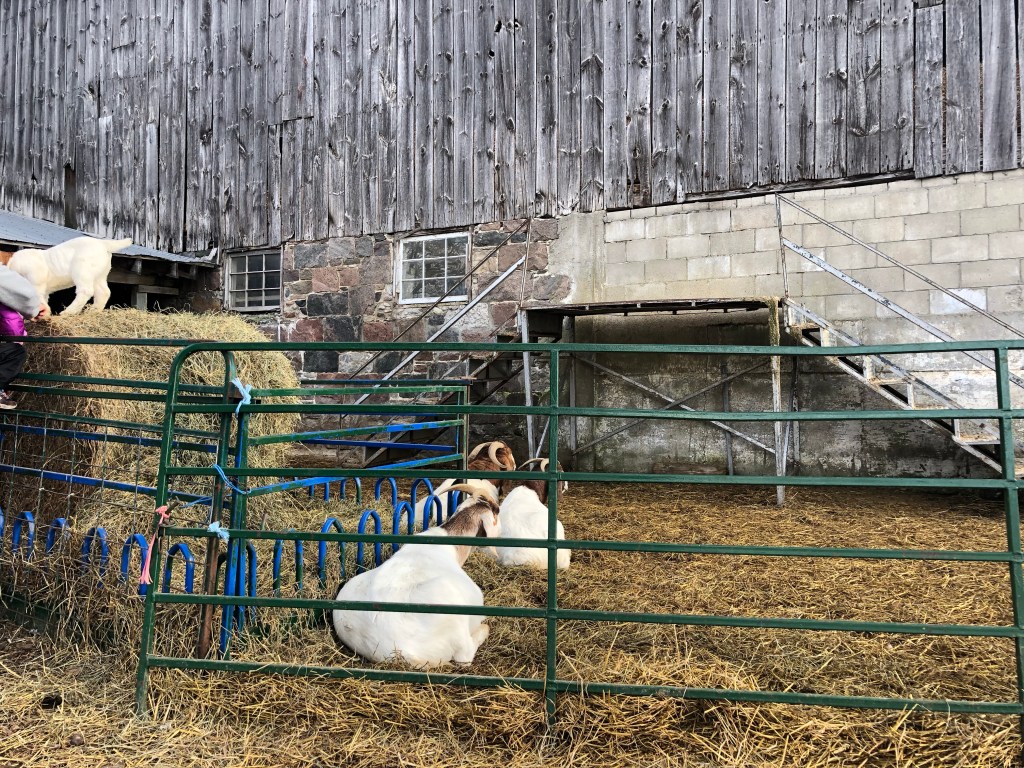
T spotted chickens and turkeys in the field, awed the pigs, goats and lambs, and was intimidated by the tall horses.

Going out with T requires lots of prep talks, transition warnings and proactive redirection.

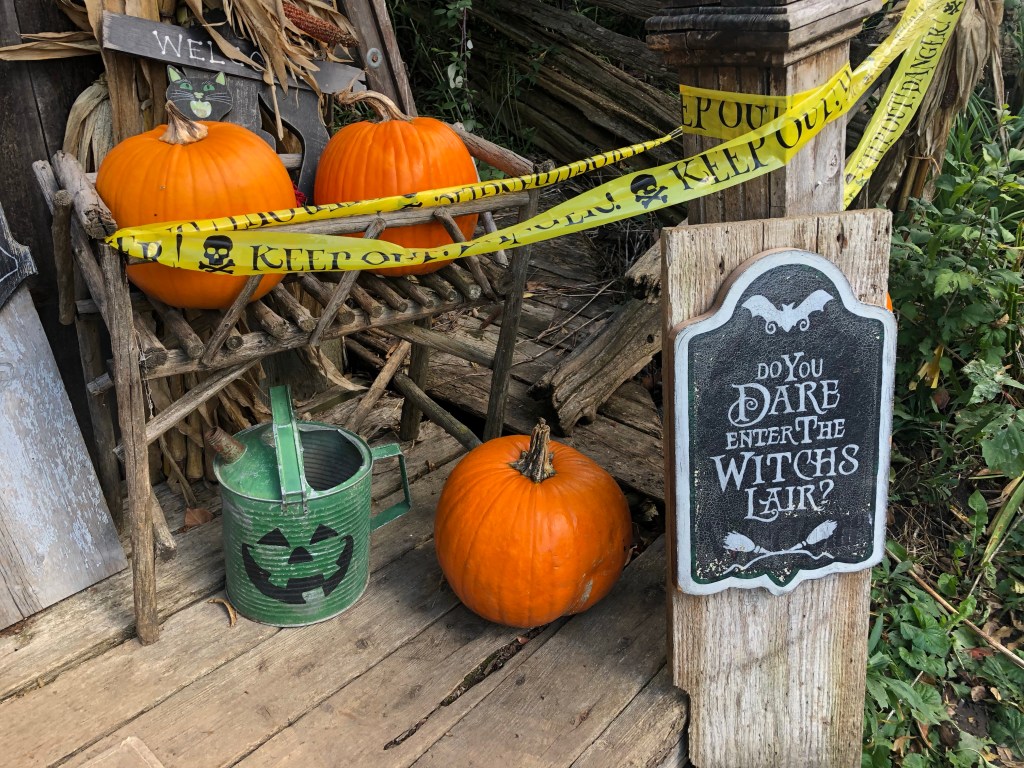
I used the intrigue of visiting “Witches’ Lair” as an incentive for him to take a pee break.

T is at that fun age where he is into scary stuff. We’re still years away from watching slasher films together and I can’t wait for that age!

For now, a haunted house will do. Our T wasn’t scared but he enjoyed it!

We then walked around the farm grounds.

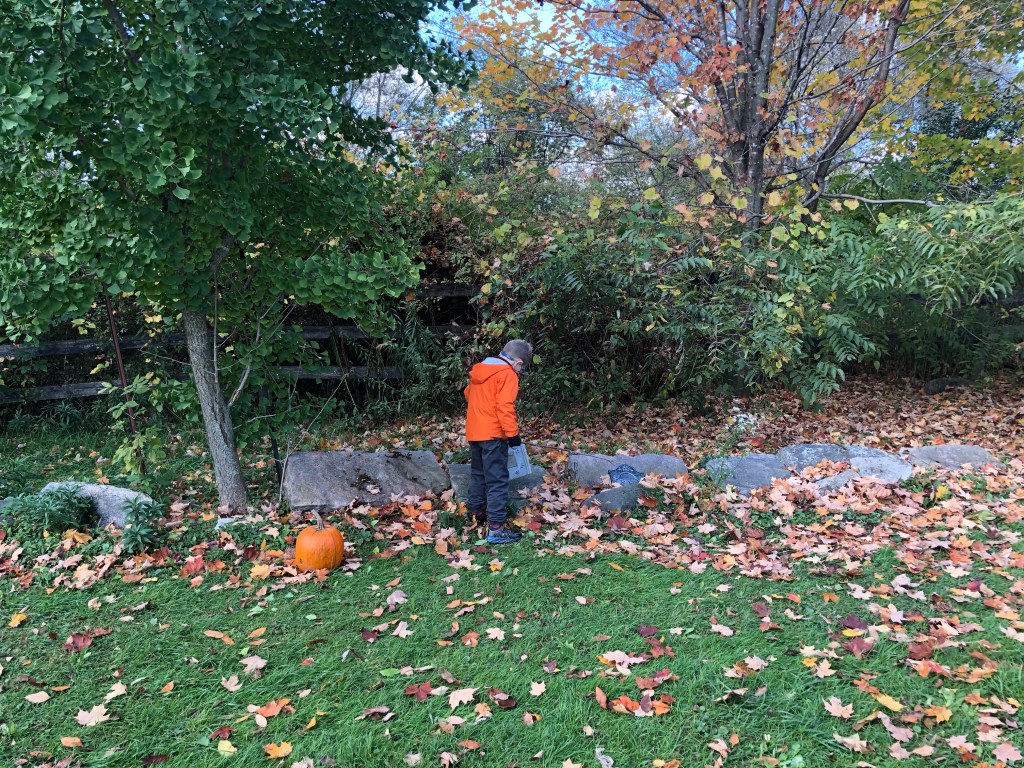
We were blessed with a beautiful day. Fall colours were near peak and it was soul-soothing to walk side by side with T in silence.

He found fake tombstones along the way. I tried to make a scary deal out of them but he said with bemusement, “They’re not real!”

Next stop: We checked out a corn maze. Naturally, T zipped ahead of me and I lost him for a few minutes – and boy, did I enjoy those few minutes of solitude!

The highlight of our visit was T going on his first pony ride.

At first, he was quite anxious and wavered between wanting to go and not. Eventually, I told him he could pick whichever one he wanted to ride: whether it’s a small pony or an adult horse.

He chose the tiniest pony in the bunch. And it was beyond adorable.

We ended our visit by picking the pumpkin.

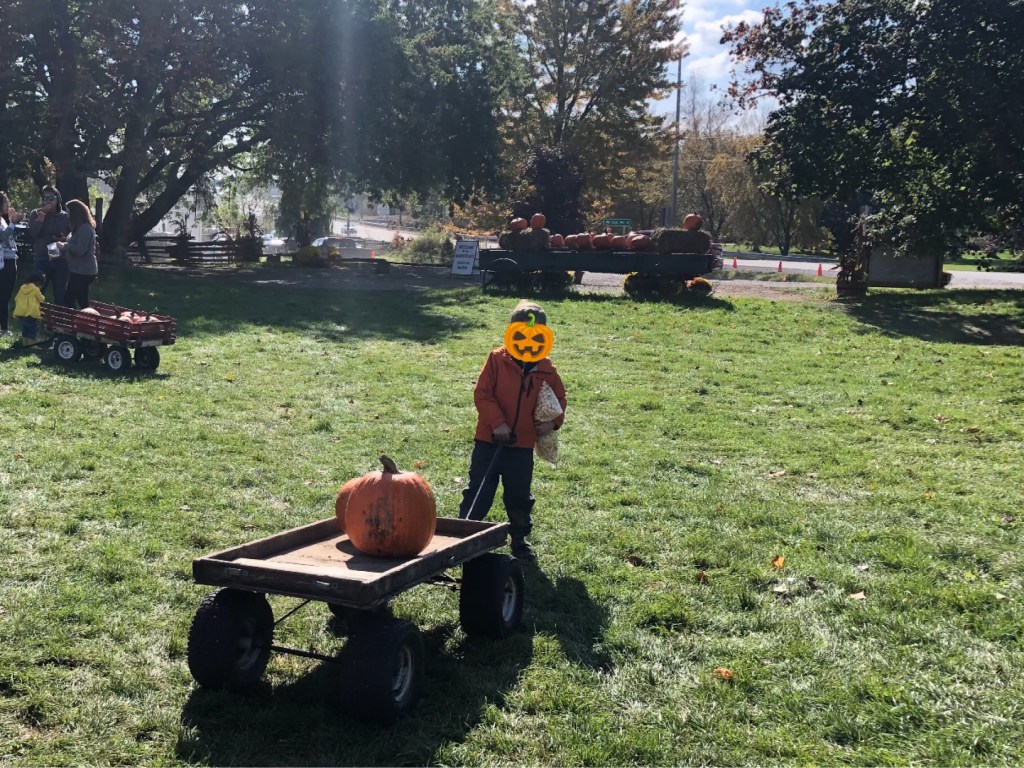
I let T pick whichever two pumpkins he wanted and he did a great job.

For having a super morning of following instructions, I let T pick a snack of his choice from the snack tent. As expected, he chose a bag of kettled popcorn.

The hubby had stayed home – and got four hours free to himself (you’re welcome, dear!). T and I came home to a tidy house (thank you, dear!).

So it was a win-win Sunday for all of us!

Love Is Half the Battle

“Love is a wonderful healer but it cannot undo brain damage.”

When starting the FASD journey, I came across a parent’s testimonial that struck a deep chord.

Sarasota-based Kathryn Shea wrote a compelling story about raising her adopted son Seth.

Stories like Kathryn and Seth’s made me feel part of a larger whole, less lonely and ever the more determined to succeed.

One part of her story stayed with me: “As a social worker, I believed nurture always won out over nature, and with love, a nurturing environment, and appropriate stimulation, he could overcome anything. Love is a wonderful healer, but it can not undo brain damage.”

After five years of parenting T, I can say that I agree with Kathryn.

Love will not cure the long-term effects that prenatal alcohol has done on his brain.

From time to time, when talking about T, family members would make comments like: Maybe one day, his brain will heal after being surrounded by love.

I find these well-intentioned comments frustratingly naive. It incites the same reaction in me as when politicians offer thoughts and prayers after a tragedy like a shooting.

Just like thoughts and prayers, while comforting and healing, won’t stop future shootings, love alone will not make T’s life easier.

Without educational supports, societal awareness about FASD, investments into social services, policy changes, and increased effort to reduce the harmful stigma surrounding FASD, T and others like him will continue to face challenges.

Recent fall family hike at Guildwood Park.

However and a big but… With that said, I strongly believe that love is half the battle.

Providing a child with a loving environment can help set a solid foundation to build their resiliency and to face the challenges.

When I attended an FASD seminar years ago, the speaker spoke about how trauma impacts the brain’s development and whereas the opposite can help influence the individual’s trajectory in a positive direction.

I’m a pragmatic optimist. I believe in the power of love to shape one’s destiny. I also just happen to believe that love alone is not enough.

To give kids like T a fighting chance, we have to invest in infrastructure, policies, resources, advocacy and education about FASD geared towards making their lives better and ditto the lives of their caregivers and key players, such as educators and employers.

It continues to dismay me how little is known about FASD by the general population, especially when it is more prevalent than one realizes.

This is why Kathryn Shea’s story inspires me. I have followed her family’s story over the years, checking in on her and her son Seth from time to time from a stranger’s distance.

Not only has she shown such compelling love for her son, but she’s dedicated her life’s work to making the world a better place for individuals with FASD.

Just last month, an FASD clinic, the first of its kind in Sarasota, was named in her honour.

As described in this article, Shea was instrumental in opening The Florida Center’s Fetal Alcohol Spectrum Disorders Clinic in 2005, the only clinic of its kind in Florida.

What touched me the most about reading this recent news story was seeing the now grown-up Seth in the photo, joining his parents in the ribbon cutting ceremony.

This story made me feel hopeful.

Hope, like love, is half the battle.

Swimming Upstream

Watching salmon migrate upstream was unexpectedly calming and relatable.

The hubby, T and I spent this sunny but chilly Sunday exploring Port Hope, located an hour drive from home.

This scenic town served as the filming location for the recent two-movie adaptation of Stephen King’s novel It.

The town has a historic charm with its old but well-maintained and beautiful homes.

We walked around downtown, which I seem to feel was featured in the aforementioned movie.

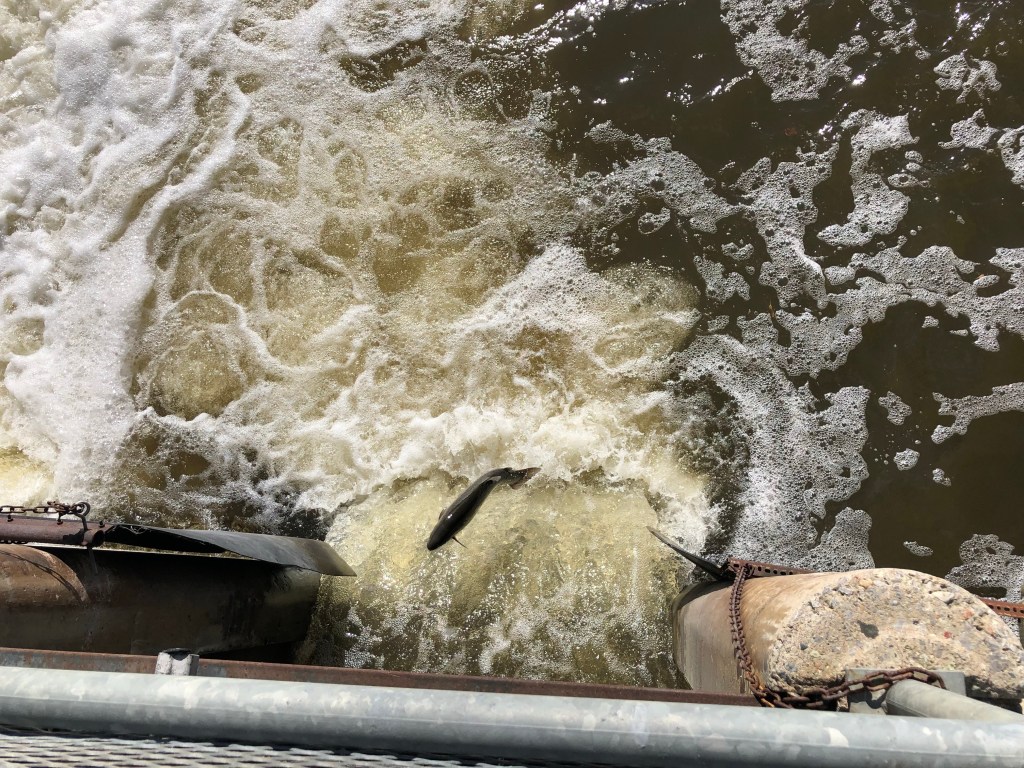
The highlight of our visit was Ganaraska River Dam, where you can spot salmon and trout migrating upstream between August to early October.

We thought we had missed the annual migration but we were blessed with plenty of sightings.

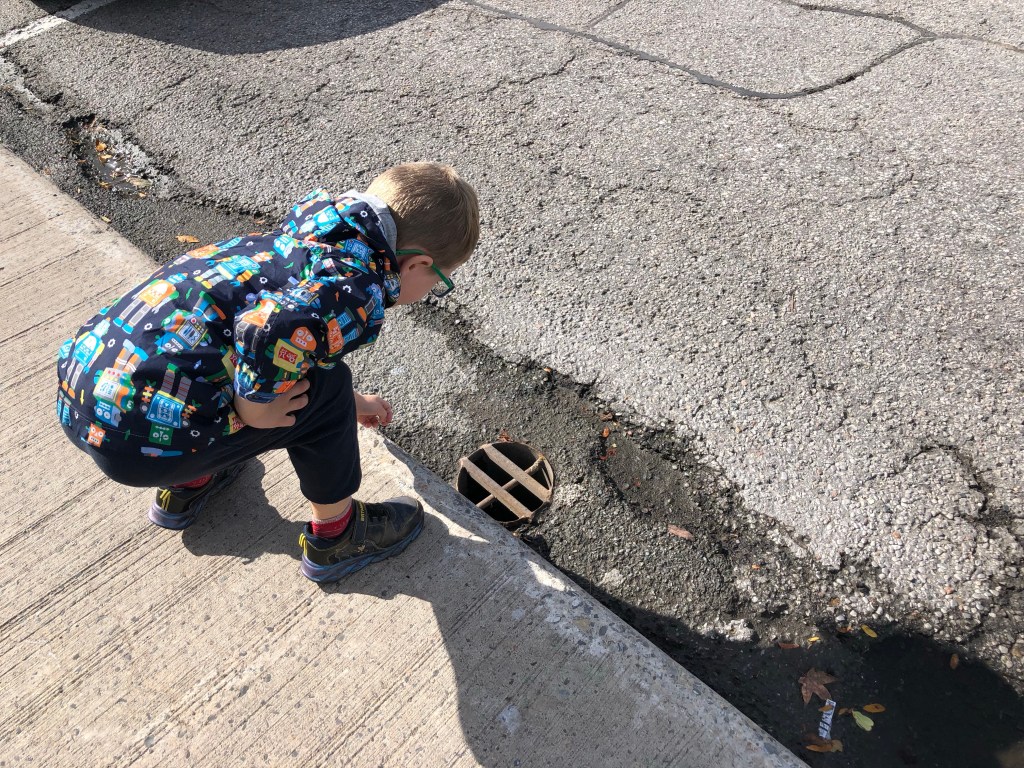
T quickly claimed his own viewing spot.

It was not hard to imagine that T sees a kindred spirit in these determined energetic fish.

Salmon are said to live 3-5 years. Near the end of their lives, they migrate upstream back towards the river bed where they were born.

How they are able to remember and find their birthing spot is surely another sign of nature’s magic.

Once they spawn their eggs they die.

As I watched these fish make the tiring swim and jump upwards, I too found a kindred spirit.

I’m the fish and that unrelenting gushing water is our T.

As I was thinking about this, a salmon jumped out of the water, smacked onto a concrete wall and fell back where he had started from.

Yup, definitely a kindred spirit.

In case you were wondering, we did not encounter the demonic clown Pennywise from the movie It. I had a red balloon ready too in the hopes of getting a few hours off from parenting.

Looking for Pennywise the clown from It.

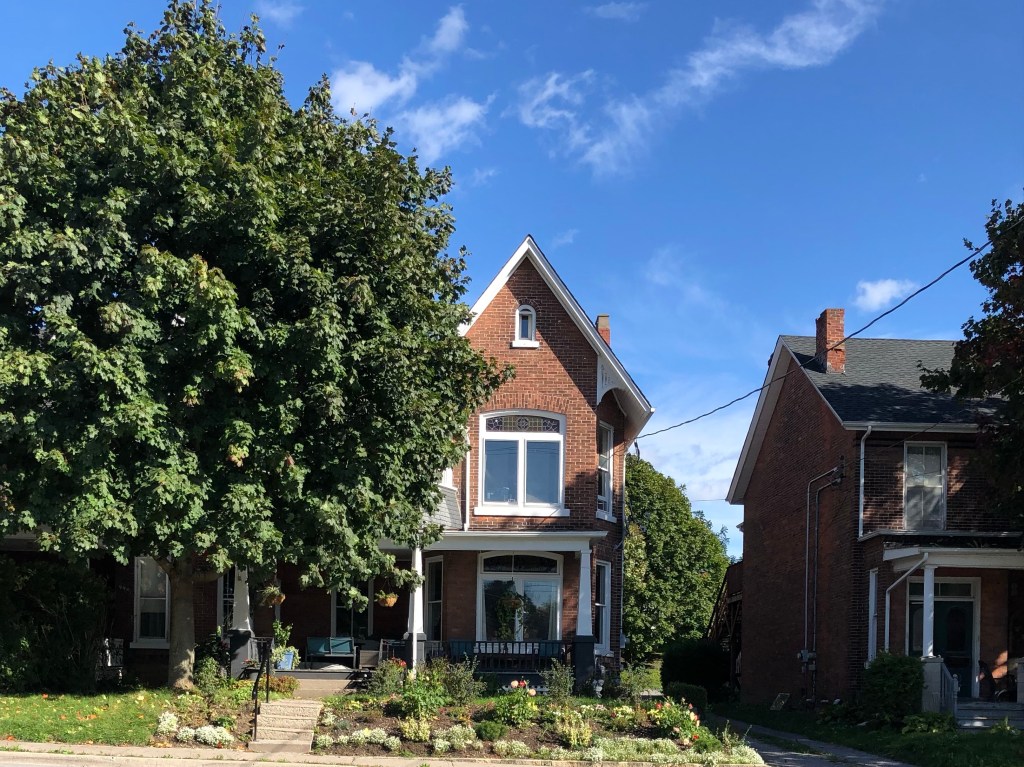
However, on the drive back home, we passed by this awesome house that was clearly ready for Halloween.

It brought a huge smile to T’s face and in turn, ours too.

Great Expectations

As a special needs parent, I often struggle with the difference between adjusting and lowering my expectations.

This is forefront in my mind now that T, a kid with great potential and a prognosis of at-risk FASD, is in Grade 1.

School learning is now more formal and less play based. Expectations have gone up and with it, so have the daily struggles and stress.

Last week, we spoke with his teacher about developing his Individualized Education Plan (IEP) for this school year.

One thing she said struck me immediately: her goal is for T to complete 25% of the Grade 1 curriculum.

I’m an honest and heart-on-my-sleeve person so I immediately voiced my concern and asked if this would mean we start to widen the gaps between T and other kids. How would he ever catch up?

I explained that while the hubby and I recognize T’s prognosis, we hope that disclosing it would not mean teachers use it as a reason to dismiss T’s potential to learn and grow.

His teacher reassured us that she has worked with many children with special needs and explained the purpose of setting IEP goals is to ensure T can feasibly meet these goals and to scaffold his learning.

If T is able to meet these mutually-agreed upon goals, she will continually adjust and increase them throughout the year.

She reassured us that, if anything, she will try even harder with T.

I believed her, as I have a good feeling about his teacher this year.

“I must be taken as I have been made. The success is not mine, the failure is not mine, but the two together make me.”

– Charles Dickens, Great Expectations

But I did ruminate about this for a few days after and felt that familiar sense of grief: when the reality of your dreams for your child clashes against the challenging reality.

I’ve written many times that T is a bright, caring, funny, determined and strong-willed child. I still believe in this wholeheartedly.

But I can also see that his academic journey is going to be challenging. There is no doubt the next few years will be very trying.

I have a love-hate relationship with the term “special needs.” I hate the stigma that is attached with this label and find that it can be damaging when it is applied by people who don’t have a full understanding nor are equipped with the tools to support an individual with additional needs.

My biggest worry is that people will limit, dismiss and not try as hard with T, because they will think about why they should even bother or they lose their patience with his exhibited behaviour.

But I also recognize that in order to build empathy and understanding – and to also advocate for and to receive the resource supports for T, we need to engage in open and respectful dialogue about his needs.

“I have been bent and broken, but – I hope – into a better shape.”

– Charles Dickens, Great Expectations

We have been very fortunate so far to have met understanding and empathetic professionals in the school and daycare system. We know it won’t always be like this.

For myself, the mental hurdle I always have to leap over is recognizing that adjusting my expectations – such as breaking down T’s learning goals into bite-size feasible pieces in order to build his long-term confidence and success – is not the same as lowering my expectations for him.

If anything, the hubby and I have higher expectations for T, because of the additional effort he requires from us on a daily basis.

I have to remind myself that T is on his own journey and the yardstick we measure him up against is himself and not other kids.

Most days, this is an easy mental model to follow. On some days, especially the frustrating ones, it is tempting to lose sight of the target and to start drawing comparisons with other kids.

It’s a good thing T is an easy kid to love and reminds us through his magical moments of pure endearment to always keep our eyes on the prize.

The Promise of a New Day

This Thanksgiving, I am grateful for the fresh start that each new day brings.

The last two weeks have been rough with T.

I don’t know if it’s because the honeymoon phase at school has passed or if he’s finding the transition period challenging but we’ve had rough patches on an almost daily basis.

During daycare pickup last week, his teacher quickly walked towards me when I arrived to let me know there was an incident.

T had punched one of the kids in the arm giving them a bumpy bruise after the kid took the toy away from T.

I was upset with T the car ride home and all evening at home, reminding him that while the kid taking the toy was unacceptable, punching someone was not right.

Last Friday was a challenging day for T at school, with incidents in the playground during all three recesses, including him hitting a kid with a stick.

It was very hard to not get upset at these incidents and it felt like every morning and evening were filled with tension and tears.

On Friday night, as we looked forward to a long weekend, I told T at bedtime, “I know there were a lot of tears, screaming and hard moments this week, but we will turn it around this weekend.”

That’s the great thing about kids with FASD, of which T has an at-risk prognosis for: every day is a blank slate and a new start.

Our Thanksgiving family tradition is to do a short weekend getaway to enjoy the fall colours.

We visited Quebec the first year T came into our lives and before the pandemic we did a chowder-inspired trek to Vermont.

This year, we kept it local: an overnight visit to scenic Blue Mountain in Collingwood, just under two hours drive from home.

It’s been nearly 15 years since I last visited with friends for a day-long ski trip.

During the fall, it was so beautiful with changing colours; vibrant yellows, oranges and reds.

We boarded a gondola, a new feature since our last visit, that took us to the top of the mountain, where we enjoyed a nice long hike through trails and beautiful views of Collingwood below.

T really enjoyed the ride, telling us proudly that he was not scared of the heights.

As I watched T in the gondola, looking out into the world below, I said a silent prayer to give thanks for this moment of reset and renewal.

Every day is a clean slate. That is what I’m most thankful for this Thanksgiving. The opportunity and the ability to keep looking and moving forward to the better views that inevitably lie ahead.

Honey Harbour

If it’s bitter at the start, it’s sweeter in the end.

I reflected on this during a two hour drive home from Honey Harbour, a scenic set of islands along Georgian Bay, where the hubby, T and I spent Saturday with my aunt and two cousins.

We woke up early to ensure we arrived at 9:30 for the boat taxi to take us to the island.

The 10-minute boat ride over was beautiful, as we daydreamed about owning one of those cottages by the water and tiny islands.

T sat the back of the fast-moving boat, enjoying the foamy waves, feeling the wind on his face.

Thankful for a day to enjoy the beauty of nature.

This weekend marked the end of the first month of school.

As a whole, things are going ok at class and daycare. But we are also dealing with daily frustrating challenges.

Simple tasks such as getting ready are battles, often resulting in tantrums, with toys thrown at us, angry words exploding out of T’s mouth.

T has had a few rough moments with peer interactions – but we are thankful for the support of a temporary Child and Youth Worker and wonderful staff at school and daycare.

Evenings are often tough around bedtime. His teacher has started assigning daily reading homework. You’d think this would be easy, but just getting him to focus is tiring as there is always an excuse to not do the task.

It may not feel like it on some days, but we are always taking steps towards the next milestone.

So it was with his mindset and deficit of energy that we entered this weekend.

Our day at Honey Harbour was great in the grand scheme. T was in his element, charging up and down the beautiful granite hilly trail. He can be a parkour artist one day!

The kid with no fear. A good reminder to focus on the bright spots while working through the patchy ones.

The challenges came with his impulsive hyperactivity. We repeatedly told him not to dig up the moss or wild mushrooms, which could be poisonous, or to step on the muddy puddles.

So he dug up the moss every few steps and threw them at the hubby and I. Picked up wild mushrooms and pulverized them in his hands. Stomped on muddy puddles and ruined his brand new shoes. The whole time laughing and thinking the hubby and I were amused.

The beauty of fall provides a wonderful moment to take a deep calm breath.

It was good for my family to see this behaviour. I sometimes feel like people don’t quite understand when I explain T’s challenges.

But as always, I framed it as challenges related to his neurological condition: hyperactivity, lack of impulse control and difficulty with learning from consequences. Reiterating that T is not a bad kid, he just has challenges many kids don’t as a result of prenatal alcohol exposure.

Other than his frustrating moments, T was at his charming best.

He was very playful with his Uncle J, whom he really likes. He helped my aunt and my cousi walk down the slippery downhill spots. He gave them big hugs.

During a picnic lunch stop, my aunt noted that she noticed he is a lot calmer than before. I thought that was very kind of her to say.

Sometimes, the hubby and I are so mired in the weeds that we forget to take a step back to see all the gains T has made.

He can be so frustrating and irritating, but he has also made tremendous progress.

I need to remind myself, especially during the hardest moments, to celebrate and focus on that.

According to experts, a hive of bees must travel up to 55,000 miles to produce a single pound of honey.

As I stood at the scenic lookout points at Honey Harbour, while our T, coincidentally wearing a bright yellow hoodie, flitting about like a busy bumblebee that’s ingested a pound of speed, this is what it means to be his parent.

It is a shit load of work, probably requiring more effort than an average parent would exert in their day, but there is sweetness that comes through this laborious process.

T was having a blast in nature, running about and exploring with abandon and enjoyment.

If it’s bitter at the start, it’s sweeter in the end.

On the boat ride back, the exhausted hubby held onto T’s leg while he peered over the boat. I silently motioned to toss T over. He said, “Oh, I’ve thought about it,” and we both laughed knowingly.

The Nights That Never Die

I often think about the important life advice I want to share with T as he gets older.

This past Saturday, I came across a song by the late Swedish DJ Avicii, whose soulful work I’ve long admired, called “The Nights.”

Its simplistic lyrics, told through the perspective of a young man recounting his father’s advice, deeply resonated with me.

He said: ‘One day you’ll leave this world behind.

So live a life you will remember.’

My father told me when I was just a child

‘These are the nights that never die.’

– The Nights

Every parent has their own perceptions of the important things to impart to their child.

One of my dearest friends gifts T with a book for every birthday. Her latest gift is Oliver Jeffers’ “Here We Are: Notes for Living On Planet Earth,” a book the Irish artist wrote detailing what he felt his newborn child needed to know.

Growing up, I always got the impression from my parents that I needed a good education and a well-paying job to be successful.

My mom always hoped one of her kids would become a doctor and has transferred that hope to T, even after I’ve reminded her that while we won’t limit him, his prognosis will make school-based learning challenging.

My parents weren’t wrong that working hard in school and life is important, but I’ve learned to use other metrics of success.

First and foremost, happiness = true success.

From that flows the values and hope that I would like to impart to T:

  • Work ethic and enjoyment over status
  • Life experiences over material things
  • Comfort, health and kindness over wealth
  • Quality over quantity of relationships
  • Journey and process over destination
  • You are never alone in this world
  • Daddy and Papa are always here for you
  • Define for yourself what happiness means to you – then work and fight for it

In my prayers, I often ask for T to live a life with happiness, good health, self sufficiency, rewarding lasting relationships, and the ability to contribute positively to the world and to himself.

Whatever that looks like for him, I’m open to all possibilities.

One day my father, he told me

‘Son, don’t let it slip away.’

He took me in his arms, I heard him say

‘When you get older

Your wild heart will live for younger days

Think of me if ever you’re afraid.’

– The Nights

On Saturday, we had a rough start to the day. The smallest things – getting ready to go for a walk, practicing reading – felt like a battle.

Feeling frustrated, I left him in the hubby’s care and went to the gym to let off steam.

Later at night, I was lying in bed reading the news, when T came in to snuggle and asked if we could look at photos on my phone.

We journeyed back to our first camping trip, a video of him going down a set of stairs for the first time, to a video of him cliff jumping for the first time at Killbear last summer.

After T went to bed, I scrolled through Instagram and came across a travel video that was scored with Avicii’s song.

The song struck such a chord, after T and my walk down memory lane moments earlier.

I imagined that it was T singing those words – and living his best life – and felt a tear or two fall down my face.

When thunder clouds start pouring down

Light a fire they can’t put out

Carve your name into those shining stars

He said: ‘Go venture far beyond the shores

Don’t forsake this life of yours

I’ll guide you home, no matter where you are.’

– The Nights

Bringing An Animated Italian Dish to Life

Thanks to Disney, I’m discovering the joys of Italian cooking with my family.

I recently wrote that T loves the movie Luca, a wonderful animated coming of age story about accepting what makes you unique.

The film is also a love story to Italian culture, from its beautiful seaside town setting to the delicious cuisine enjoyed by the characters.

One memorable scene is when the characters enjoy a traditional Northern Italy dish called trenette el pesto (pictured at top).

I enjoy Italian food but it’s not something I often make. Carbs are also counter productive towards my current “I want abs, dammit!” mission.

I recently discovered Instagram videos by The Pasta Queen. She is over the top but in a tongue-in-cheek way and her recipes are amazingly beginner friendly.

I came across her pesto pasta recipe and noted that it looks like the dish from Luca.

I thought about how much T loves Luca and what a picky eater he is. So I had to try making this, in the hopes of adding a new dish to his limited rotation.

BuzzFeed recently made the Luca recipe as provided by Disney’s marketing team.

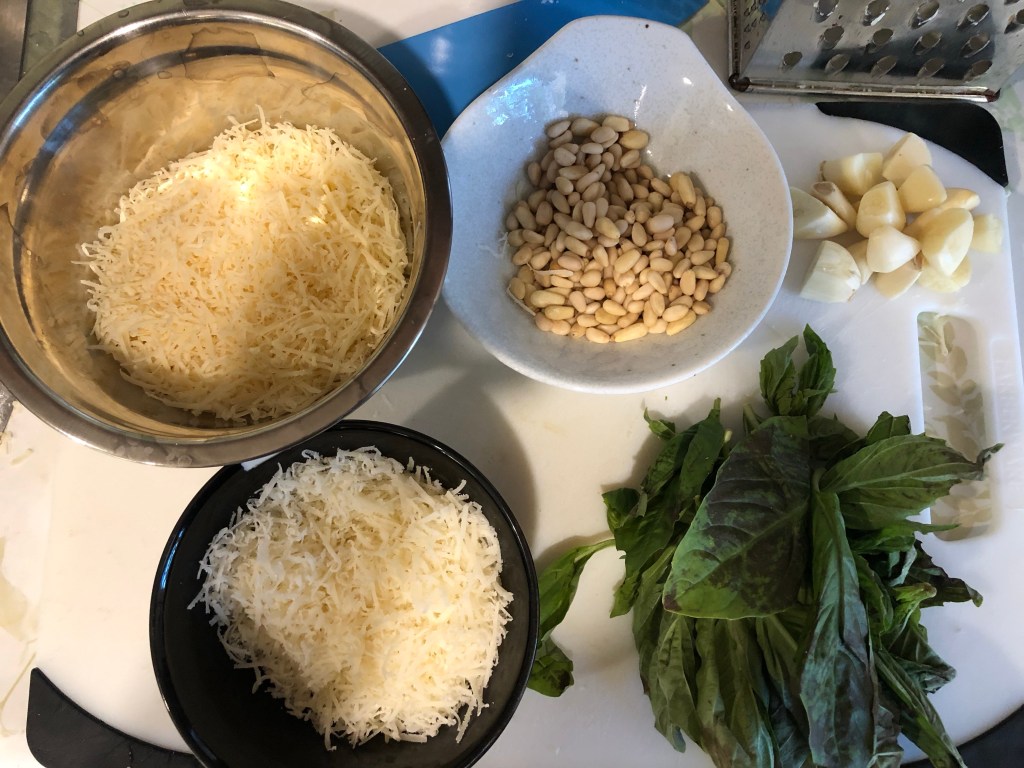
I stuck with the Pasta Queen recipe, which has almost all of the ingredients for trenette el pesto: fresh basil leaves, garlic cloves, pine nuts, pecorino Romano, parmegano reggiano and extra virgin olive oil.

The Disney recipe also includes green beans and potato. But whatever.

Just seeing the lovely ingredients together was so soothing to my soul. Cooking truly brings me comfort these days.

What was great about this dish is how easy it was to make. I guesstimated portions for each ingredient and tossed them in the food processor.

And voila! I made pesto. I never realized how easy it was!

The hubby teased me, as he always does, after I threw around, with extra enunciation, the fancy-sounding names of the ingredients.

“You know parmegano reggiano is just Parmesan cheese, right,” he said.

I gave him a silent glaring look that said, “Get out of my kitchen.”

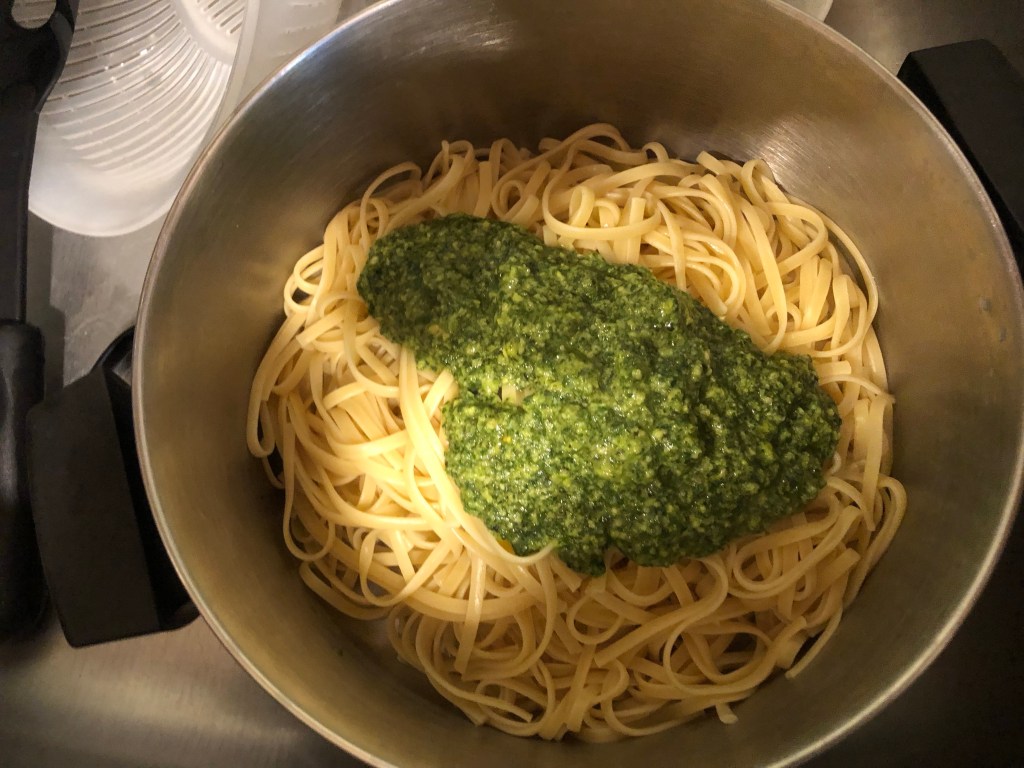
I then placed the pesto atop freshly-boiled linguini. Then I applied an Italian cooking technique I recently learned.

Instead of throwing out the pasta water – from the pot the linguini cooked in – I kept a cup and poured it over the pesto and linguini.

The pasta water, pictured below, helped bind the pesto to the linguini. Who knew!?

And voila, here is the pretentiously-plated pesto pasta!

T was excited as I was making it, popping by every now and then to check on my progress.

When I presented him the final plate, he looked at it, smelled it and promptly said, “Yuck!”

Oh well, we tried! In all honesty, I was glad there was more for the hubby and I to enjoy!

This experience has unlocked a new interest in exploring traditional Italian cooking.

Like I do with everything else, I had used triple the amount of garlic required. And boy, did we feel it after!

As I was lying with T at bedtime, we snuggled closely as always. After I spoke, T told me in his usual frank way, “You need to brush your teeth, Papa. Your breath stinks!”

As they would say in Italy: That’s Amore!

Low Tide

One great advice I’ve received about finding balance in life is a metaphor about tides.

Tides are described as “the rise and fall of sea levels caused by the combined effects of the gravitational forces exerted by the Moon and the Sun, and the rotation of the Earth.”

My colleague’s advice is deceptively simple but wise: when tide waters come in, swim. If treading water is all you’re able to do, you’re doing great!

When tide waters recede, take time to catch up on things you never get to do during turbulent times.

It’s a great metaphor that applies to anyone. When viewed as a busy working special needs parent, the advice boils down to: take advantage of the bits of downtime that life blesses you with.

This summer, we were blessed with nearly two weeks of relaxation in August to visit T’s Grammy and Grandad in the East Coast.

After a challenging Spring of simultaneous virtual schooling and work, I took full advantage of this gift of time: I did not log into work once, I went to the gym and I inhaled the salt water air.

On our last day at my in-laws’ cottage, we were blessed with a beautiful low tide morning. The waters receded and exposed sandbars.

T, his cousin, Aunt, grandparents, the hubby and I joined other locals to walk leisurely bare feet on the shallow water and sandbars.

T busied himself by helping dig up quahogs and crabs. The hubby was especially great at knowing where to dig up quahogs.

Together, we collected quite the stash (see photo at the top) and even found a large one!

In the past, the hubby would cook the quahogs into a yummy chowder. But there’s been reports of a mysterious neurological condition affecting locals that’s been linked to eating wild quahogs.

So no thanks! We have enough neurological-based challenges that’s keeping us very busy!

So we left the quahogs alone and they all eventually buried themselves back in the sand. It’s quite marvelous how they do this!

T also found small crabs and even larger ones (above) and also jellyfish (below).

Myself? I zoned out. My mind drifted off into my quiet, calm and happy place – that the hubby jokingly refers to as “La Isla Bonita.”

I watched T and his cousin enjoy themselves. I let the shallow refreshing water sway back and forth above my ankles. I silently prayed to give thanks for the two weeks of restful bliss.

We then went back inside to have lunch and to enjoy the final hours of our vacation before we had to head back home early next morning.

Outside, tide waters started to come into the bay.

Bugs and Helping Kids Overcome Fears

Our 6 year old was bugging out and we tried to help him find a new way to look at his fears.

We first noticed this behaviour in July, when he’d hyper-focus on flying insects: everything was a “bumblebee”, including flies, dragonflies, mosquitoes and yes, bees, wasps, hornets.

He’d become frozen in fear, asking for our help to walk down our front steps because he was afraid he’d get stung.

The hubby and I were not sure how it all started and we also knew fear of insects is normal.

But we also just began summer and we didn’t want it to affect plans we had to explore the outdoors, where there were bugs everywhere!

Thankfully, T was still game to do our outdoor activities – hikes, roadtrip, swimming in the wild. But unlike previous years, a lot of his attention was on the bugs, either not wanting to be stung or wanting to swat them.

And the kid wonders why they could ever want to sting him!

I did have a lot of empathy for T.

When I was 7 in the Philippines, I was watching TV on my parent’s bed when I felt something crawl on my leg. It was a big cockroach!

I screamed and swatted it off my leg and then its wings spread open. I jumped off the bed screaming as the roach flew after me out of the room and into the living room. I jumped on the couch and turned around and saw this roach flying towards me.

I felt so creeped out about insects for many years after.

So it was with this mind that I knew we had to try a different approach other than, “Relax, they’re not going to hurt you.”

It was important to validate T’s feelings, while trying to find a productive healthy way to help him face his fears.

As someone who works in information services, I thought the best way was to share factual and fun information about insects – and to show T that insects are nothing to be afraid of and in fact, are very cool.

So I first found a few age appropriate videos about bees and we watched them.

We learned about why the bumblebees buzzed about busily in our garden next to our front steps. What a surprise: they were collecting nectar and not waiting to attack T!

We learned that bees do sting people, but they only do so when they are afraid or angry. We learned that when bees sting, they die. So they have to be really scared or angry to sting someone!

So every time we were outside and T got into one of his perseverating moods about “bumblebees,” I reinforced the same message, “Bees only sting you when they are angry or scared, so just leave them alone and you’ll be fine!”

In addition to watching videos, we tried to read books about insects.

Books are a great way to convey a message in non preachy ways. Astronaut Chris Hadfield’s The Darkest Dark is one of my favourite books that we’ve read to T as it conveyed the message out the dark in T’s room at night is nothing to be afraid of.

To be clear, T still gets creeped out by bugs… and the dark at night. We never expected nor received an overnight cure.

But over the summer, we slowly saw a calmer T around bugs. By learning more about them, he even started to find them interesting.

He became curious and less fearful and approached them to observe them… and yes, to squish them. He is a six year old after all!

Daycare staff report that he enjoys looking at ant hills when they play outside.

At home, he likes to look at the spiders and cobwebs outside our disgusting old living room windows.

Most recently this week, he became very fascinated with walking sticks, insects that look like, well, walking sticks – after they were very briefly mentioned in a bedtime story we read called, “Goodbye Summer, Hello Autumn.”

It was all he could talk about this week.

So I found a short video about walking sticks that we enjoyed together before bedtime. It was a nice way to show him just how amazing insects are, in this case, camouflaging themselves to increase their odds of surviving predators.

When I think about what is going on in the world, with spineless politicians and groups waging a disinformation campaign against COVID safety protocols and vaccines, using fear as a weapon, I can’t help but think about what our T has taught the hubby and I about facing one’s fears.

Hot Pot and The Case for Eating Together

My family recently enjoyed a Chinese traditional dinner that dates back over 1,000 years.

Enjoying a meal together as a family is something we don’t do enough of.

T is a picky eater, so we make his own meal and get him fed on school nights before we eat.

Weekends, going to someone’s home or eating out present less frequent times to eat together.

I wish we could do better. But I don’t lose sleep over it, because there are many other moments we spend time together and T gets social eating moments and skills at school and daycare, so we’re not quite raising a feral cat.

This past Saturday, I prepared a hot pot dinner for us to enjoy. It was all I could think about in my free time last week, as cooking has provided me much comfort as of late.

The hotpot concept is simple: “a simmering metal pot with broth boils at the centre of a table and people can add and cook all the raw ingredients they like in the broth.”

The hubby and I haven’t had hotpot in years. We usually enjoy it at a restaurant but we also own a portable cooker powered by gas canisters. We purchased it in Chinatown almost 20 years ago! It’s practically a family heirloom.

Ingredient hunting was fun.

I went to the local Chinese supermarket. I don’t often shop at these stores, so it’s fun to find ingredients I normally don’t use. For starters, there’s an entire aisle just for soy sauce!

I settled on the following menu: sliced beef, imitation crab, “lobster” balls, fish balls, Napa cabbage, enoki mushrooms, fried gluten, dumplings, udon noodles.

These ingredients were packaged as hotpot ready to cook, so I had very little prep work.

It’s way more affordable to enjoy hotpot at home than at a restaurant. Let that sink in: you’re paying to cook your own food!

The broth is the foundation of hotpot. Our pot has a partition. So one half had standard chicken broth. The other half had satay (peanut) broth, using soup base from the store. Yum!

The condiments to dip the cooked food in are also important. We used what we already had at home: soy sauce, chili oil, sesame oil and chili garlic.

You mix your condiments in a bowl with a raw egg. Dipping sauce is now ready!

The cooking part was enjoyable.

As always, we threw the meat and mushrooms in first. I threw in full stalks of green onion to richen the broth.

T was curious about the hotpot. He helped add items in. We warned him to not toss items in, because this was piping hot boiling water!

You know the best part of hotpot? It forces participants to slow down and savour the moments while the food is cooking.

Once the food is cooked, you dip it into your sauce and enjoy. Then add more food into the pot.

Simplicity at its enjoyable best!

After the meat, mushrooms and gluten were finished and when the broth had built such rich flavour, we started the final act of hotpot: we added the Napa cabbage and udon noodles.

A nice bowl of flavorful veggie udon noodle soup was a nice way to end the evening.

As I previously wrote, I’m working hard to portion control, so the hubby and I didn’t overdo it. We were satisfied but not stuffed.

So we now have enough leftover ingredients for another round of hotpot this coming weekend. You can bet that I’m counting down the days!

Oh, and I bet you’re wondering if T ate the hotpot food, aren’t you?

Are you nuts? The kid won’t even eat a fucking carrot!

He sat down at the dining table and ate a plate of spaghetti and meat sauce while the hubby and I cooked and enjoyed our meal.

And honestly, it was a perfect Saturday dinnertime spent together as a family.

Silenzio, Bruno

What does your self talk sound like? How do you silence your negative internal dialogue?

“Silenzio, Bruno,” is a line from the animated film, Luca. It translates from Italian to “Be quiet, Bruno” or “Shut up.” We’re gonna go with the PG translation, thank you very much!

The two boy characters, who are a wee bit older than T, say the phrase to silence the fear and doubt in their minds during key moments.

The hubby was pleased T finally watched the film on Disney+ two weeks ago after trying to get his attention all summer.

I watched it with T, who now watches it almost daily, as he does with any movie he likes. I’m glad he’s moved on from Frozen 2 and Moana – and that characters in Luca don’t launch into annoyingly catchy songs!

What I love about Luca’s story – no spoilers – is it’s literally and figuratively about a fish out of water and provides a wise metaphor about accepting others that may be different and loving the things that make yourself unique.

The theme is universal. 2SLGBTQ+ individuals see a metaphor about coming out. Immigrants see the newcomer experience. I see a metaphor for individuals with additional needs.

I often think about helping T build resilience and a growth mindset.

I think part of that includes helping T foster a positive inner dialogue – or self talk.

This HealthLine article describes self talk as one’s internal dialogue that is influenced by one’s subconscious mind; it reveals one’s thoughts, beliefs, questions, and ideas.

Positive self talk contributes to better health, reduced stress and greater life satisfaction.

I wish to help T develop a positive inner dialogue and the skills to combat negative self talk – especially when studies show that 9 in 10 individuals with FASD will face a mental health issue in their lifetime.

Think about that: 9 in 10. How sobering.

I recently wrote about how it is imperative to try differently not harder.

I think part of that includes being very mindful about the things that we say and do in reaction to T’s behaviors.

I often feel guilty afterwards for how I sometimes unintentionally react to his challenging moments.

In those moments, I would wish right away that I did not say certain things – because I should know better that when a child hears negative words enough, these are the things they internalize and form as their self talk.

So the hubby and I do our darn best – most days are successful, some days less so – to sandwich T’s days with a positive start when he wakes up to a positive moment before bed.

We’re aware that the most challenging parts for him are when he is out in the world, navigating new routines, relationships and increased expectations at school and daycare.

Kids’ confidence soars when they feel good about themselves and that confidence is like rocket fuel that propels them through rough terrain.

We’re like that as adults too. When we feel good about ourselves, our confidence soars. Negative interactions cloudy our day with anxious self talk that distract from the bigger picture.

And that’s why I love “Silenzio, Bruno!” 2 words, 5 syllables. None of this long drawn out Shakespearean soliloquy you engage yourself in. I like efficiency.

Try it!

The first week of school is in the can!

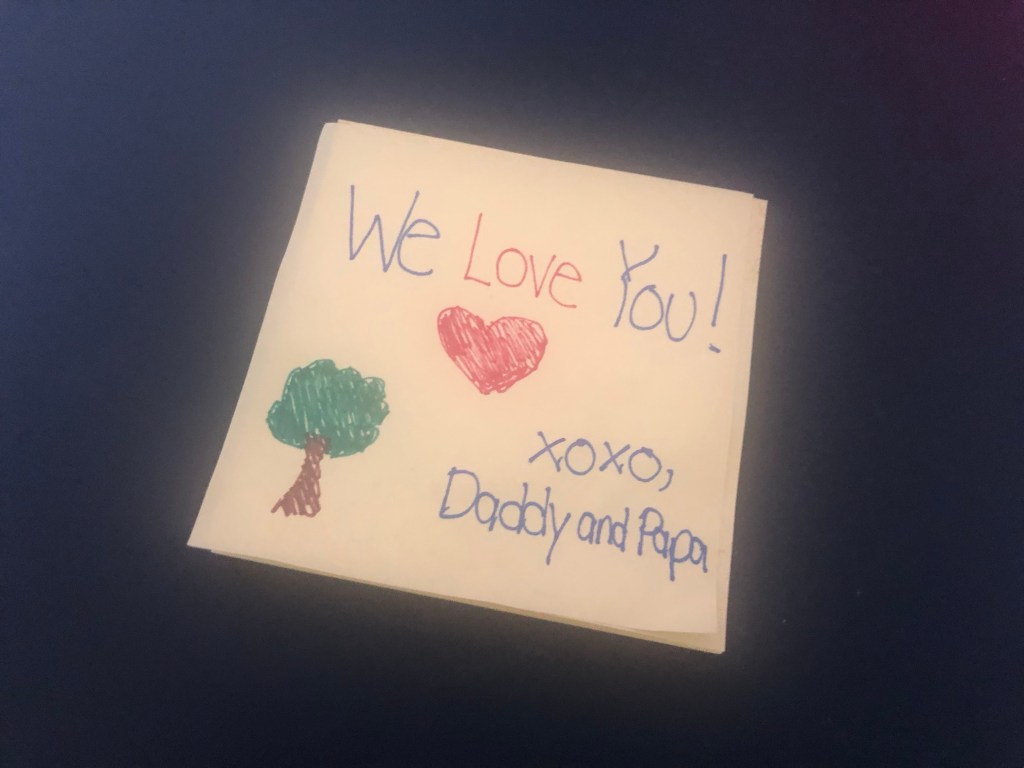
T’s teacher said he had a good first day – and the lovely postcard (above) given to each student was a wonderful gesture.

The daycare staff, on the other hand, said he had a rough start. We expected it, given he went from a group of 5 peers his age to a group of 14 kids up to twice his age.

He had challenges with respecting personal space and said some questionable words when he got frustrated with other kids that were overheard by a parent, who was not pleased.

We’re grateful for daycare staff that get it. They don’t let T get away with these moments but they are open and supportive to working with T and us. What more could we ask for?

As I drove T home that day, I was tempted to get into lecture mode. But I reminded myself quietly, “Silenzio, Bruno!”

Instead, that evening, T and I read one of our frequently-read books, Giraffe and Bird, a book about friendship.

Afterwards, I had a brief talk with T – because I only ever have a few moments of his attention – about friendship and about what he thinks contribute to good friendships, such as respecting space and using kind words.

During Friday’s daycare pickup, the staff said T had a good day. It was a really lovely way to end the week.

We went to play in the park and I showered him with praise and congratulated him on having a good end to the first week of school.

T zipped through the monkey bars, even doing an unexpectedly awesome 180 degrees-reverse turn move while dangling in the air, like an American Ninja Warrior powered by rocket fuel.

A wonderful message posted and shared by one of my favourite blogs, Our Sacred Breath.

Trying Differently Rather Than Harder

On FASD Day, I’d like to share an important lesson I continue to learn as a special needs parent.

FASD Day is observed annually on September 9 and has grown into a month-long event: FASD Month in September.

FASD stands for fetal alcohol spectrum disorder, a lifelong disability that affects the brain and body of people exposed to alcohol in the womb.

Our son T, now 6 whom we adopted at 14 months old, has confirmed prenatal alcohol exposure and currently has a prognosis of at-risk FASD.

He has yet to receive a formal diagnosis, when he’s a bit older, but we can see tell-tale signs manifested through behaviour challenges such as hyperactivity, emotional disregulation, and difficulty with focus and transitions.

Longtime readers of my blog know that T is a bright, funny, caring, determined and curious kid with a lot of potential – but he also faces day-to-day challenges that neurotypical kids often don’t.

We’ve been blessed with an amazing summer. Interestingly, September 9 is also the first day of school for T.

The coincidence with FASD Day feels somewhat symbolic. As he enters Grade 1, I am filled with a mixture of hope, optimism and anxiety.

It is a huge leap from kindergarten with a more formal learning setting and expectations. I worry how the new routines will clash with his challenges, along with gaps that may have resulted with virtual learning.

I’m choosing to stay positive. We have good supports in place and I have to remind myself about taking it one day at a time.

What’s contributing to my anxieties is the last few weeks, since the return from our wonderful roadtrip, we’ve had challenges in the mornings and evenings with routines that should be straightforward by now.

Getting him ready in the morning for daycare – getting teeth brushed, dressed – were challenging, with tantrums, battles and meltdowns. Similar situations in the evening with getting him to bed.

Even the hubby, who is normally way more patient and calm than me, lost his cool a few times.

And of course, when either one of us lose it, T enters into his fight and flight mode, and we’ve officially entered into a meltdown situation.

These explosive moments don’t feel good as a parent. You feel like you’ve let your child down and you feel guilty about how you could’ve handled the situation better.

Individuals wear red shoes to observe FASD Day, a movement started by RJ Formanek, an individual with FASD and an inspiring advocate.

Two years ago, I bought and read a book called “Trying Differently Rather Than Harder” by Diana Malbin.

It is a book written in concise plain language for caregivers of individuals with FASD and is considered a seminal text of wisdom. I encourage all parents on similar journeys to pick it up.

I won’t pretend to be an expert but it did teach me to reframe how I view T’s invisible disability.

First, it is to recognize that it is brain not behaviour. This is such a hard one to internalize, because we do not see the alcohol-based brain injury, we only see the behaviour.

Second, parents are encouraged to reframe a child’s difficult behaviours as “a child won’t” to “a child can’t.” I’m not sure I completely agree with this. So I like to reframe this for myself as “a child can’t… yet.”

Third, when we start viewing a child’s challenges as they are experiencing a struggle or difficulty rather than they are misbehaving, then we can reframe our response more positively as a child needs accommodation and support rather than punishment and discipline.

I know what you’re thinking. I’ve thought it too: these are such common sense and obvious advice. Let me add: it’s so obvious… in writing, that is.

Applying them is an entirely other beast. I know, because I speak from personal experience of wanting to do better and to try differently rather than harder.

But there are days when logic and determination go out the window, because we’re all human, and we often react with emotion rather than logic.

But T is my inspiration and T deserves his parents to truly try differently rather than harder.

Every day is a new opportunity to do better.

I recently put a renewed focus on my physical fitness routine. It’s been a month in and I’m feeling great and recharged.

I reflected to myself that it wasn’t easy at first, and there are evenings when I really don’t feel like driving to the gym to do 30 minutes of cardio, but I have to put in the work.

In a way, it’s like parenting. Trying differently requires you to build a new set of muscles to flex and to do so, you gotta put in the effort.

Earlier this week, determined to break the cycle of tantrum-filled mornings, I decided to try something different.

The breaking point for T is when we usually transition from getting him off the dining room table straight to the bathroom for teeth brushing.

I told T we were going to run around and play chase for 5 minutes. He loves being chased.

And so we did. He was laughing and smiling the whole time.

Then when 5 minutes ended, he went straight up to the bathroom with me – zero fuss and then afterwards, dressed himself in record time.

We repeated a similar approach during the evening, in between his tablet time and bath time, to positive results.

I certainly didn’t feel like I expended that much more effort by running around with him. It certainly felt far less taxing than losing my patience or riding out a tantrum or meltdown.

So yes, trying differently rather than harder. I love this phrase. It’s gonna be a tagline for me.

I’m gonna stumble with this repeatedly in my parenting life, but I’m sure gonna keep trying. Because it sure is easier to try differently rather than harder.

PS. I’d like to share a terrific documentary called The FASD Project. It is a short but informative and important work that helps advocate and reduce the stigma around FASD. Worth a watch.

Cooking for the Soul

Nature, travel, music, writing, prayers, exercise, reading. How do you nourish your spirit?

For me, the answer is all of the above!

While I didn’t intentionally set out to do so, my last few posts have been about how I prioritize the mind, the body and the spirit in my journey as a special needs parent.

Time is a luxury for any parent, especially time to one self and to pursue one’s interests. But it is essential to refill your cup so you can continue to pour for others, especially your little one.

Cooking appeals to me, because it is something that I can do at home and disappear into, while keeping T nearby.

It is satisfying, because the pursuit can lead to endless possibilities to explore – and you can enjoy the fruits of your labour instantly and to share that enjoyment with others.

Lately, I’ve been enjoying exploring ethnic cuisine, because it allows me to try out ingredients I often don’t get to use.

Indian cuisine is among my favourite. The photo at the top of this post was taken at a spice shop in Kerala, a south-western state in India, during the hubby and my cross-country visit in 2012.

I still dream about the food we had those three wonderful weeks that seem like a lifetime ago.

I’ve always been intimidated by Indian cooking. But I recently gave two favourite dishes a try.

Chicken biryani is my favourite Indian dish and who knew it would be so simple to prepare using this Amy + Jacky’s Pressure Cooker recipe?

It was nice to cook with spices I’ve never used before, including star anise, cloves, green cardamon pods, turmeric, and garam masala. I also cooked with basmati rice for the first time!

The bulk store is the best place to get these ingredients in small amounts, so you don’t spend a fortune getting huge amounts of each spice.

I had a few hiccups along the way with repeated “burn error” messages on the Instant Pot but I kept going and eventually had to wing it. 

It turned out pretty good – and very aromatic!

This Labour Day, I tried my hand at butter chicken, a family favourite, using another pressure cooker recipe from Amy + Jacky.

The ingredients list and process were not as intimidating as I had thought.

I didn’t realize heavy cream and yogurt were the trick for the yummy sauce.

I was happy with the results and the hubby approved!

I also like to try different ways to cook vegetables, even though T is incredibly picky and avoidant of veggies, especially carrots.

Brussel sprouts is a vegetable I never cared much for until the last few years and now I love them.

These simple Recipe Tin instructions used olive oil, minced garlic, salt and pepper, Parmesan cheese and panko to coat the veggies before roasting them in the oven.

The best recipe I’ve found yet and paired with roasted salmon for a light filling meal.

And there’s always room for dessert! The satisfying ones draw from home grown ingredients.

I’m not much of a sweets person nor do I bake much. But I enjoy harvesting the rhubarb from our garden to make into a strawberry rhubarb pie using this recipe from In Diane’s Kitchen.

Very simple to make and tastes great, even if the crust was not applied properly and some of the filling spilled out onto the baking sheet this time.

T helps me from time to time with my cooking adventures and we keep our projects simple.

This was a no-bake cheesecake recipe we had originally done last summer and re-did this Spring when we were finding learning activities to supplement virtual schooling.

T did a good job as always with helping.

But more often than not, T prefers to stay out of the kitchen and play with his toys instead.

And that is a-ok with me. 

It’s good to have your own interests and to use those rare quiet moments to yourself.

While the moments to recharge my mind, body and spirit are limited, I’m thankful for them and the opportunities to make the most out of them.

And I wish the same for those of you who are on similar parenting journeys.

“Never Let the Fire Inside You Leave.”

Fire has long served as a symbol of creation, destruction and rebirth.

T’s latest song obsession is “Iconic,” from Madonna’s 2015 album “Rebel Heart.”

Every August 16, M’s birthday, we listen to her songs. This triphop autotune-laced song appeals to T, because he thinks a robot is singing.

If you try and fail, get up again.

Destiny will choose you in the end.

If you don’t make the choice,

And you don’t use your voice,

Someone else will speak for you instead.

What you want is just within your reach.

But you gotta practice what you preach.

You pay with sweat and tears,

And overcome your fears,

Never let the fire inside you leave.”

– “Iconic“

This song resonates with me, because I’ve long admired and been inspired by M’s work ethic.

Forty years into her career and past her commercial peak, she still pushes herself, against misogynistic comments about her age, experimenting with new sounds and touring techniques, instead of resting on her laurels.

What lights your flame and keeps it burning?

I think back to my 20s. I felt that my inner fire was like a set of fireworks. Huge shortlived bursts of energy, reaching for the skies, then flaming out until the next explosion.

At 21, I took a 10-hour overnight bus to New York City, from Canada, and walked into the office of a literary agency, without an appointment, and asked to speak to an agent so I could drop off my manuscript with them.

Nothing happened with it, because it was frankly not very good. I sometimes think and cringe to myself, who was that bold little kid?!

Sightseeing by myself on the 86th floor of Empire State Building in Summer 2002, with an entirely different perspective about life. Things are more grounded these days!

I turned 40 this year. I feel like my inner flame is now more like a tall thick candle – more reserved, silent, but nonetheless lighting a way forward for those around me.

The best thing about getting older – note that I did not say about being old! – is you know yourself better.

I know who I am and who I’m not. I’m happy and thankful for who I’ve become and the list of things that motivate me to keep trying to do better everyday is more focused and narrow.

As a parent, my inner flame also burns so that I can help ignite the spark within my child’s spirit.

The reality of special needs parenting is that it is mentally, physically, emotionally and spiritually draining.

This is not a complaint, because being T’s Papa is the most rewarding role in my life. This is just me telling it like it is; it is very damn challenging.

While I have many things in my life that take up my time and energy, T is at the nucleus.

My flame flickers, so that I can help him find his way in his life and shine in his beautiful own way. I hope that my flame can light the spark and give him the skills and resiliency to burn brightly despite the obstacles he may face.

“I can’t. Icon. Two letter apart.

One step away from being lost in the dark.

Just shine your light like a beautiful star.

Show the world who you are.”

– “Iconic”

In the early days of parenting, the hubby and I often had conversations – and I’ve always reflected to myself – that although T is now the centre of our lives, I do not want to lose myself in the process of being a parent.

I still have my own goals and dreams, even though most of them are now deeply integrated with my hopes and dreams for T.

While I reprioritized my own goals around T, I was always mindful to not lose sight of myself.

To be able to light a way forward for T, I have to keep my own flame burning.

This is why the pandemic was so brutally hard.

Like other special needs families around the world, we were on survival mode. There was no time or energy for anything else.

Not a flame, but just a dimly flickering light bulb in a persistent brownout state.

“Tell me I’m no good and I’ll be great.

Say I have to fight and I can’t wait.”

– “Iconic”

But fire is about rebirth.

This summer has been a blessing for our family.

With daycares reopened to offer daily reprieve from T to our summer roadtrip, I do feel rejuvenated and reenergized.

I previously wrote about the importance of nurturing mental well-being. Another important aspect of my self care, one of my most important personal goals, is physical well-being.

One big blessing is the reopening of gyms.

With careful attention to safety precautions, I go two evenings and Sundays every week.

Thirty minutes of cardio on the elliptical followed by weights – plus three additional evenings of swim time with T – I am finally getting the physical activity I’ve missed so much.

I’ve also focused more attention into my diet, something that went out the window during the early days of the pandemic.

Smaller portions, cut out pop and juice, and stopped eating snacks in the evenings.

I started herbal alternatives to my daily second cup of coffee, alternating between bittermelon green tea and turmeric ginger “golden milk,” the latter (pictured below) of which is soothing and gives me a great night of sleep!

This past Thursday was our final evening visit to the outdoor pool for this summer, because it closes this Labour Day weekend.

It was a cool evening, you could feel autumn in the air, so T wanted to leave after just 15 minutes in the pool.

During the drive home, I remarked how quickly the summer flew by.

During a red traffic light stop, I glanced at our little boy, from the rear view mirror. He was still little, but not so little at the same time.

He is always in his element in the water, full of fiery confidence and joy.

I so wish for that flame to help him sparkle and shine in all other areas of his life.

I know and fully expect that the upcoming school year, entering grade one, is going to be a huge test for T and for us as his parents.

I’m filled with both hope and anxiety.

But all we can do is take it one day at a time.

The song “Iconic” was playing on repeat in the car and it arrived at the bridge (middle part) of the song and T sang along loudly with it.

“Born to be a superstar,

that’s exactly what you are.”

I thought to myself at that moment about how much I wish for him to internalize that message and to let it be a fuel that keeps his flame burning brightly.

How Counseling Helped Me Become a Better Parent

Special needs parenting can be a rollercoaster and wonderful people can help along the journey.

A crucial turning point came early on for me when I recognized and acknowledged that the stress I was experiencing with the challenges of parenting a child with a prognosis of FASD did not always match my capacity to tackle them.

A week ago, a key relationship in my parenting life came to a close. The wonderful psychologist whom I had been seeing for over three years was retiring and we had our final session together.

It all began five years ago when our family doctor made a referral to Surrey Place, a wonderful organization that supports individuals with developmental disabilities and their caregivers.

He made the referral after we shared that T was prenatally exposed to alcohol. At 18 months, the developmental pediatrician at Surrey Place gave T a prognosis, not diagnosis, of at-risk FASD.

It was devastating news to receive and it took me a while to process it. But thanks to this prognosis, we received a plethora of life-enhancing services: developmental therapy, speech therapy, occupational therapy and behaviour therapy.

Another significant service was family counseling.

The developmental therapist asked early on if I was interested in their free family counseling services. She cautioned there would be a one-year wait list.

My philosophy, which I’ve adopted early on, was to take advantage of all the services we were being provided, because I knew that T would age out of these services at 6 without a diagnosis.

A year flew by and I was matched with a PHD student completing a practicum. We met once every two weeks after my work.

After she completed her practicum and left six months later, the psychologist whom served as her supervisor decided to keep me as a client.

I will forever be grateful for this, because her support the last 3+ years has truly helped me become a better parent.

Our sessions were typically an hour. It was and wasn’t what I expected a relationship with a psychologist to be.

In one sense, yes, there was a lot of talking. I talked and surprised myself with how open I was.

On the other hand, there was none of that deep analysis of my childhood or subconscious – or me breaking down in tears – that I expected thanks to how counseling is portrayed in pop culture. Not that there is anything wrong with that, just so we’re clear!

I talked a lot. We met every 3-4 weeks – and virtually during the pandemic – and I always came prepared with a list of the things that had happened with T and/or that was on my mind.

Our early conversations were less candid. It was a relationship after all and like any relationship, trust and comfort must be built first. But thankfully, they were built very quickly.

With no offense intended to the practicum student, who has a bright future ahead of her, working with the seasoned psychologist was different, because she instinctively knew, through years of experience, when to listen and when to probe and even challenge me.

She was not just someone who listened and validated my concerns but she became a trusted coach.

When T got kicked out of the Montessori program, when the public school board cancelled the specialized kindergarten program he was in, whenever I had to meet with school board staff to advocate for resource supports for T, the psychologist and I strategized and she coached me with wonderful advice from her years of experience working with families like ours.

I also want to add that many of the sessions we had together were also spent celebrating the milestones and successes that T has had. Being able to take a step back and to reflect with an objective person was also helpful in recognizing the gifts that we are blessed with.

I am very thankful that in recent years, open and frank conversations about mental health are being had and that there is a concerted effort to reduce stigma surrounding mental well-being.

I truly believe in saying that it is ok to not be ok.

In my case, being a special needs parent has changed my life profoundly – in positively rewarding and crushingly challenging ways.

Reading the experience of other parents going through their own journey has been inspiring. One common thread I repeatedly see is the feeling of stress, exhaustion, helplessness, loneliness and being misunderstood.

I’ve felt all those emotions in varying degrees.

As someone whose family has benefitted immensely from the social services available in our community – and I acknowledge this privilege, as I know that many others are not as fortunate – I can testify that there is no shame or embarrassment in asking for help.

In fact, it is essential for your survival.

Special needs parenting is a long game and I know that every day is a few more meters that I run – or stumble and fumble – in this life-long marathon.

Taking care of myself mentally, emotionally and physically and spiritually are important in allowing me to be the best parent to T, which also happens to be just one of the many hats I wear in life, along with husband, son, friend, employee and so on.

I became a better parent because of the psychologist that I had the blessing to have been matched with.

At our last session, I made sure to spend time to thank her and to tell her how much her support has meant to me and how she has made my life, and in return, T’s life, better.

For the first time in the three years that we’ve been meeting, we both teared up and got emotional.

Can you spot my cameo in this wonderful video promoting the incredible services of Surrey Place? It was taken during one of my counseling sessions before the pandemic.