A child’s ability to find fun and enjoyment is as limitless as their imagination.
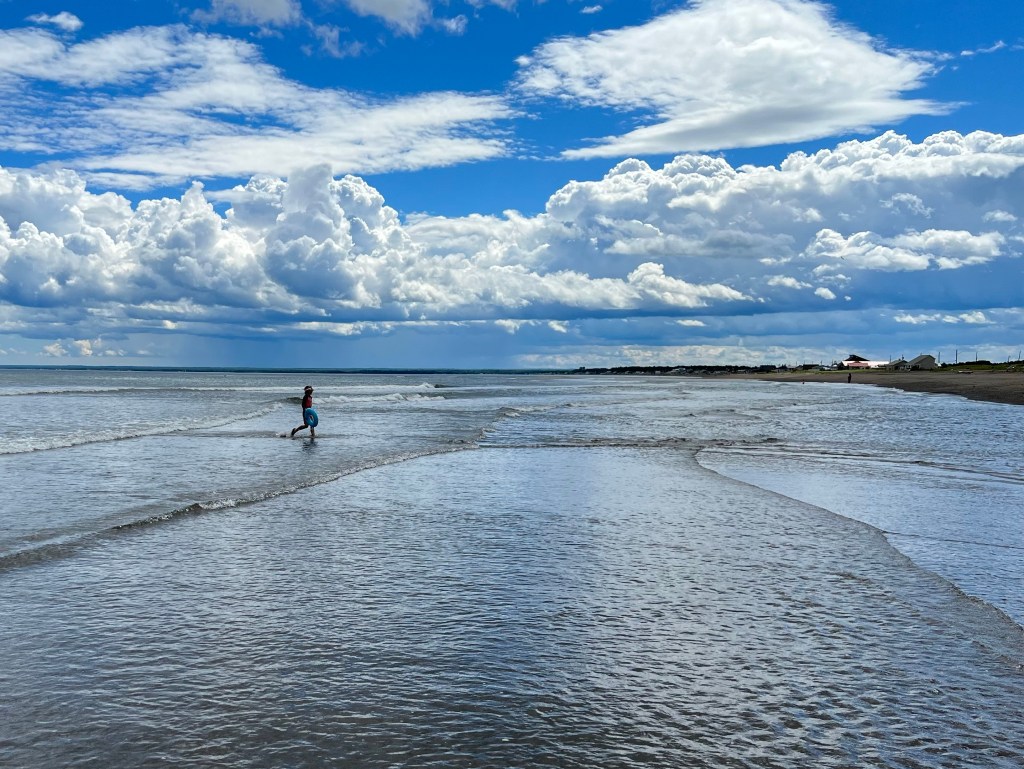
The calming breezy saltwater bay ushered in the next wave of our family summer vacation.
After a short visit from T’s aunt and cousin, we headed off early Friday morning on a 16-hour drive for our annual visit with T’s grandparents, who live in a small Acadian town in New Brunswick.
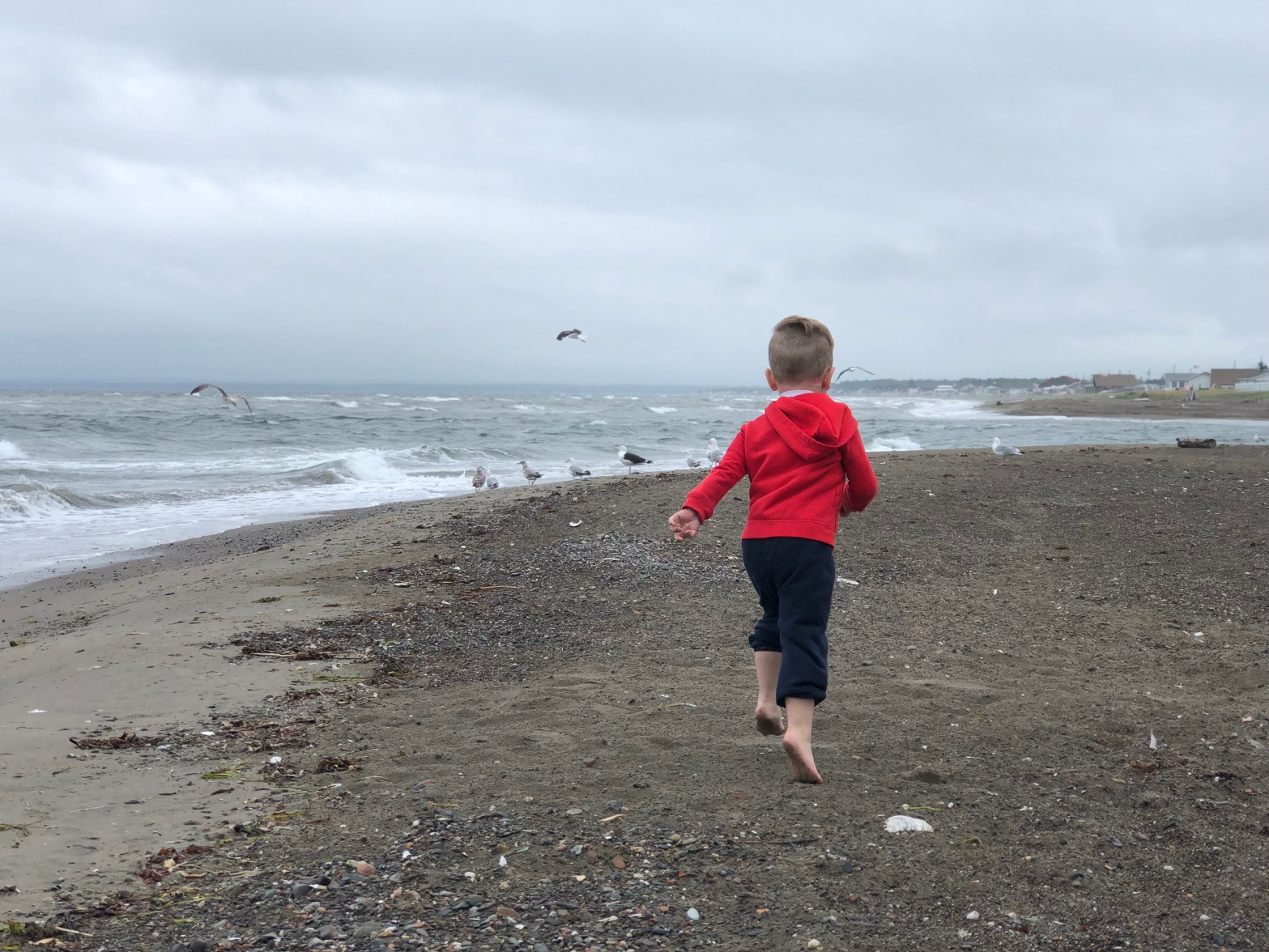
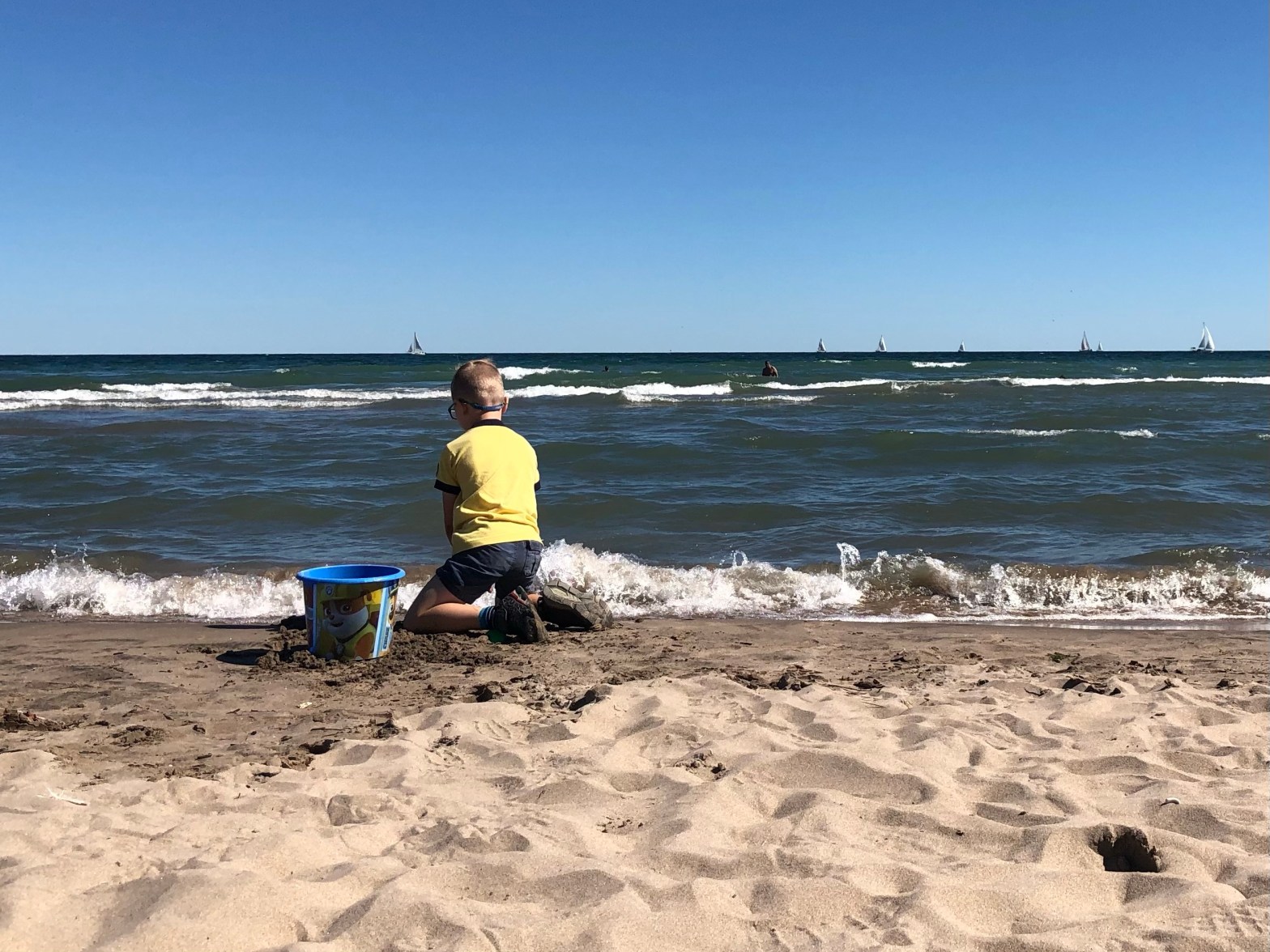
T loves it here, because his grandparents adore him and he enjoys running around the beach.
I believe in the soul-soothing healing qualities of saltwater air and the sound of waves.
Children like T need this calm from the storm – as do their parents! – and I am thankful for this break for T and us to create positive memories.
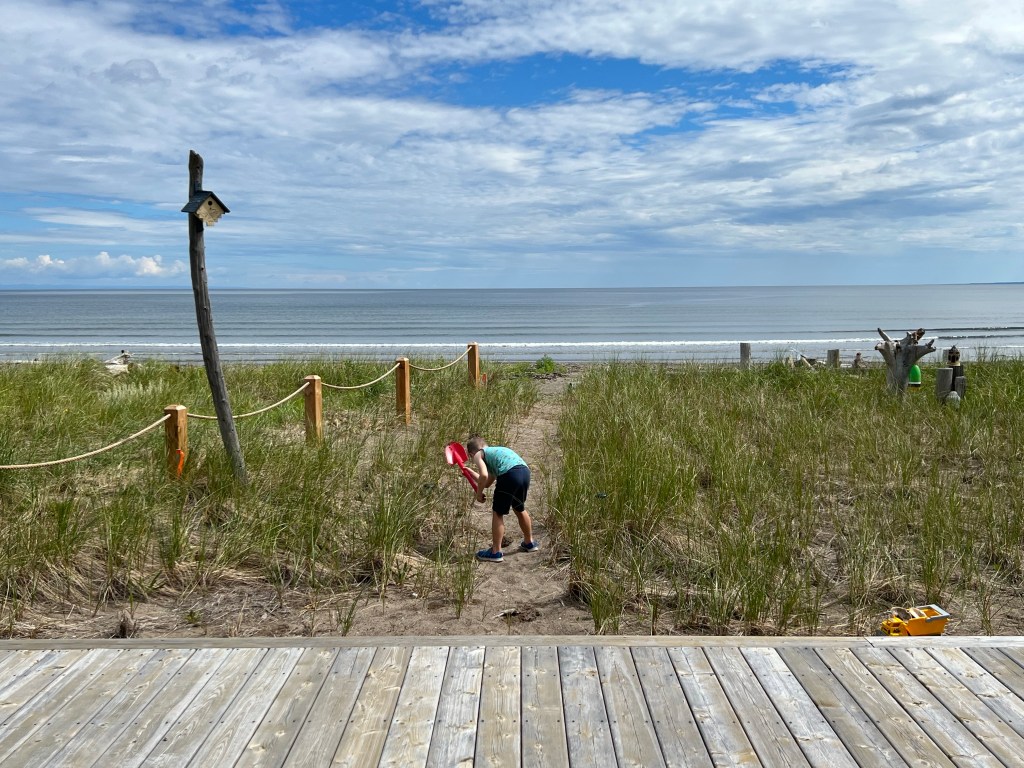
T quickly loses himself in play on the sand or throwing rocks into the water.
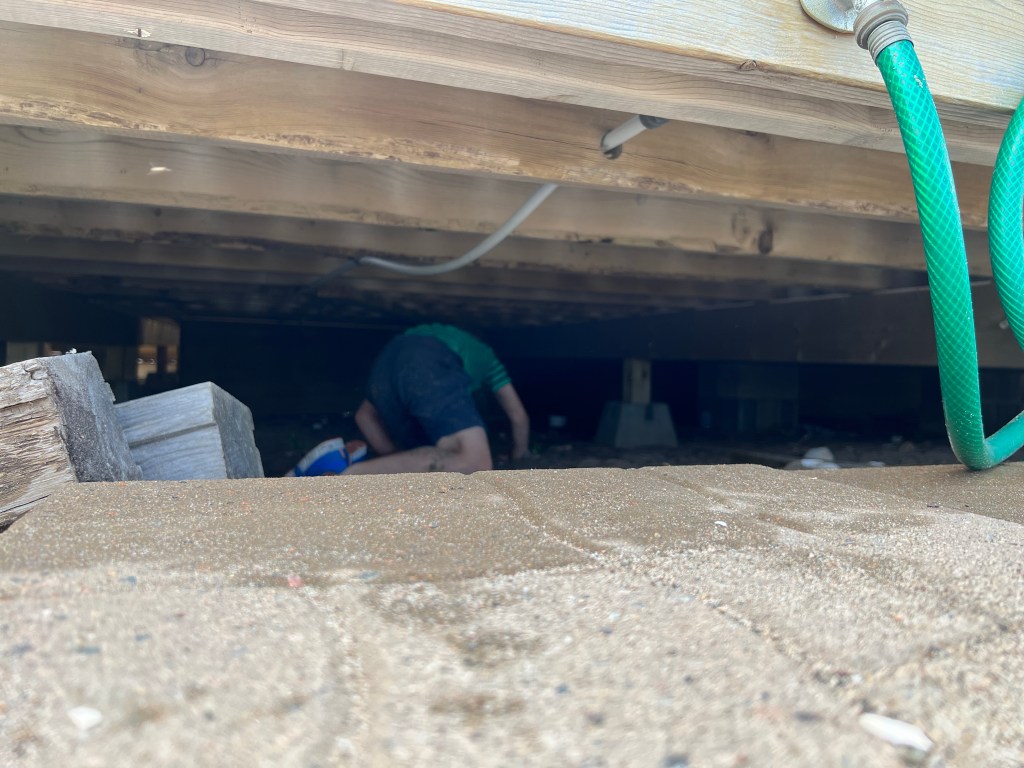
He even made himself comfortable in the crawl space under their deck – which transformed into a cave in his imagination.
After breakfast one morning, T and I went for a long walk by the water.
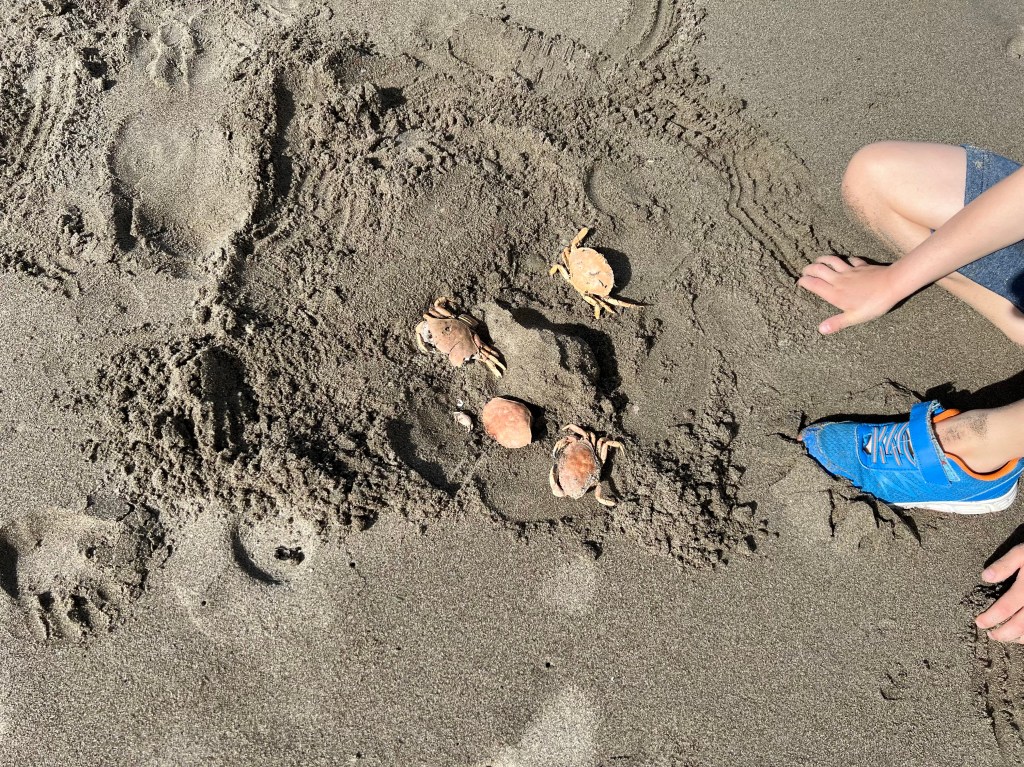
There’s always something interesting to find on the beach – shells, rocks, sea glass or dead crabs.
T decided to collect crabs and I helped him carry as many as I could.
Then T dug up several holes and buried them one by one in the ground.
He then found round pebbles and used them as tombstones for the crabs – humming The Bee Gees’ Staying Alive as he laid them out.
This kid has a wicked sense of humour, whether it was intentional or not.
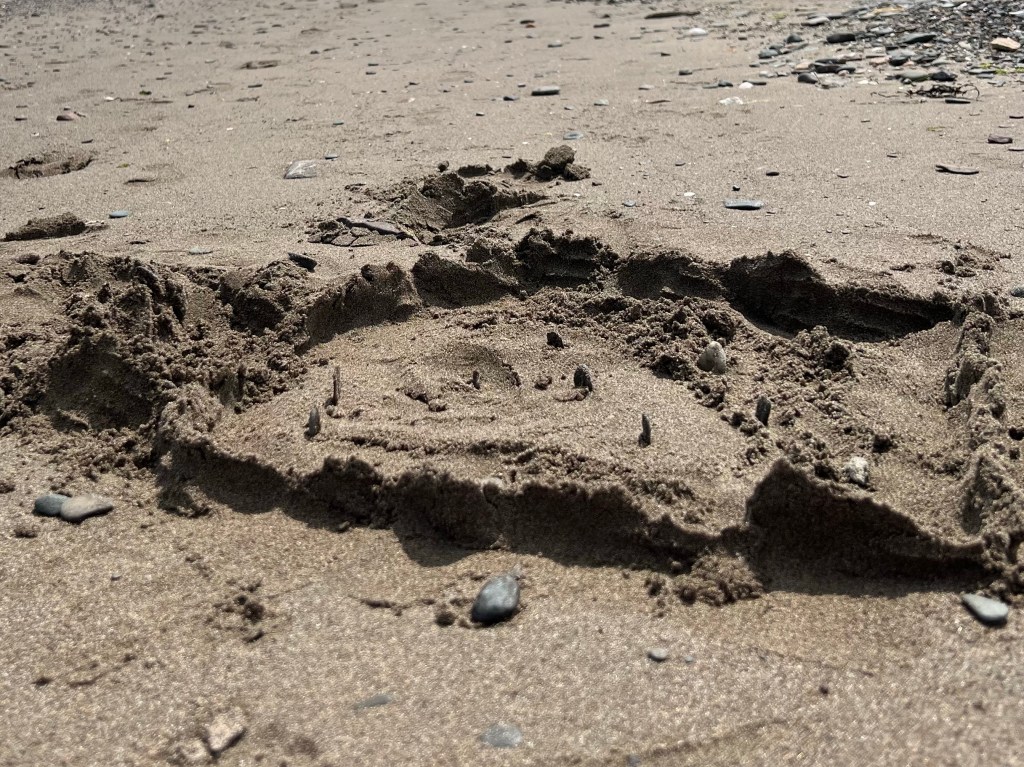
Afterwards, he found a flat patch of sand and used his fingers to spell out Crab Semetary (sic).
The next morning, T went out to look for his graveyard and said that it was gone.
I explained to him the tide must’ve come and washed it away.
Instead of getting crabby, the new day brought a clean slate for T to find another adventure for his imagination to run wild with.
Slowly, our little one’s innocence will be tempered with lessons about the hardships of the world.
On a drive home this weekend, we stopped at a red light and a disshelved man approached each car, with a cup in his hands.
We found two loonies in our car and I rolled down the window and put it in his cup.
T asked why he did that, so I explained the man was asking for money and it was important to help others when we are able to.
He asked why the man asked for money.
To keep it simple for a 7 year old, I explained the man was probably homeless.
“What does homeless mean?” He asked.
I explained that it means he probably doesn’t have a home to live in, which means he doesn’t have things that T has, like a bed, shower, or toilet.
“So he poos on the ground?” T asked in a bewildered tone.
The matter of fact way he said it made me chuckle, because it reinforced just how innocent his view of the world is.
The hubby explained he probably has to use a public washroom or borrow one at a restaurant.
T agreed that it was sad.
I often think about how fortunate we are that T has an innocent childhood.
As he gets older, he will undoubtedly be exposed to the uglier realities of the world.
As his parent, I want to hang onto his innocence, while providing him with the skills and knowledge to face those realities with grace and to do his part to making this world better.
The suddenness caught me off guard but I appreciated the hubby using the conversation to share this story – as we try to find opportunities to slowly piece T’s story in his mind.
As with the other times when we talked about his birth mother, T took the news in silently.
We sat quietly in the car for the next few minutes, listening to music and watching the beautiful sunshine outside.
One blessing during the pandemic was spending more time together as a family.
When I was losing my mind with virtual schooling, I stopped to think when else could I take a break during work to go for a walk with T or to eat breakfast together when I’d normally be at work.
This summer, things have returned to as normal as they have been in two and a half years.
In June, I returned to the office on a hybrid work schedule, which I am very thankful for.
Let’s keep it real: getting up earlier and a 1-hour commute each way really suck.
But there are benefits: getting time to mentally transition into and out of work and in-person collaboration with colleagues whom I’ve missed.
For most of the last two years, my morning routine consisted of waving bye to T on our steps as he left for school or daycare with the hubby.
His car window would roll down as he screamed and waved, “BYE!”
It really is the simple things in life that bring the greatest happiness.
In the mornings I now head to the office, I often sneak a kiss on his cheek while he’s still in bed before I head out.
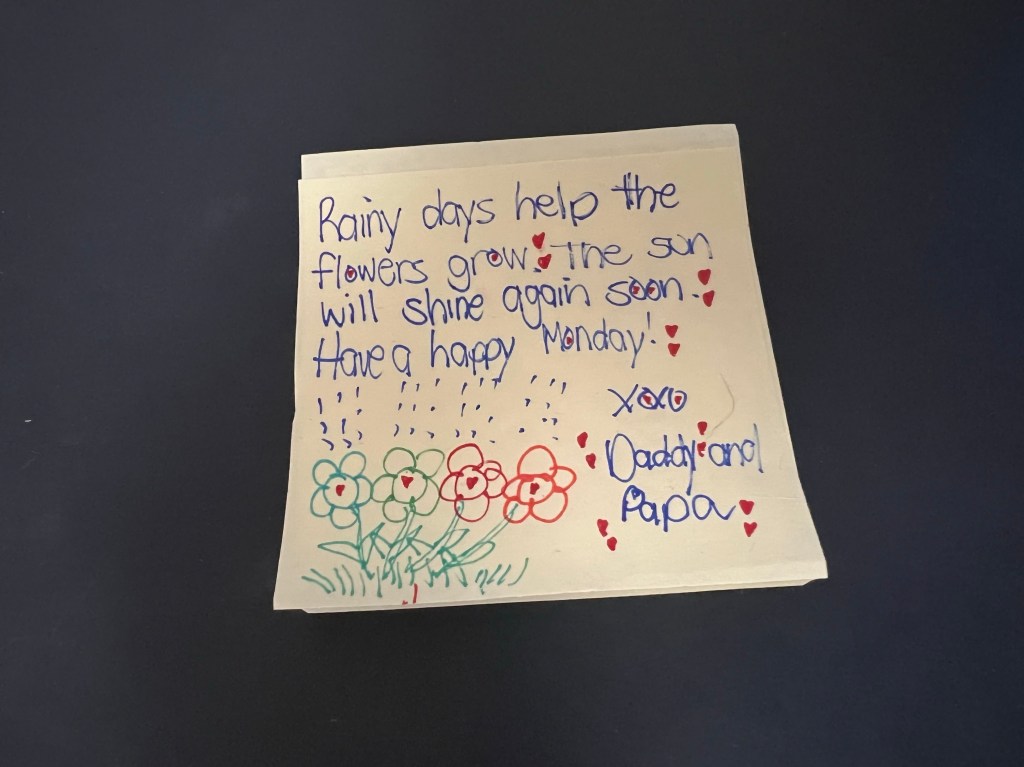
His breakfast, vitamins, his lunch and snack, and his “post it note” are all prepared beforehand.
One morning last week, T got up as I was leaving.
He walked out with me and stood on the front steps in his PJs, barefoot and waved as I left.
As I walked halfway and then all the way down the street, I turned around and saw him on the sidewalk, repeatedly screaming “BYE!” at 7:15, waking up the street.
I shouted back for him to get back in the house. But inside, I felt a warm fuzzy glow. It was certainly a wonderful way to start my work day.
Any parent of a child with FASD will tell you that “calm” is like a mythical unicorn.
A few weeks ago, a Saturday morning in the playground started off well enough.
Then a little girl with her grandmother came over to the slide and T didn’t want to share it.
I reminded T the slide is for everyone. Irritated, T said, “Do you want me to go home and get something sharp?”
The look on the grandmother’s face was priceless.
The situation escalated as he piled sand atop the bottom of the slide and I told him to stop.
Huge meltdown. I had to carry him home screaming.
Finding the calm in the chaos is a journey of trial and error.
There is no one standard formula, because every child and parent-child dynamic are different.
What I continue to struggle with is that even the best laid plans that align with routines and anticipate triggers can still go belly up.
The pandemic years have had truly hard moments. Some days felt like I was at the breaking point.
Somehow, we made it through each storm, whether it directly or indirectly involved T.
The calm after each storm provides moments for reflection of lessons learned and relearned.
Brain Not Behaviour
I try to remember “brain not behaviour” and that T struggles with emotional regulation, impulsivity and hyperactivity.
It’s hard to practice this during a storm – like when he sprayed bug spray in my mouth during our camping trip and refused to take responsibility.
I was livid. In hindsight, I know his brain just can’t help touching every object that catches his eye.
Self Care Is Vital
I believe in carving out time for myself, no matter how limited, to exercise, cook, read, blog, sleep – and other things that nourish my spirit.
I don’t believe in suffering in silence and believe in seeking out help. This includes connecting with FASD professionals, finding online communities and continuing to get counseling.
The pandemic reinforced the importance of setting boundaries to protect my family’s wellbeing.
Create Joyful Experiences
As one of T’s teachers diplomatically put it, there’s never a dull moment with T.
The truth is, as frustrating as this kid can be, we love him to pieces and our positive moments outweigh the challenging ones.
We create regular plans – big or small, local or away from home – to create anticipation and memories that lift us through the harder moments.
Celebrate the Victories
When I’m in the trenches with T, like frequent battles to do his school work, it feels soul sucking and at the worst of times, soul crushing.
These moments make the wins that we do experience so incredibly satisfying – and we go all out with celebrating them.
It’s not just for us as his parents but it is important for T to know, think and feel that he is very capable – and will get to where he needs to.
But while T can quickly move on, the emotional debris left behind from his stormy moments takes longer to process as an adult.
You feel it all – anger, frustration, anxiety, stress, regret, guilt, doubt, defeat, sleeplessness, exhaustion. I remind myself to feel these emotions, because the alternative is to turn my heart into unfeeling ice.
Then I try my best to move on and, as T teaches us, tomorrow is a new day to try again.
Enjoy the Calm
When we got home from the park that Saturday morning, T was still crying and disregulated.
I left him with the hubby and went to the home office for quiet time.
I felt livid, embarrassed and frustrated as to why these moments still happen.
Those feelings soon turned into guilt, self doubt and regret as I wondered how I could’ve handled the situation differently.
An hour or so later, I heard a knock on the door and when I opened it, I found a group of T’s favourite “pets” on the floor.
He didn’t need to say sorry for me to know how he was feeling.
I looked for him in his room, gave him a quiet hug and we lied down on his bed and enjoyed the calm silence for the next few minutes.
As flowers bloom in our garden, T reaped a sweet harvest this week.
Report cards were sent home during this last week of school.
The hubby and I spotted T’s very first A right away – given for reading!
We were so thrilled, because of how hard T – and all of us at school and home – worked on his reading.
As I waved bye to T as they drove off to his last day of school, I looked at our flowers, glistening under the sun, wet from the overnight rain.
What started as small blooms, blossomed through the hubby’s care and nature’s sun.
I beamed with pride and happiness as the memories of the last year came flooding back.
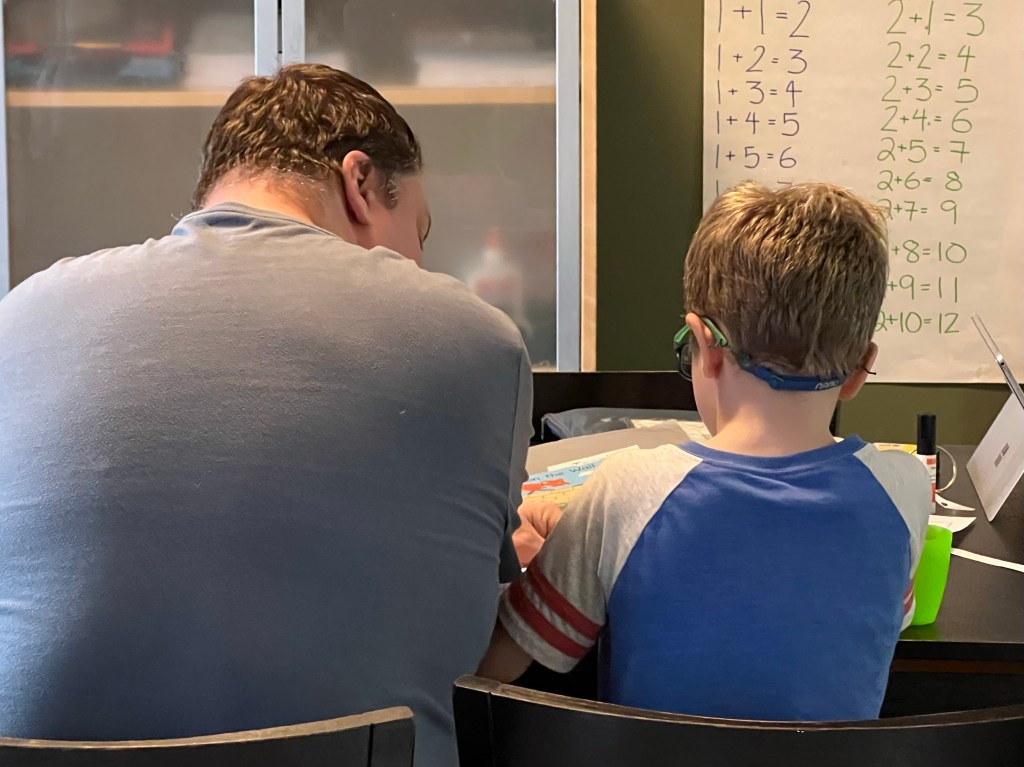
The moments of seeing the hubby and T reading and doing homework together.
My Saturday and Sunday morning reading practices with T.
The pride T felt as he went up a reading level – exceeding the year-end target his teacher set for him in his Independent Education Plan.
We also highlighted and celebrated all of T’s gains in other areas. He had Bs across his other subjects, including a B+ for math.
To the hubby and I, As are wonderful but the most important part is consistent growth and T showed improvement from his previous report card where he had many Cs.
He still had 1 C in this report card for drama. But I’m not losing sleep. I know this kid can laugh, cry, scream and do the whole range of emotions when he’s motivated!
His teacher and CYW kindly agreed to our request for a year-end debrief.
We appreciated hearing their candid feedback and we were aligned in what his strengths, needs and areas of concerns for next year.
The hubby and I are worried how T will do without a dedicated support in Grade 2.
But we can only live one day at a time.
Like a garden, we will enjoy this moment of bloom.
We will celebrate his achievements, because summers – in the literal and the figurative sense – are short before winter arrives again.
We plan to have a super relaxing summer with T.
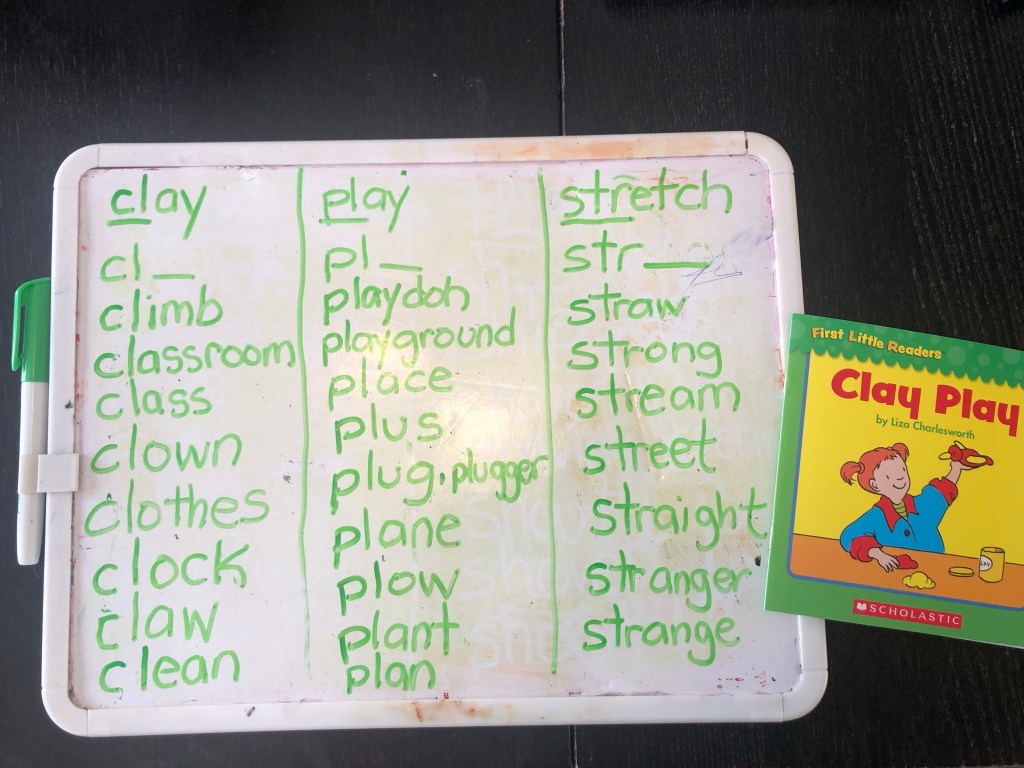
Like last summer, we asked his teacher to lend us a stash of DRA level books we can read with T. We’d like to devote 20-30 minutes each day for reading and learning.
Because routines are so important for kids like T.
His teacher, who is so organized, also prepared a binder of worksheets for T that we plan to tackle with him over the summer, in a relaxed pace.
But for this upcoming long weekend, we’re letting the reading and learning go.
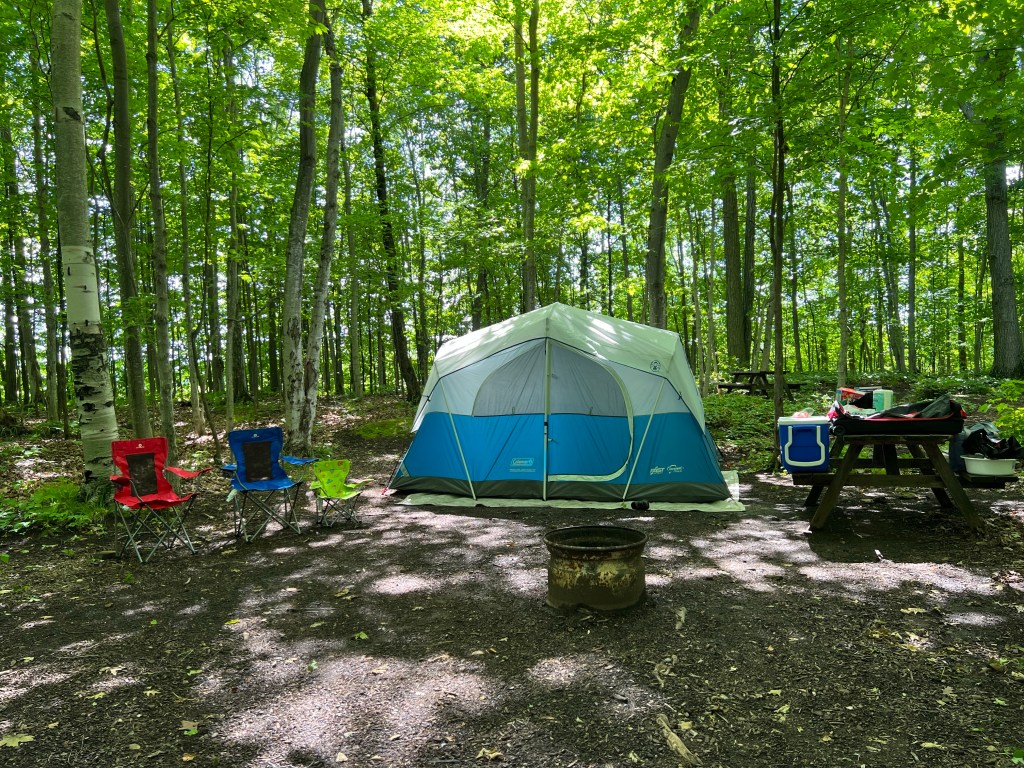
Because we’re kicking off summer fun tomorrow morning – on the first day of summer break – with our first camping trip since the pandemic!
T helped me pull our camping gear from our basement crawl space. They’ve gathered a ton of dust!
We all can’t wait to get up tomorrow and head off on our adventure!
Letting emotions stew is never productive. Stewing with tofu is a healthier outlet!
One of the most challenging aspects of parenting a child with FASD are when they get emotionally disregulated.
T’s meltdowns are hard. There are days when the hubby and I feel we are being verbally and physically threatened and attacked.
As life with T teaches us, focus on the big picture. The positive moments far outweigh the challenges.
There is a reason for why T has these moments and we’re learning to better support him before, during and after these moments happen.
One blessing of individuals with FASD is every day is a fresh start. In our experience, T is not one to stew much over things.
For better and for worse, he moves on – even though the rest of us are still reeling from his explosive moments.
It takes me longer to process things, especially when the time and space in my life to do so are so limited.
Writing continues to be my outlet to reflect and to process – so thank you to the blogger community for having coffee together.
Cooking is another outlet. Prepping ingredients, hearing the sizzle in the wok, and smelling the aroma fill the air are soothing to the soul.
Stews and stewy dishes are especially comforting. Here are a few recent dishes that I made:
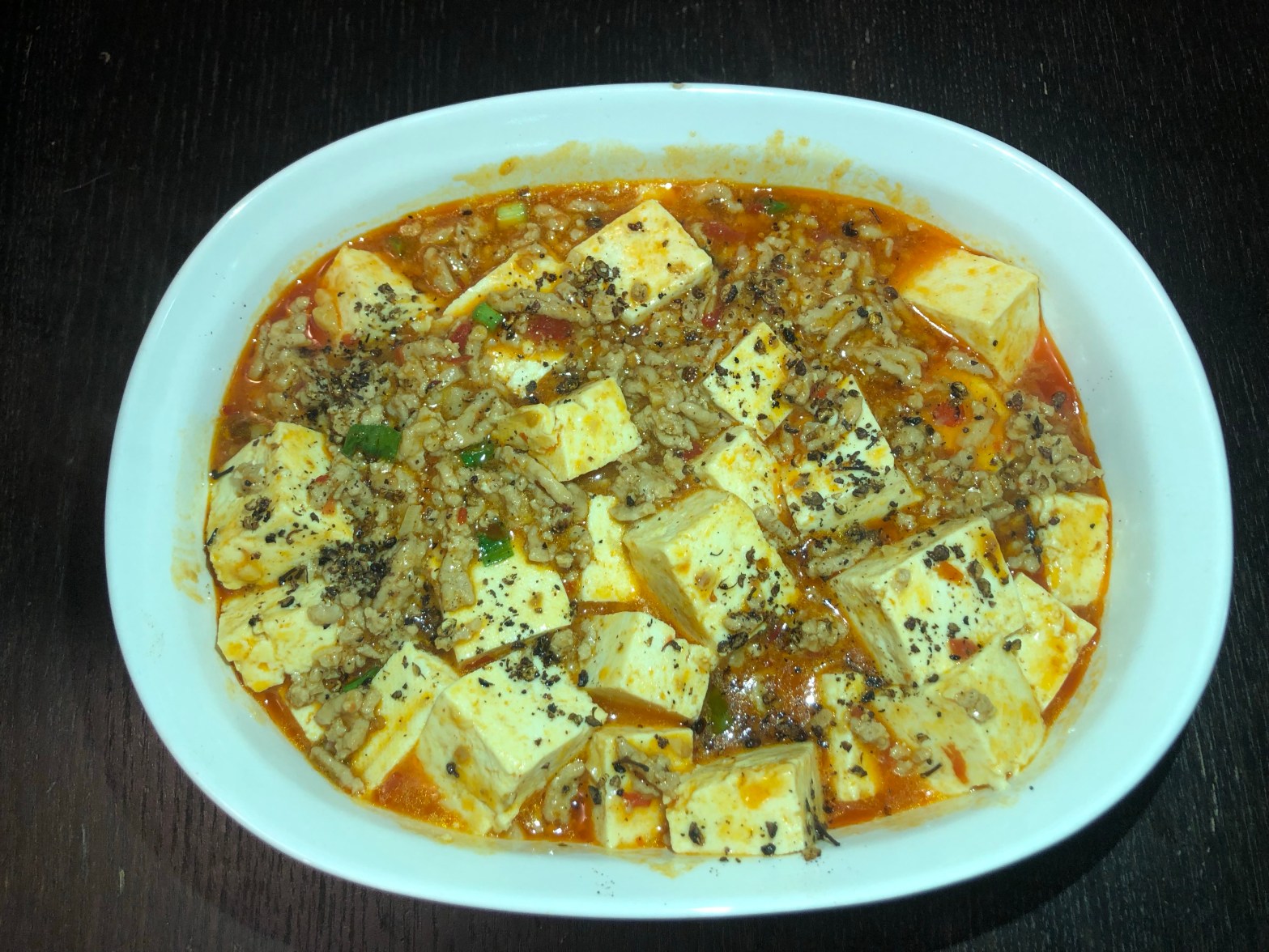
Mapo Tofu
Mapo tofu is a popular spicy Chinese dish from Sichuan province. Key ingredients are firm tofu, minced pork, sichuan peppercorn and chili oil.
It’s one of my favourite comfort meals and I was glad to finally make my own using this Wok of Life recipe.
Kimchi Jiggae
Jiggae is a type of Korean stew and the foundational ingredients are tofu, kimchi and gochujang (red pepper paste).
Kimchi jiggae is made with canned tuna or pork belly. I’ve made both many times – and made my recent one with pork belly.
Cà ri gà
Vietnamese goat curry is something I love to order at the restaurant. I stumbled across this chicken curry recipe and had to make it.
It was interesting cooking using lemongrass. It turned out pretty well. I will try this recipe with lamb next time!
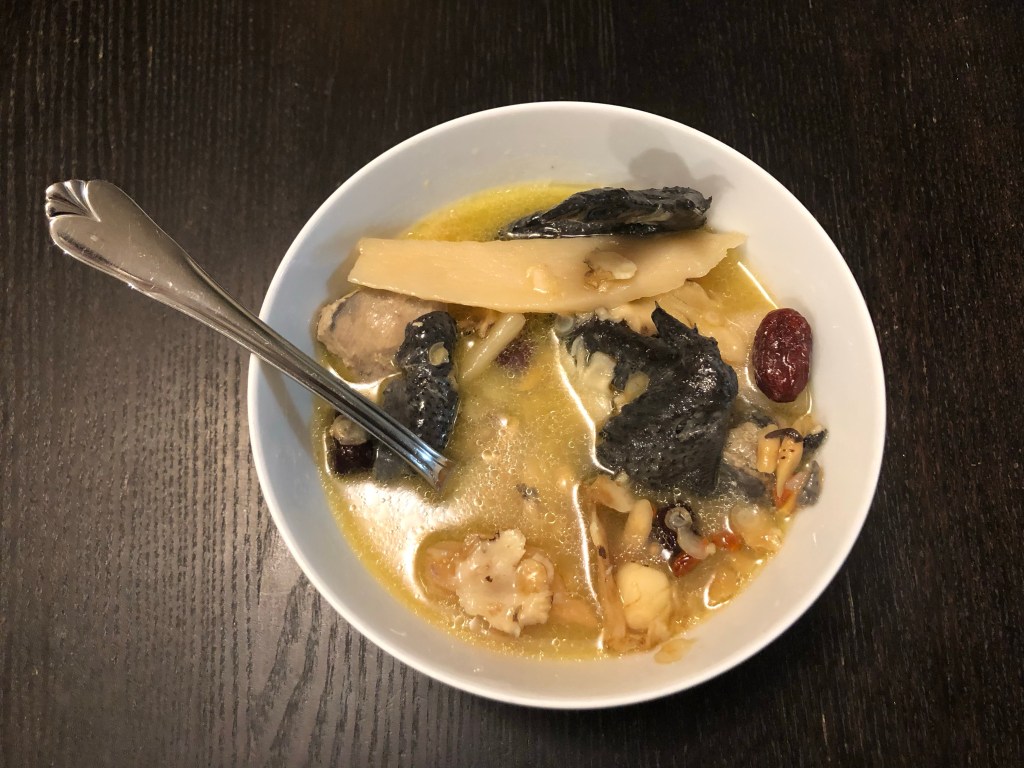
Silkie Chicken Herbal Soup
Silkie chicken (aka black chicken) soup was a comforting medicinal soup my parents made.
This was my first time making my own and I bought a pre-packaged herbal mix that included ginseng, goji berries and red dates – which made the broth soothingly sweet.
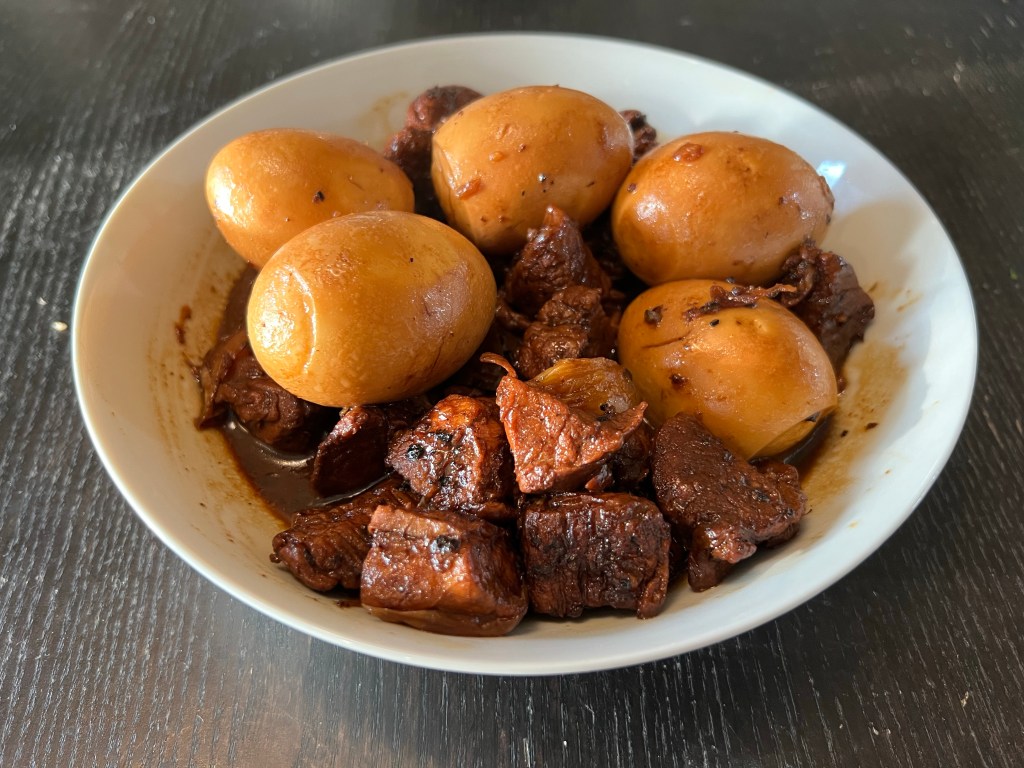
Braised Pork and Soy Sauce Eggs
Out of all the comfort foods I had growing up, this is at the top of my list. This is a staple in many Asian cultures and I recently used a Malaysian variation called Kong Tau Yew Bak.
As a kid, I thought it was a magical ingredient that made the eggs brown and so tasty. It turns out it’s just soy sauce! 😆
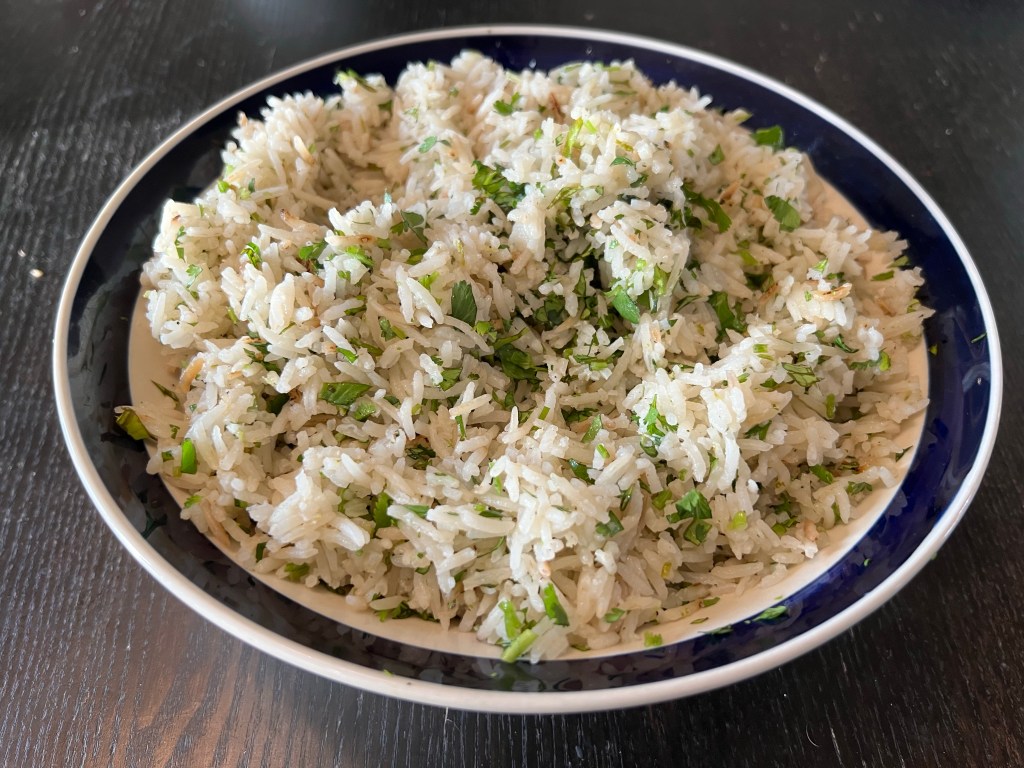
Cilantro Lime Rice
A good stew needs a warm bowl of rice. I don’t have experience making Mexican food (unless you count opening a bag of nachos and a can of salsa!)
I stumbled across this Cilantro Lime Rice recipe and had to make it because I didn’t know such a juxtaposition of ingredients existed. It was a perfect match for the braised pork and soy sauce eggs.
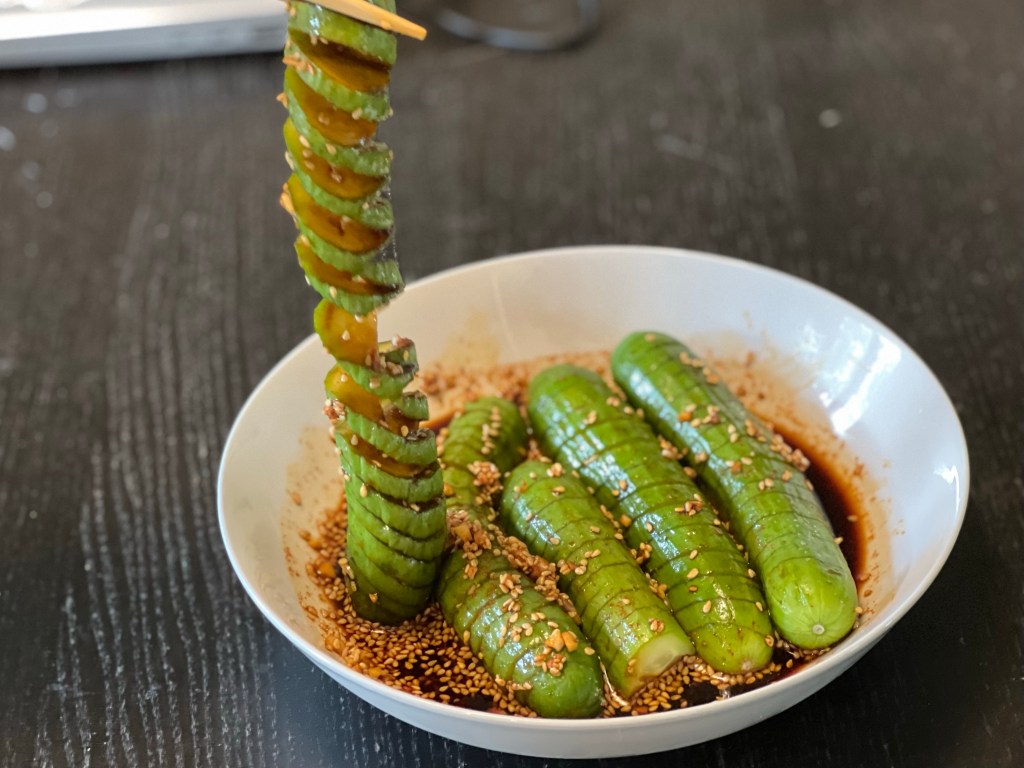
Chinese Cucumber Salad
A good stewy dish needs not just rice but a pickly salad.
To be honest, I only made this side dish cuz it looks so cool. As this Instagram recipe shows, it’s easy to make but looks impressive.
As I’ve written in the past, cooking helps me keep cool as a cucumber through the trials and tribulations of FASD parenting.
During a recent bedtime, I told him that it was 45 days until she visited us in July. He got all excited and took a while to fall asleep.
He’s been counting down every day since.
As a parent of a child with FASD, I’ve learned that maintaining a positive mindset helps weather the disorienting storms and deflating setbacks.
As explained in this PhillyVoice article, creating things to look forward to helps provide positive mental and emotional boosts to motivate one through challenging times.
As an FASD parent, each day can have moments that go sideways and sometimes explode.
The power of anticipation helped us weather the two years of the pandemic by providing emotional buffer and motivation.
Whether it was scheduling self care days, our roadtrip during the first pandemic summer, or our recent Spring Break, it gave us something to look forward to away from the stress of simultaneous parenting, virtual schooling, working, and managing my Mom’s appointments.
There are also simple economical ways to build anticipation. For me, these include daily lunch hour walks during the work day with the hubby, Friday Netflix nights or a weekend hike with T.
In building moments of anticipation, it helps me reframe things in my life and take stock of how the blessings far outweigh the challenges.
The hubby and I started planning our summer back in the dreary days of winter and it helped the last few months fly by.
We’re looking forward to our first camping trip since the pandemic, the outdoor pools opening (next week!), and spending time in nature.
When I recently told T about our camping trip and how many more days until he visited his Grammy and Grandad, he lost it in the car.
“Today is going to be my last day on Earth,” he said.
“Oh, why is that?” I asked.
“I’m going to die tomorrow of happiness and excitement.”
When those in power seek to maintain the status quo, they target access to information.
I read with dismay and anger about Republican leaders seeking to ban books that discuss diversity, specifically 2SLGBTQ+ people, and to ban school curricula that discuss critical race theory.
In addition to being enjoyable, it helps him build his knowledge and literacy and to open his mind to the world.
Todd Parr’s “Family Book” was one of the earliest picture books we read with T that talks about families in all their forms.
“And Tango Makes Three” is another book in T’s collection that tells the real life story of two male penguins that raised a baby.
“And Tango…” was once banned for its “homosexual overtones” and was the most challenged book in US schools and libraries in 2006, 2007 and 2008.
Conservative politicians are targeting and banning books that talk about gay, lesbian and trans people under the guise of protecting children from inappropriate sexual content and from being groomed for inappropriate lifestyles.
I encourage anyone to read these books and give a rational and common sense reason as to how they are inappropriate.
It must be these deviant penguins! 🙄
As someone who grew up with stories, movies and media imagery about heteronormative life, I turned out very gay. How odd is that?!
I think most politicians know these books are harmless but they use their message to grow and embolden their base.
For decades, LGBTQ people have been labeled as mentally ill, predators, sinners – and in 2022, homophobia and transphobia are packaged as “concern for children.”
Do you know what hurts and even kills children?
It’s not books nor drag queens reading to kids.
Guns kill kids. Yet no Republican is risking their re-election by lobbying for gun control.
In what mad world is a rainbow more dangerous than a gun?
It’s also interesting to watch conservatives get flustered about critical race theory.
Jerry Craft’s graphic novel, “New Kid”, is a recent example of an award-winning book targeted and banned for exploring issues around race.
It tells the story of a 12-year-old boy, who experiences culture shock when he enrolls at an affluent private school.
Access to knowledge and critical thinking are dangerous to those that do not want the status quo to change – a status quo that benefits their narrow-minded exclusionary beliefs.
When information can’t be controlled, there is an effort to discredit it as “fake news.”
There is an effort to create an “other” to unite followers against, because it’s easier to create a distraction than to do actual good.
Fundamentalists can champion their efforts under the guise of protecting children from imaginary predators, they can deny or try to rewrite a history of racism – but hate is hate.
Love always finds a way in the end.
We can and we must do better.
In our home, that means sharing books and messages that affirm and uplift others and to help spread positive messages.
It means being open to learning and re-learning.
The parent of one of T’s peers at daycare recently shared with the hubby and I that they are a trans man.
It was a good re-learning moment for me as I had wrongly assumed their gender.
We excitedly chatted on the park bench about summer plans, as our kids played together in the playground.
A coyote and pine cones. Unlikely ingredients for friendship for a 7 year old.
With warmer Spring days, T and I play outside after daycare pickup before heading home.
There is a group of moms and kids that are there every day.
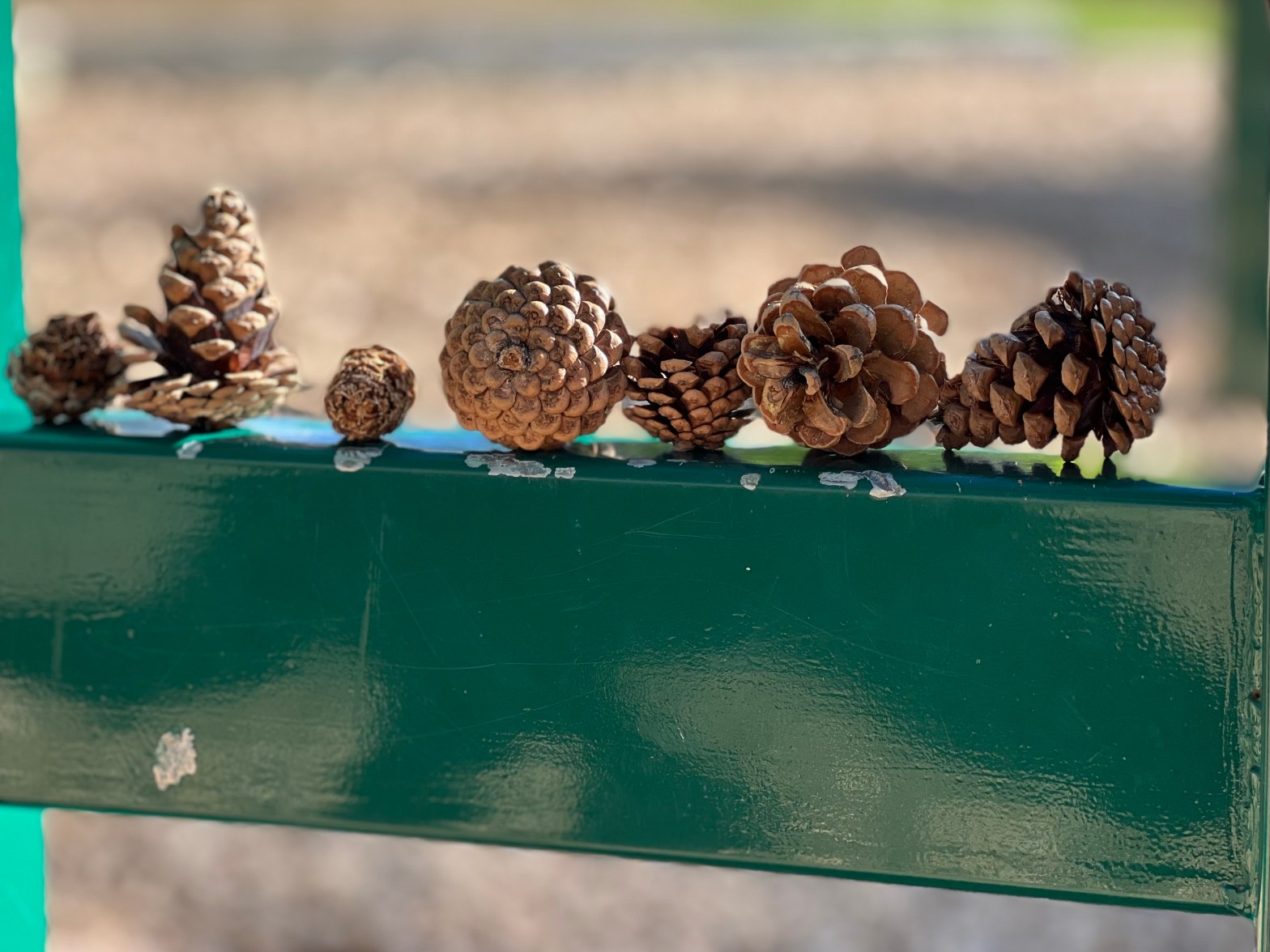
It’s amusing watching T try to initiate play. He likes to be chased but these kids are younger and stick to their activity of stockpiling pine cones.
T often struggles with personal space, social cues, and impulse control, so his strategy to get their attention is to take their pine cones and run.
This would annoy the kids. On one recent outing, one boy saw T arrive and whined, “Oh no, not that kid again.”
This upset T and he vented during bedtime about how rude the kids were.
T is quick to point out others’ faults but fails to see these same faults in his actions.
The hubby and I try not to be helicopter parents. He has to learn to figure things out with ongoing coaching from us.
So I asked T to reflect on how his own actions may cause the kids to act that way and what he can do differently next time.
This past Wednesday, there was much excitement when we arrived at the park.
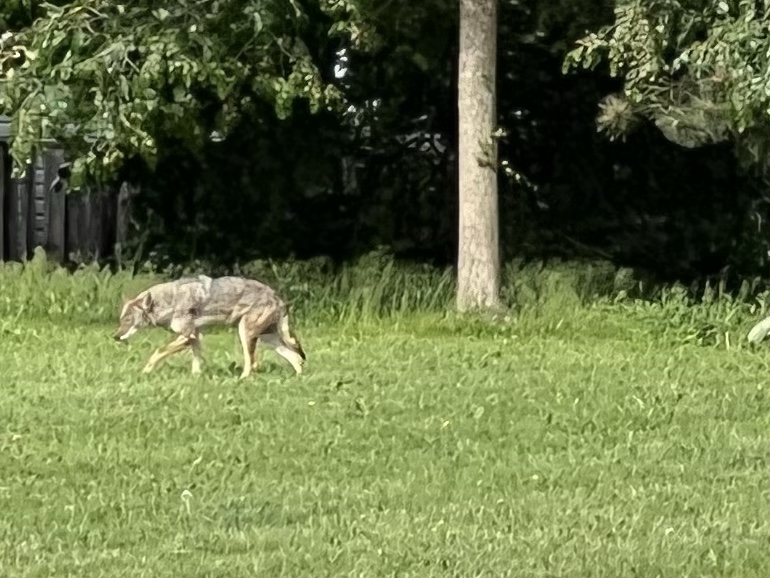
One mom said there was a wolf in the field.
I squinted my eyes at the animal lying down. It looked like a fox. Then it stood up. Yup, a coyote.
The kids were all excited and I pointed out the animal to T, who went from 0 to 100 in a flash.
I told T that coyotes are dangerous and we need to keep a safe distance and not agitate it.
So Mr No Impulse Control started shouting at the coyote and throwing pine cones at its direction.
The kids gathered close to T, who told the kids the coyote was dangerous. They huddled close together and it felt like a bonding moment.
On Friday afternoon, as T was swinging by himself, the kids went up to him and offered him pine cones from their pile. One kid at a time.
T stockpiled them on the side and kept swinging.
After he jumped off the swing, he approached the kids, who let him into their group play.
The hubby and I let T stay and play for while.
At bedtime, T asked about the kids in a positive way. The hubby and I praised him for a great afternoon of play and we asked him if it felt good to have a positive interaction with them.
I will soon add wannabe basketball coach to my CV.
As a student, gym was not my strong subject. I did well in sports like cross country and baseball, but basketball terrified me.
Similarly, participating in class, including gym, is an ongoing struggle for T in Grade 1, his first full year of in-person learning.
T’s gym teacher and CYW noted this Spring that T enjoys and is good at basketball.
The hubby and I try to take a strengths-based approach to learning for T. It’s important to build on things he feels good about to buffer the difficult moments in school.
Part of this requires both T and us to adopt a learning mindset: to be willing to try new things, make mistakes, and learn together.
We recently bought T his own basketball to practice and play with during weekends and over the summer in the nearby school.
Do I know what I’m doing? Not really, but we’ll learn and have fun together!
Basketball net for kids at nearby school.
Physical activity and the outdoors provide a great way for kids like T to burn excess energy and regulate emotions.
T picked up biking again after showing no interest last summer. We’re optimistic the training wheels will come off this summer.
Outdoor pools open this month! The hubby is registering T for his first lessons and looking for instructors that support kids with ADHD.
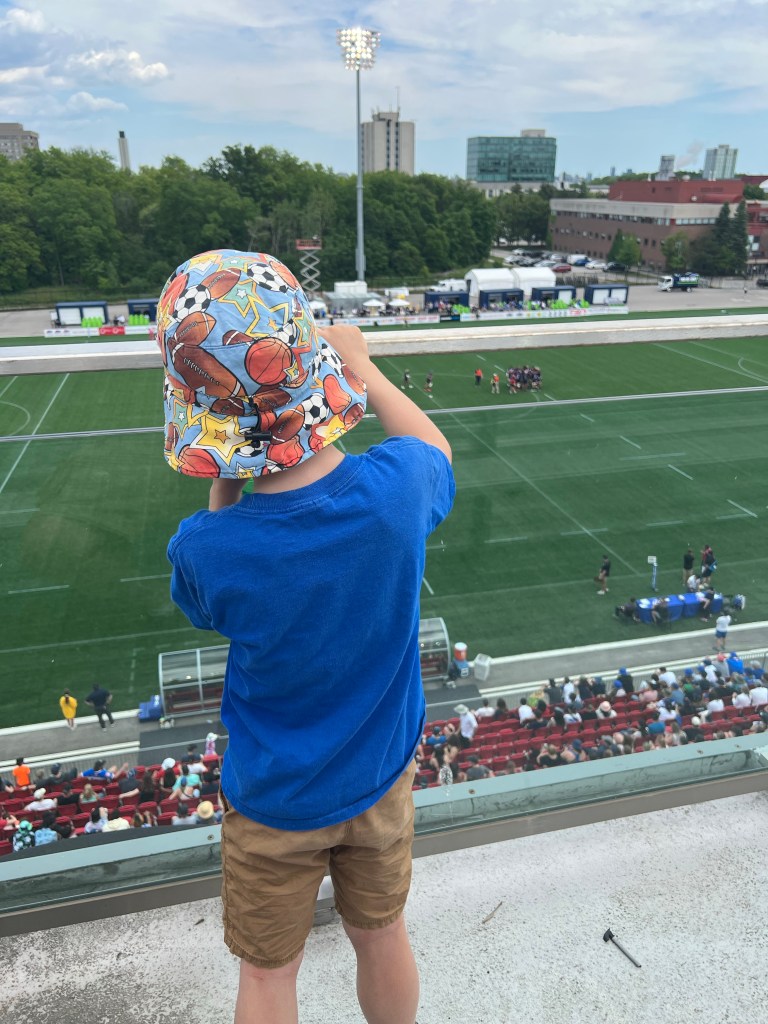
Last Sunday, we took T to his first rugby game.
T’s gym teacher recently invited rugby players to present to his class and they invited the school to their final game of the season.
It was really fun to do something different during our often quiet weekends at home.
We had no idea what the hell was going on, but watching buff guys colliding against each other was appealing. 😆
Toronto lost the game and it gave T a good introductory lesson in sports life:
You don’t always win, but you keep trying, have fun, pick yourself up, and move on.
We walked far way to get it to fit in this picture.
The night views of the city was awesome.
Do you see a cross and a heart below like I did?
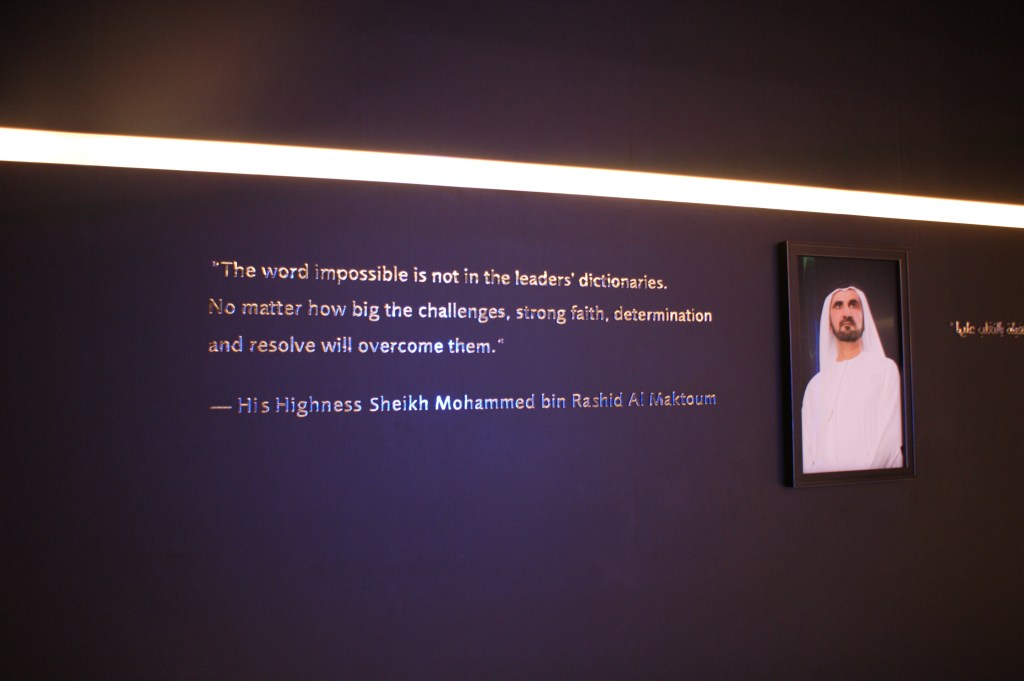
This message below, posted on one of the exhibit spaces inside the building, still resonates:
“The word impossible is not in the leader’s dictionaries. No matter how big the challenges, strong faith, determination and resolve will overcome them.”
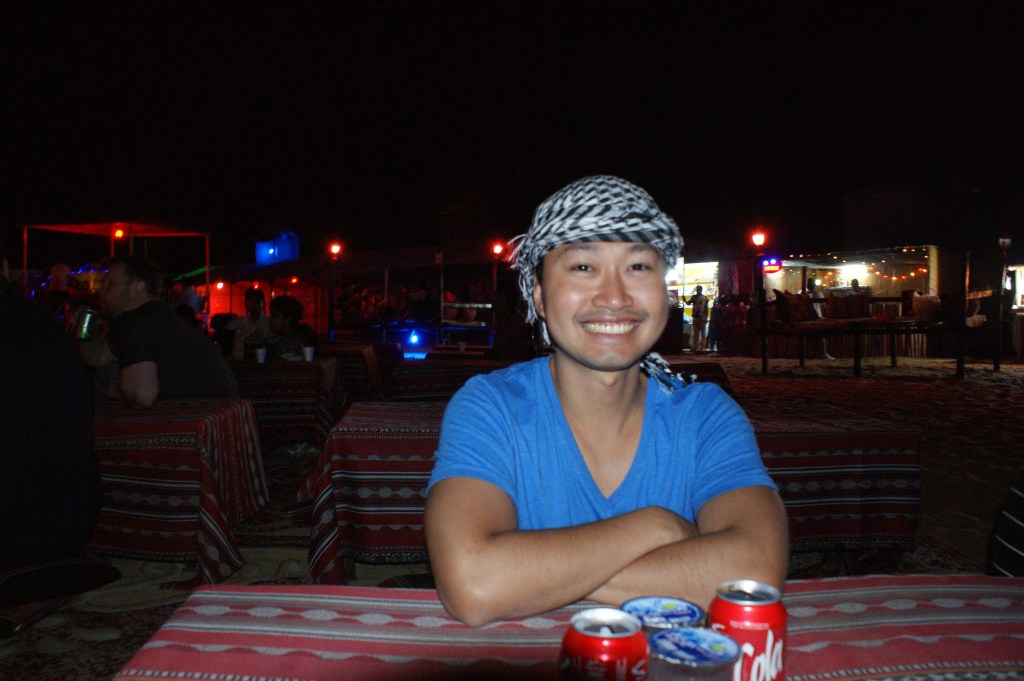
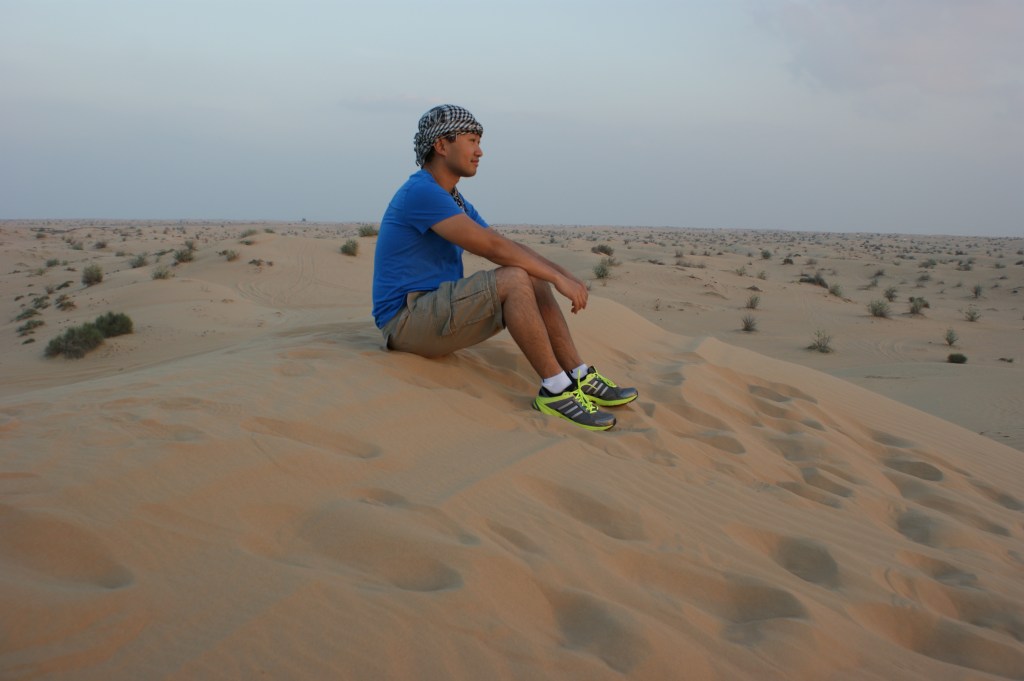
The highlight of the trip was the sunset desert safari on our last day.
We rode a camel…
… saw a falcon up close…
… enjoyed a barbecue in a Bedouin camp …
… with amazing music and dancing.
Sometimes, when I look back at photos from life before T, it was so carefree.
These days, the sand we get pour out of T’s shoes from overzealous play in the school sandpit.
But I have nothing but gratitude for what came before T and what is in front and ahead of us.
I am thankful the hubby and I explored some of the world before starting a family.
Every sight, sound, taste and smell shaped us into the people that are now T’s parents.
We draw from every memory to inspire and inform us through the successes and setbacks.
What always stuck with me about Dubai was how this city’s ambitions were built on shifting sands.
As with everything in our life with T, I continue to see the parallels and metaphors.
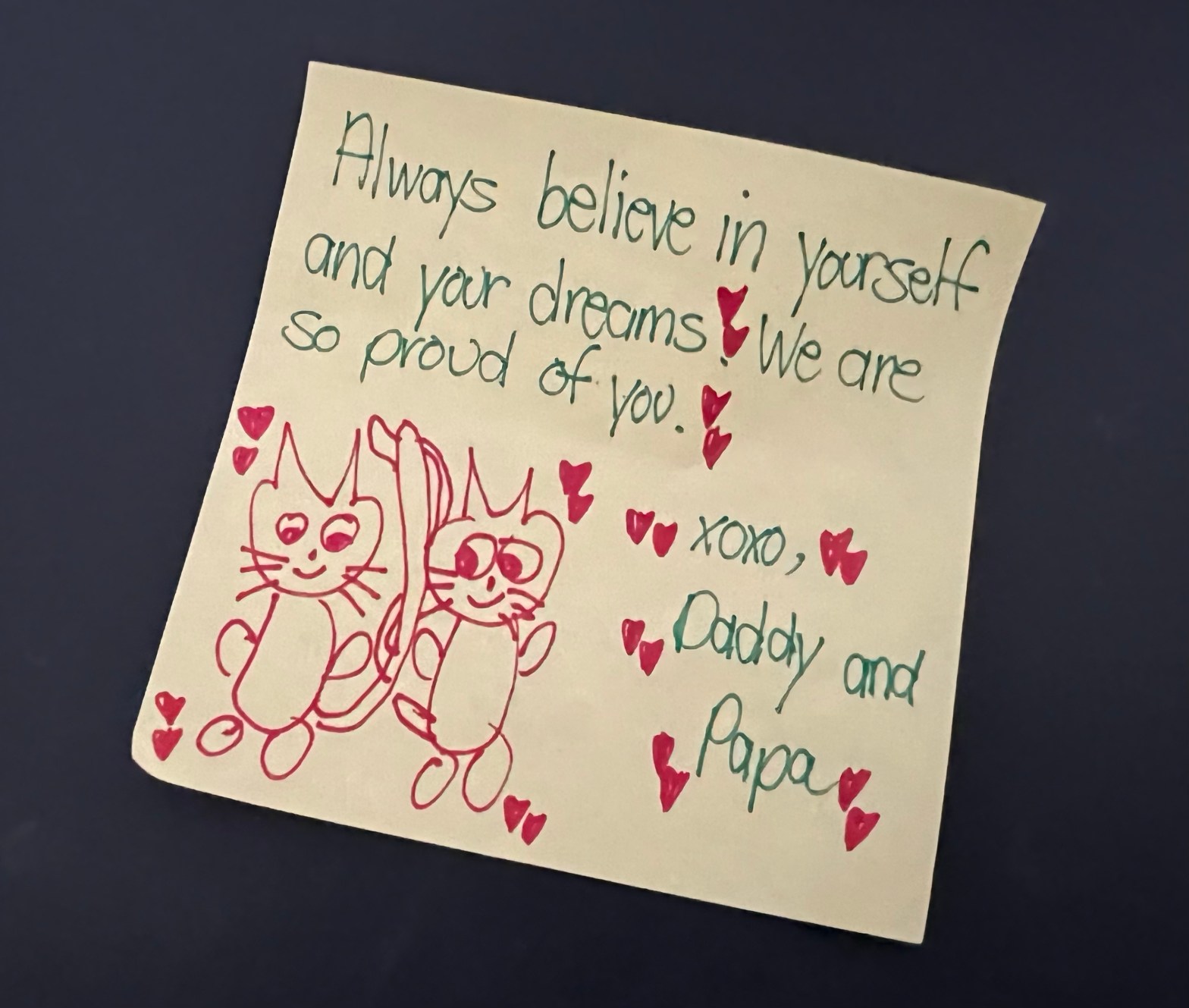
How do we give children the space to dream and view the world with wonder?
As children, movies and TV shows often tell us that anything is possible if you believe in dreams.
As an adult, I have a nuanced view, because we don’t always get what we wish for – and that’s ok.
As a parent, I love watching T experience life in his light-speed fashion with wonder, optimism and fearlessness.
I want this attitude to grow but as he gets older, it is important to temper it with pragmatic optimism – or I’ll set him up for disappointment otherwise.
A library book he borrowed last week gave us a chance to chat about why it’s important to dream and the need to work for them.
Canadian astronaut Chris Hadfield seems to be a recurring figure in our bedtime reading.
A few years ago, a friend gifted T “The Darkest Dark,” Hadfield’s children’s book based on his childhood. It helped T learn the dark is nothing to be afraid of.
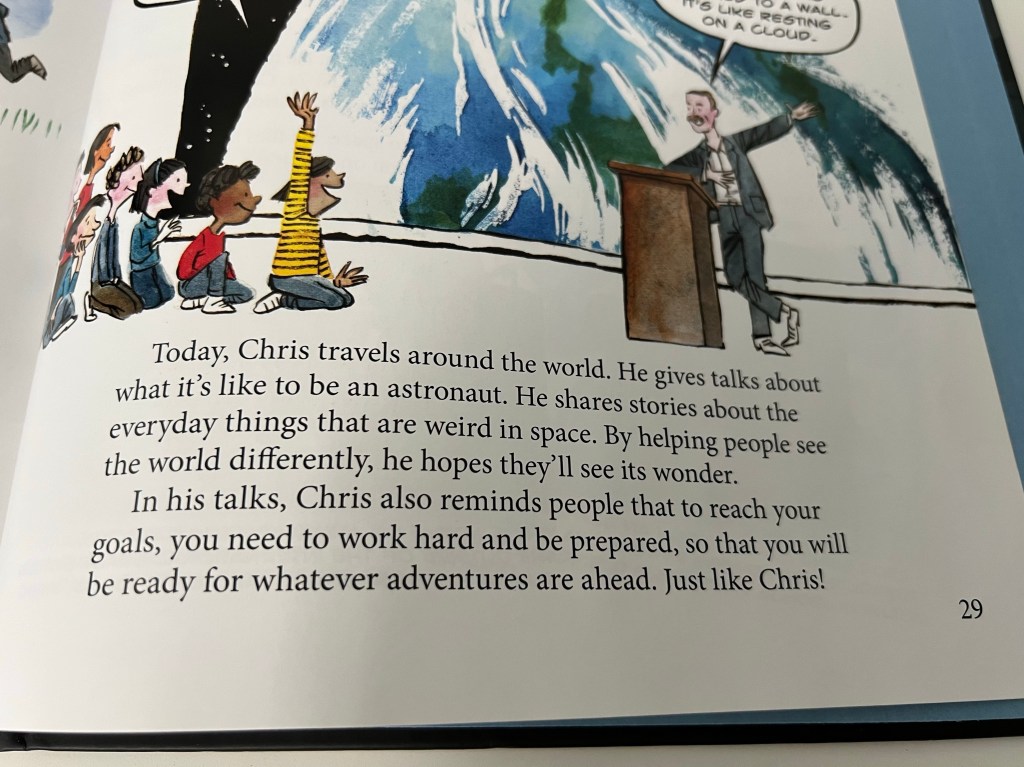
The book “Meet Chris Hadfield,” is a non-fiction biography of Hadfield.
I pointed out to T it’s the same Chris from “The Darkest Dark,” except he’s a grown up and became an astronaut.
This book had a nice message about having dreams and to work for your goals.
I love the last paragraph in the book: “… Chris also reminds people that to reach your goals, you need to work hard and be prepared, so that you will be ready for whatever adventures are ahead.”
T and I chatted about what this means and I let him know that’s why we do all that extra reading and homework that he sometimes finds annoying. It helps him and his brain grow.
Being a pragmatic optimist, I am mindful that because of T’s FASD, he will have additional struggles in school, daily life, and work.
As to how FASD may impact him, all we can do is carry on as we already are: proceed with pragmatic optimism, accommodate his struggles, anticipate and plan for future challenges, adapt from his setbacks and celebrate his successes.
As adults, we know that the sky may not be the limit but it should never stop us from looking up with childlike wonder and reach for the stars.
Life is blessed and brighter if we have a Dorothy, Rose, Blanche or Sophia in our lives.
During pandemic lockdown, I watched a lot of Golden Girls reruns.
It was a show I watched after school in grade school and nicely complemented the Teenage Mutant Ninja Turtles!
Revisiting the show as an adult, the story of four older women living together and finding a new lease on life felt comforting.
Parenting changes one’s social life, because you have less time and energy to hang out with friends. Layer on a child with special needs, time and energy are even rarer.
I often read with empathy about parents of children with FASD who’ve lost friendships, because of misunderstandings over their children’s challenges, often perceived as bad behaviour.
I can relate as I sense the judgment from other parents at the park when T – who plays nicely most of the time – has one of his moments.
“Thank you for being a friend
Traveled down a road and back again
Your heart is true, you’re a pal and a confidant
And if you threw a party
Invited everyone you knew
Well, you would see the biggest gift would be from me
And the card attached would say
Thank you for being a friend.”
Friendships evolve. Some strengthen, some drift or fall apart. The ones that endure are based on mutual care, respect, empathy and effort.
I am blessed to have amazing friends; some of whom were only 5 years older than T is now when we first became friends.
The hubby and I have been open with our close friends about T’s FASD since the beginning.
We make them aware of the highs and lows and how FASD may manifest in a social situation. Some friends have also witnessed his moments.
We balance between educating and not making our conversations all about T’s diagnosis. It’s one part of our and T’s larger life.
Hiking a trail with “Auntie E” at the 1,000 Islands.
We try to be strategic about activities we do with friends.
We include time for T to run around. We avoid situations that may disregulate T, because that’s no fun for anyone.
The reality, however, is as a parent of a child with FASD, especially during the pandemic, my time with friends is limited.
So I’m thankful for the ways we make time for each other – Zoom chats, lunch get togethers, sending a “How are you” text, and even a roadtrip to the 1,000 Islands.
I’m thankful for the ways my friends support T – from giving him books for birthdays to gifts that support his sensory needs.
During the recent May long weekend, a group of our close friends got together for lunch at Congee Queen – home to T’s favourite Fish Maw Soup.
I had seen some of them during the pandemic but this was the first time all of us were together as a group since the pandemic started. The last time I had seen one of them was in February 2020!
It was soul soothing to catch up. It felt like no time had passed, except one of them has a three-year-old daughter we haven’t met yet!
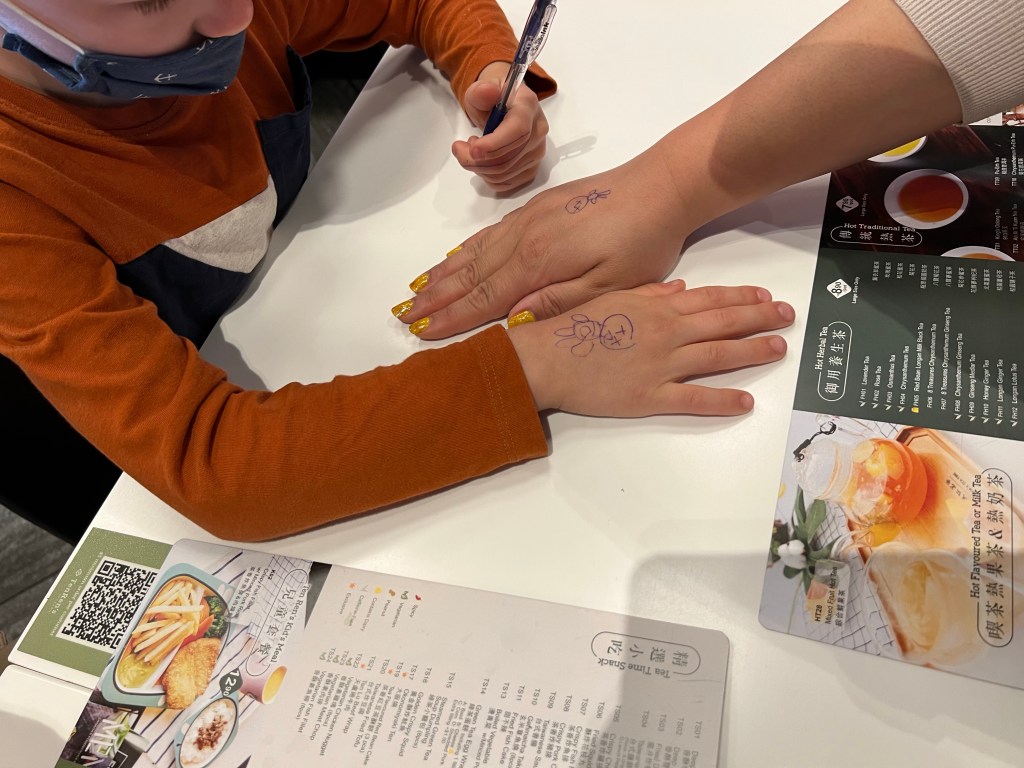
Afterwards, we went to get bubble tea with T’s “Auntie E.” We were supposed to get takeout but ended up sitting and chatting for an hour.
T got bored of the adult conversation and started drawing on his hands. My friend reached her hand out and offered it for T to draw on.
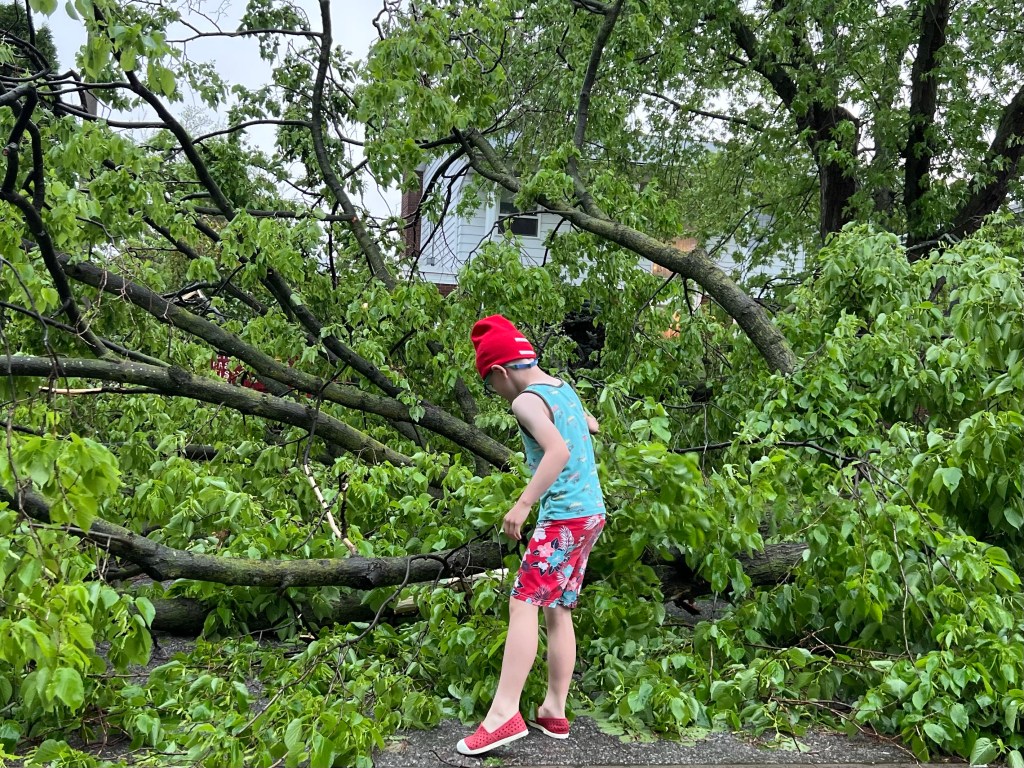
A scary thunderstorm downed a tree and created unexpected treehouse fun for neighbourhood kids.
Saturday started off like any other Saturday – with T getting up earlier than my brain and body was ready for; playing dead no longer works.
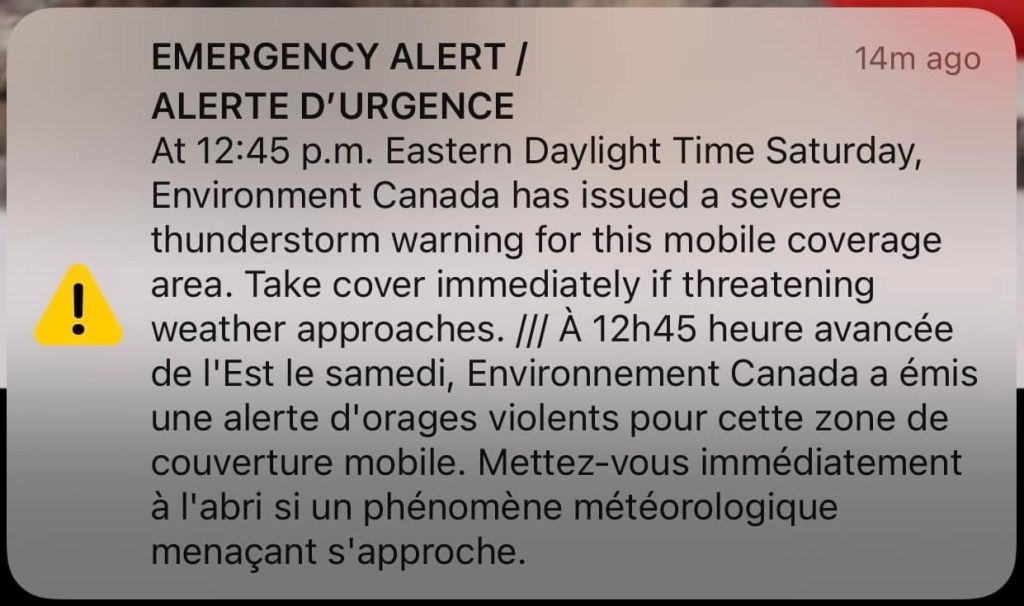
After lunch, as I was about to head out for groceries, Environment Canada issued a severe weather alert to cell carriers in southern Ontario.
The sky looked fine, but since this was our first time receiving such an alert, we took it seriously.
Soon after the hubby moved the car in the garage, the sky turned dark.
We stood on our steps and looked at the eery calm sky. We heard a strange wind sound and wondered if this was the calm before a tornado.
T looked at cars outside and said that people should move them in or they won’t have cars after.
As winds picked up, T and I looked with worry at the tall oak tree in our backyard.
Suddenly, the hubby screamed that the tree in the house next door just fell.
T was both scared and excited. It was all our first time beholding such a sight.
The rain and wind died down. We went out to survey the damage.
As you can imagine, this was the coolest thing ever for T, a hands on geography lesson.
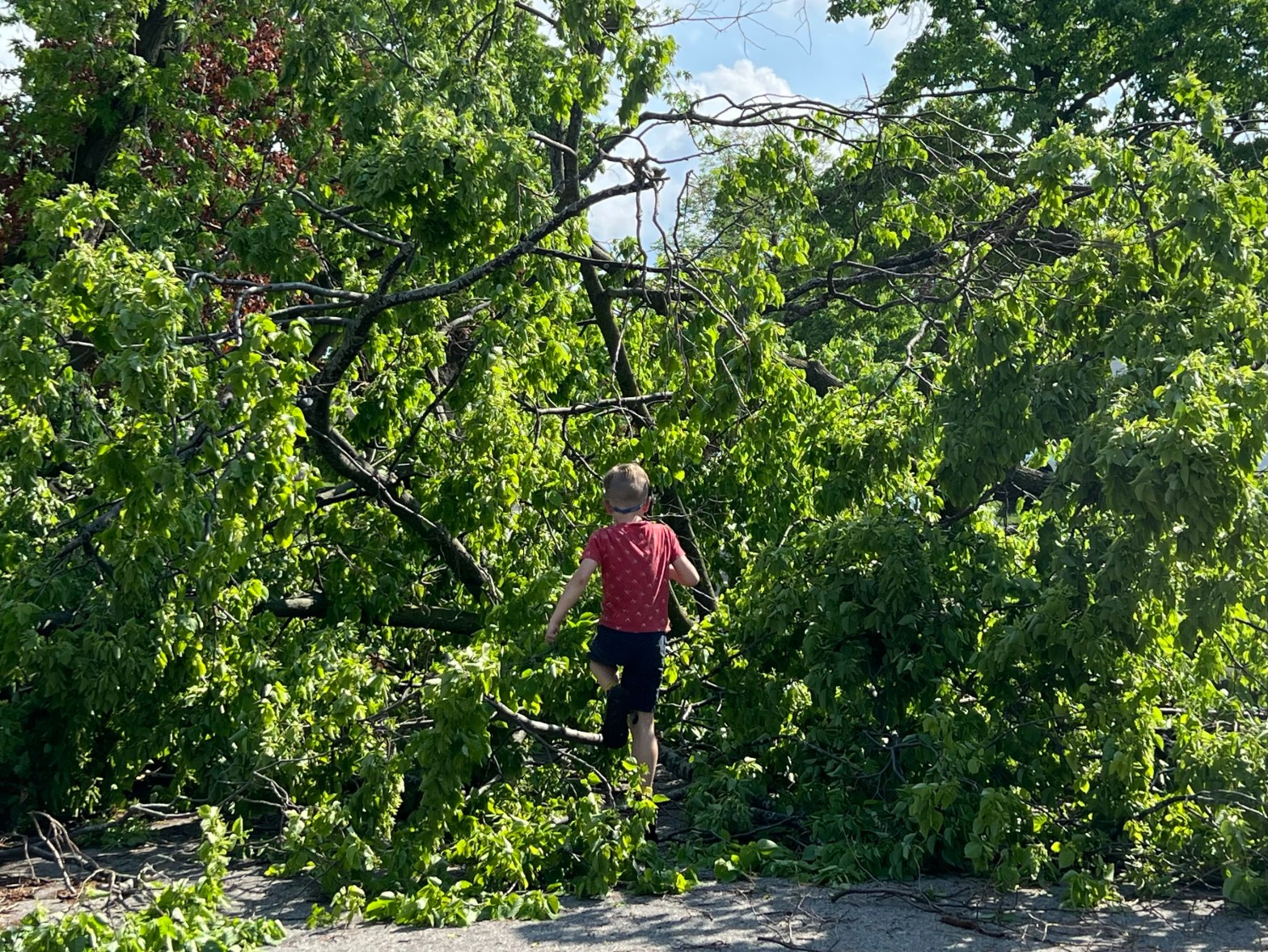
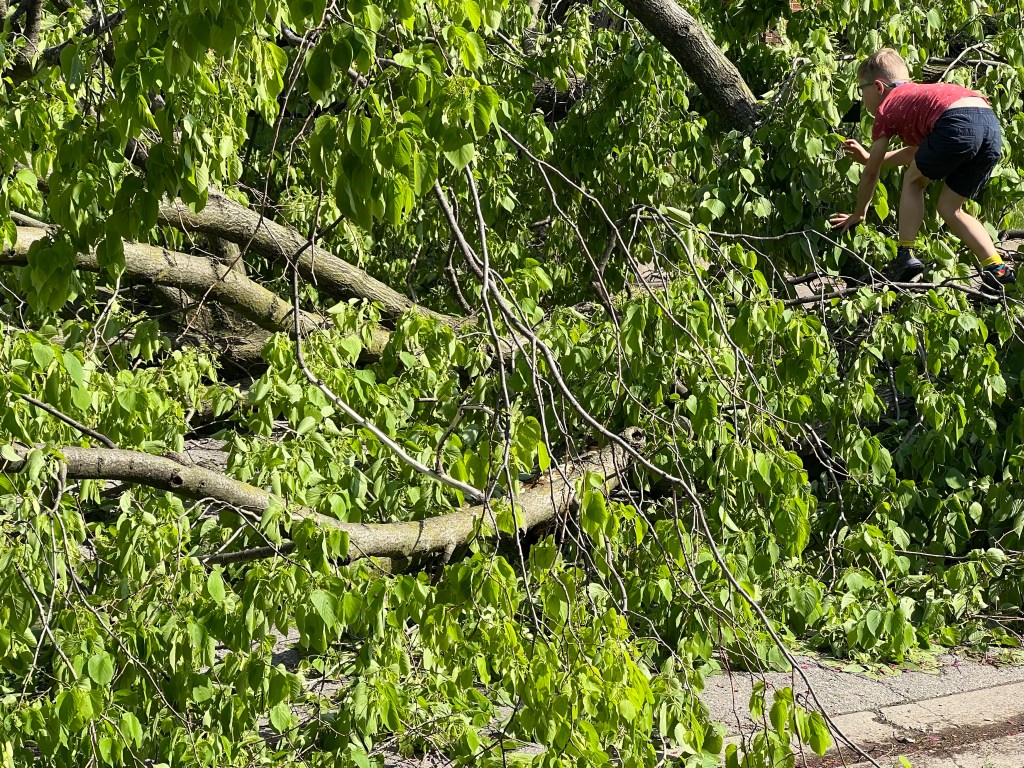
When the sun came out, we headed back out and T claimed the tree as his personal treehouse.
Kids teach us so much about making the best out of a bad situation – and the storm was bad indeed.
I stood on the sidewalk, watching him explore the treetop, imagining the adventures he was having inside his vast imaginary world.
Moments later, four kids joined him and it was the most precious joy to behold.
I thought about one of my favourite children’s books, “The Giving Tree” by Shel Silverstein, the story of a tree that loved a boy unconditionally despite his often selfish actions.
I couldn’t help but think these increasingly severe weather we’ve never experienced before are a result of climate change; the consequences of harmful actions to the planet.
Yet the immediate outcome of the tree fatally falling down on our street was to provide an afternoon of joy and fun to children.
There was a beauty in that very moment about childhood innocence, unconditional love and living in the here and now.
I thought about this from the perspective of parenting when I read this article about naturalists encouraging people not to mow lawns or pluck weeds, in an effort to encourage biodiversity.
Biodiversity, it is argued, is good for everyone, including animals and endangered bees.
Naturalists encourage us to look at weeds not as invasive, but contributors of unique beauty.
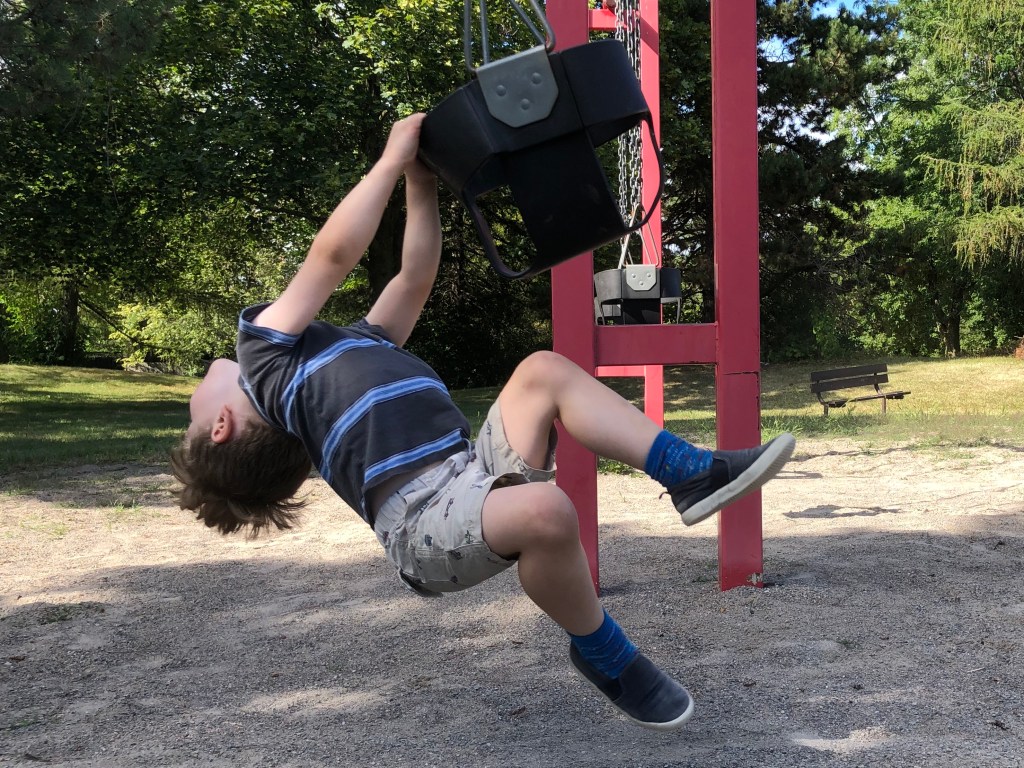
I thought back to the first photo I posted of T when I started this blog in 2019.
T swinging on the outside instead of the inside reminds me why he can be like a wildflower.
He may come across like the active duck in a family of calm ducklings or the bright dandelion in a field of tulips.
I wouldn’t have him any other way.
We live in a society that needs more awareness and understanding of neurodiversity.
How wonderful is it to stare out into a field of dandelions – like the one on the other side of our backyard – and see a golden carpet of sunshine rather than a gardener’s nightmare?
What if we looked at wildflowers in society with these eyes and accommodate them into our gardens instead of weeding them?
We’ve been blessed with nine consecutive days of sunny warm weather.
The perennials in our garden are blooming, giving us a vibrant visual feast.
Our cherry tree bloomed its beautiful white petals, a sight we enjoy for a handful of days each year.
We spent this weekend getting ready for our annual gardening during the May long weekend.
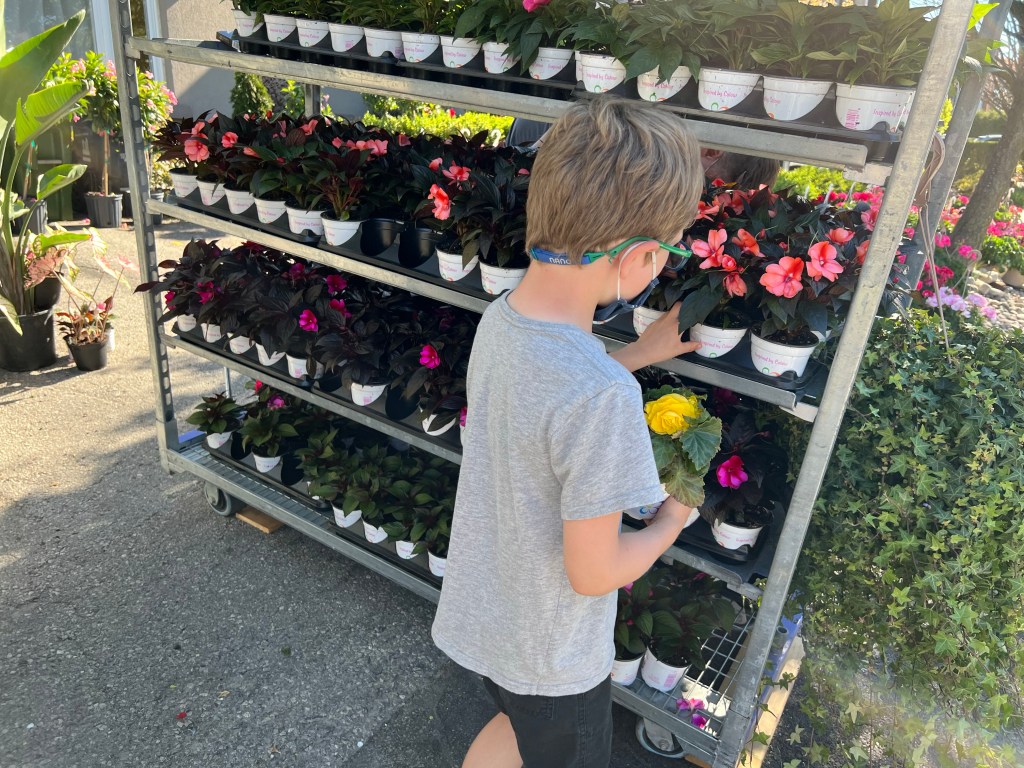
We stopped by a nursery. Like last year, we let T pick a flower to plant in our garden. He could pick any one he wanted.
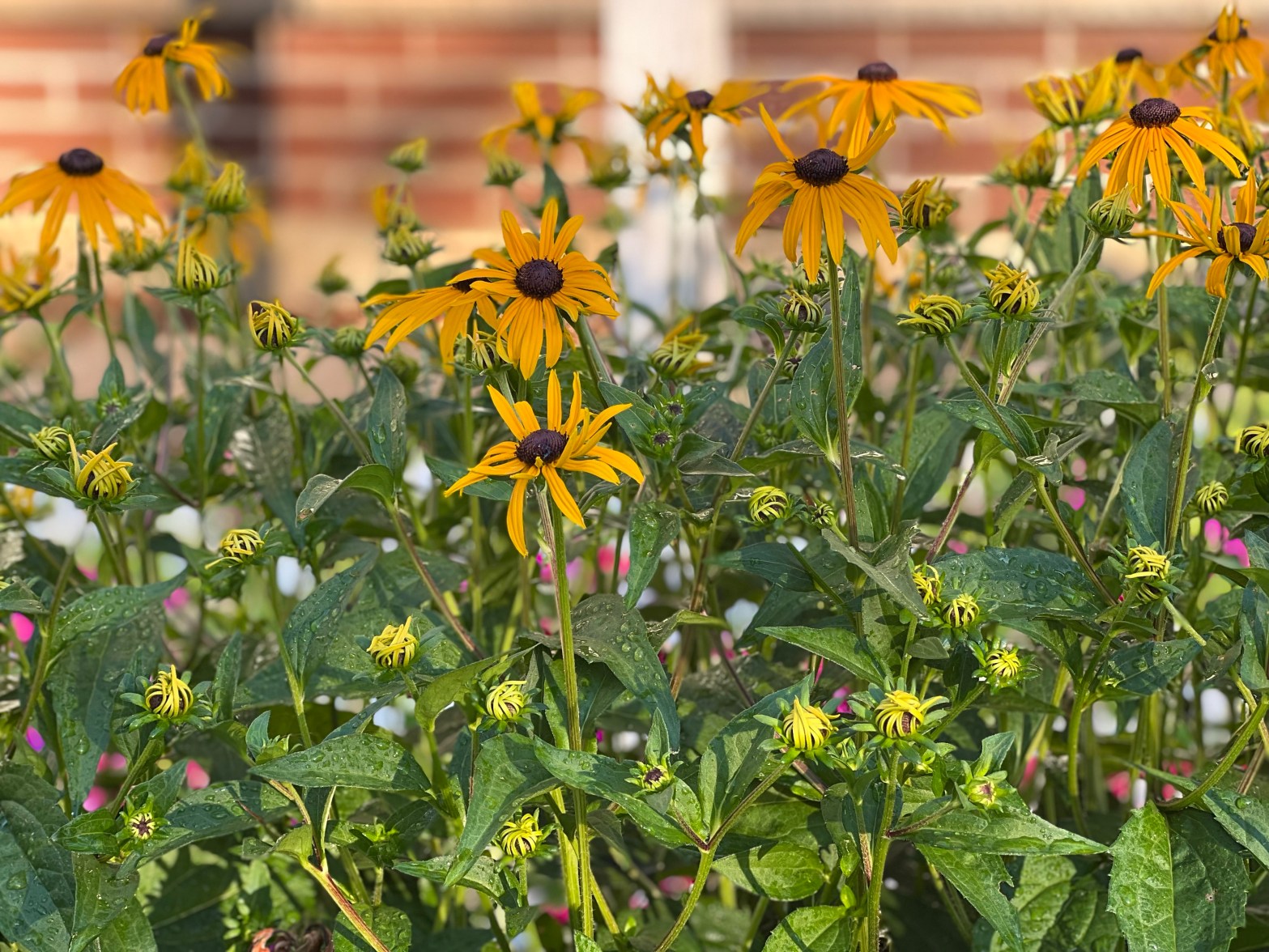
This year, we let him pick two. He chose these lovely pink and yellow flowers.
The hubby muttered to me that they didn’t match the colour palette he had in mind.
And that’s ok.
We’ll think of T as these lovely yellows and pinks sprout over the next few months.
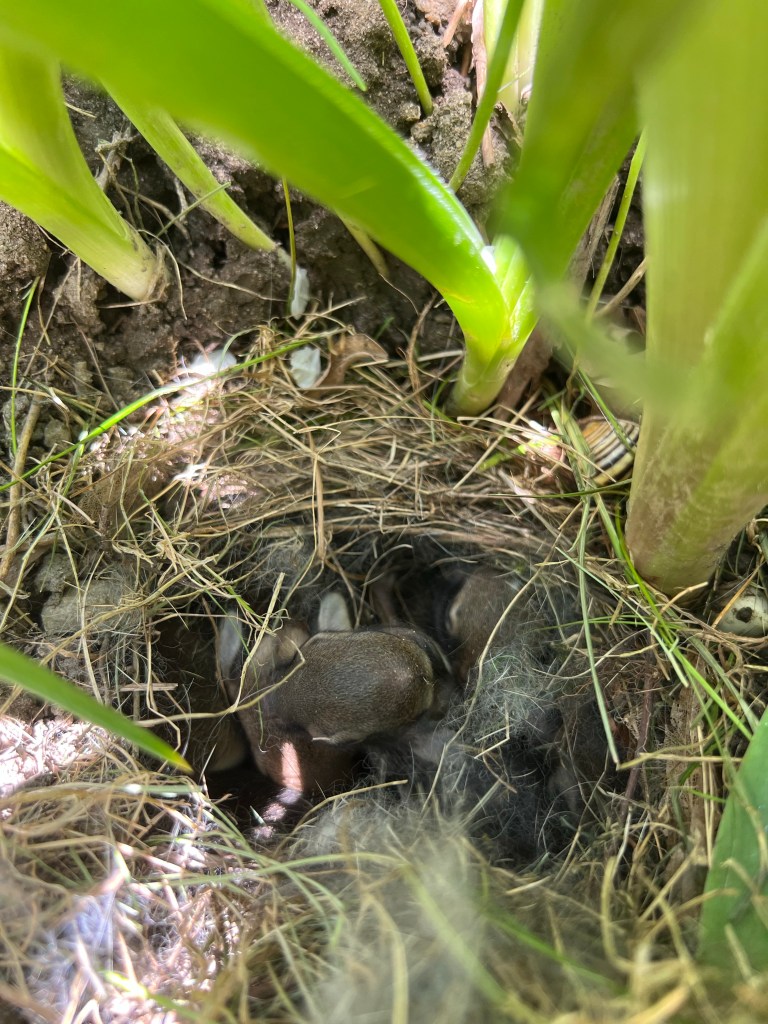
Earlier this week, the hubby noticed a hole in our garden. He was convinced and annoyed that squirrels were burying food there.
Yesterday morning, he called excitedly for T and I to come out for a surprise.
It turns out baby rabbits were nesting inside.
T stared at the babies with delight and care.
Then we covered the nest back up with the grass that the mother bunny had used – to leave nature alone and let it take its course.
How do you share difficult life changing news with a young child?
That’s a question I’ve been thinking a lot about since we received T’s FASD diagnosis in January.
The hubby and I shared the info with the school right away as it would better inform the way they supported T.
We’ve held off on sharing the info with T as it’s been a year of unexpected events and we didn’t want to add this on top of everything.
We’ve decided we will share his diagnosis this summer, as it is a less pressure time.
We also have three weeks off – can’t wait! – to spend with the hubby’s family and T’s favourite cousin, which can provide positive emotional cushion.
We believe that honesty is key.
From lived experiences shared by individuals with FASD that I’ve come across, they speak about how knowing their diagnosis helped made the world make sense to them.
This testimonial below by advocate Reinier DeSmit, who received his diagnosis late in life, moved me deeply when I watched it a year ago.
I consider our family very blessed to have received this diagnosis early on in T’s life. I feel deep in my heart this will benefit T, despite the hurt, confusion and anger it may also cause.
We will take a strengths-based approach.
From resources I’ve seen – see the links at the end of this post – it’s important to take a strengths-based approach.
We will highlight T’s many gifts: He’s a bright, caring, funny, strong, determined kid among many other positive qualities.
We will discuss that because of his diagnosis, he will need supports – such as why he’s had a CYW.
Where possible, we will use age appropriate tools, such as books and online games (see a great example below).
We will be upfront that we don’t know all the answers but reassure him – and ourselves – that we’ll figure it out together.
Knowing T, we will need to do this over time. We only get his attention for a short while, so we will need to do this in bite-size age-appropriate pieces.
Best case scenario, there is instant adoption and a positive reaction. Worst case scenario, anger, hurt, confusion and resentment. And of course, everything in between.
Regardless of the outcome, we will do our best to support him with patience and empathy.
We know this will be a difficult conversation(s), but it will be one of the most important milestones in our parenting journey with T.
Community Resources
Revised May 13, 2025
Here are some great resources shared by our FASD service coordinator on how to take a strengths-based approach in sharing and helping a young child understand an FASD diagnosis.
Brain Build Book – Part of a larger framework to help kids understand their assessment results.
FASD and Me Interactive Game – An interactive comic that explains what FASD is, how it affects people and things that people with FASD have done to make their lives easier.
FASD and Me Workbook – An interactive journal with activity sheets, inspired by Hope Myers, an individual with FASD, and her mother Miranda. Here’s the related Webinar for further viewing.

































































 My Life With T